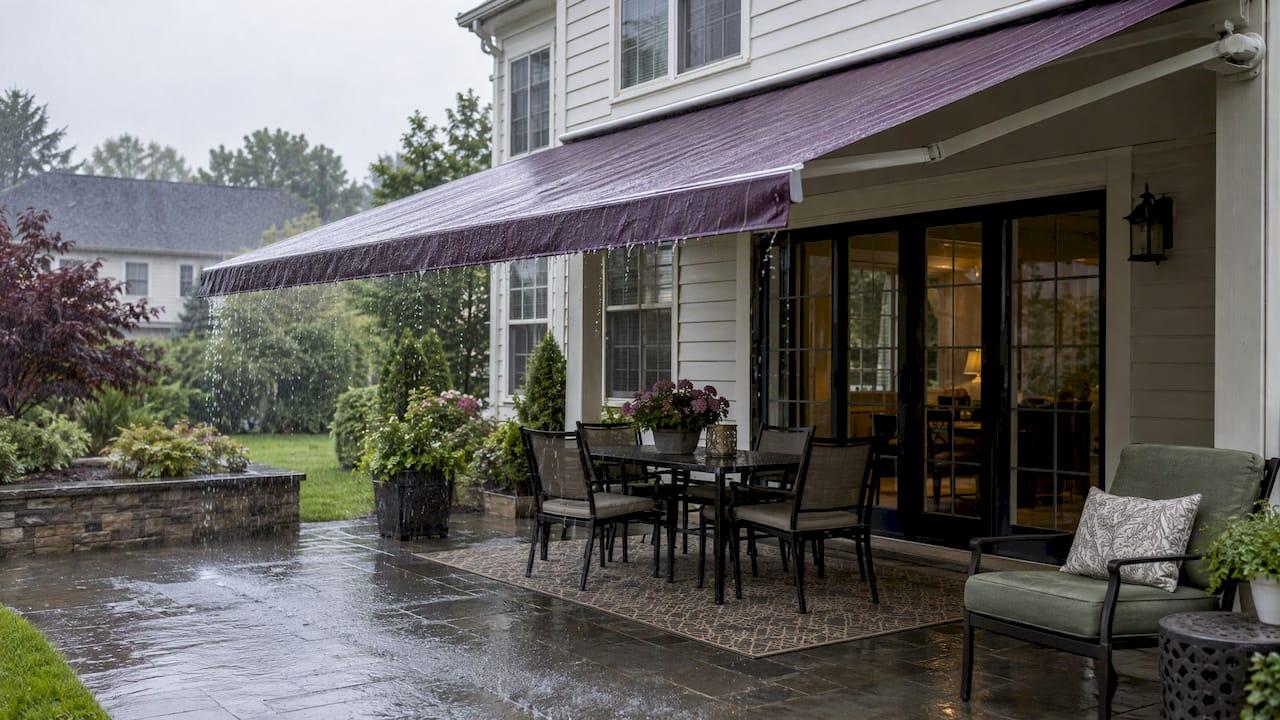
A retractable awning gives real rain protection for a light shower, as long as it is pitched steeply enough for water to run off and the fabric is pulled taut. It is not a solid roof. In heavy, prolonged or windy rain, the safe move is to roll it in. This guide explains what "water-resistant" actually means, which features let an awning shed rain well, and how to dry and care for it, so your patio stays usable through a Bucks County spring.
TL;DR
- Most fabric awnings are water-resistant, not waterproof. They shed light rain well, but they are made for shade first and are not a permanent roof.
- Pitch is the biggest factor. A drop of at least one foot for every three feet of projection keeps water moving off the fabric instead of pooling.
- Retract before heavy rain, strong gusts, snow or hail. Standing water is heavy and can bend arms or stress the wall mounting.
- A wind sensor and a motor make retracting automatic, which matters most when you are not home.
- Dry the fabric fully before rolling it up for any length of time, so mildew does not set in.
Table of Contents
- Are retractable awnings waterproof?
- How much rain can an awning handle?
- Why pooling water is the real risk
- What makes an awning shed rain well
- What about the patio under the awning?
- Using your awning in rain: a simple routine
- Drying and caring for the fabric after rain
- Who this matters for
- Our view on rain and awnings
- Plan your awning with a free in-home consultation
- FAQ
- Sources
Are retractable awnings waterproof?
The honest answer is "water-resistant." The fabric on most retractable awnings is woven, treated to repel water, and stretched on a frame that tilts. Rain beads up and runs down the slope. That is different from a sealed, waterproof membrane, which holds water out entirely and is built to carry the weight of it.
The difference shows in how the manufacturers describe their own material. Sunbrella, one of the best-known awning fabric makers, describes its fabrics as breathable and water repellent. Breathable matters: it lets moisture and heat escape from underneath, which helps against mildew. The trade-off for breathing fabric is that it is designed to shed water, not to hold a puddle.
So think of an awning as a sloped umbrella over your patio. Used that way, it works well. Used as a flat roof that has to stay open through a storm, it is asked to do something it was not built for.

How much rain can an awning handle?
Three things decide it: how steep the awning is, how tight the fabric is, and how hard the wind is blowing.
Light to moderate rain with little wind. A properly pitched, taut awning is a good place to sit through a passing shower. Water runs off the front edge and you stay dry underneath.
Heavy or prolonged rain. The longer and harder the rain, the more likely water finds a low spot in the fabric. Dometic, which makes patio awnings, says in its operation manual to stow the awning when snow, heavy rain, wind or severe weather is expected.
Wind with rain. Gusts tug at an open awning and make water pool and slosh. Fabric retractable awnings are not meant to stay out in strong wind, and rain makes the load heavier. Our guide to awning wind ratings goes through the safe speeds by type.
Snow and hail. Treat these as retract-only conditions. Snow is far heavier than rain and does not run off.
The rule that keeps awnings alive for years is simple: enjoy the light rain, and retract before the weather turns serious.
Why pooling water is the real risk
When water collects in a sag, it pulls the fabric down, which creates a bigger sag, which collects more water. Dometic's manual warns that standing water can make an extended awning unstable and lead to bending or collapse. Water weighs about 8 pounds per gallon, so a few gallons in one panel put real strain on the arms and the wall brackets.

This is also why a drop of rain and a bucket of rain are different problems. A light shower never accumulates. A long soaking storm on a flat awning can.
If you notice water collecting while you are home, retract the awning, or if it is safe, let the water run off before rolling it in. A motorized unit makes this a button press.
What makes an awning shed rain well
If rain protection matters to you, these are the features to look at when you are planning a custom awning.
Pitch
Pitch is how steeply the fabric slopes down from the wall. Sunbrella's fabrication guide recommends a minimum drop of one foot for every three feet of projection. That works out to roughly an 18-degree slope.
Here is a worked example. If your awning extends 10 feet out from the house, the front edge should sit at least about 3 feet 4 inches lower than where it attaches to the wall. A flatter slope than that gives water less reason to leave.
Pitch also depends on where the awning mounts. Solera, an awning maker, says in its support FAQ that it needs a minimum mounting height of 7 feet 6 inches (9 feet is optimal) so the awning can pitch downward 15 to 30 degrees for runoff while still leaving head clearance at the front edge. A low wall or a second-story overhang changes the math, which is why measuring the actual wall matters before choosing a size.
Fabric and drainage details
The fabric should be a woven, water-repellent outdoor material, stretched tight so there are no slack spots. The Sunbrella guide also recommends drain grommets behind the front bar and a double front bar when the pitch is less than ideal, plus rafters no more than 36 inches apart on frame-type installations. Those details are small, but they are what keep water moving.
For how fabric choice fits our region's weather, see our guide to awning fabrics for Bucks County homes.
Wind sensors and motors
Most awning damage comes from rain and wind arriving together while nobody is home. A wind sensor helps with that half of the problem. Solera explains that its sensor detects vibration from gusts and triggers retraction at a set threshold. The same page cautions that a sensor is not foolproof and that you should retract the awning when a storm is approaching. It also notes that a beeping sensor usually means low batteries, during which auto-retract is off.
Two takeaways: a sensor works only with a powered, motorized awning, and it reacts to movement already happening. It is a safety net, not a forecast. Combining a motor, a sensor and your own habit of retracting ahead of a forecast storm is the setup that holds up.
Motorized awnings can also be tied into a smart-home setup. We offer motorized and smart-home-compatible products that work with Alexa and other major platforms, so a single voice command or a schedule can bring the awning in when the forecast turns.
What about the patio under the awning?
An awning keeps rain off you, but the water still has to go somewhere. Runoff from the front edge lands on the patio, and if the surface does not drain, you will have a puddle right where you want to put your chairs.
If you see water lingering after storms, look at the grade and drainage of the patio itself. This guide to patio drainage fixes covers common ways to stop standing water, and for older masonry surfaces, this walkthrough on brick patio drainage shows how to diagnose where pooling comes from. Positioning the awning so its drip line falls on a well-draining area makes the whole space more comfortable.
Using your awning in rain: a simple routine
- Check the forecast in the morning. Light showers are fine. Thunderstorms, a nor'easter, or gusty fronts mean the awning stays rolled in.
- Extend it fully and keep the fabric taut. A half-open awning has less pitch and more sag.
- Watch for pooling. If water collects, retract the awning right away.
- Retract before heavy rain, wind, snow or hail. Do it before the weather arrives, not after.
- Dry it afterward. Let the fabric air out in the open position once the rain has passed.
The Philadelphia suburbs get a mix of spring showers, summer thunderstorms and winter snow, so the routine changes with the season. The awning earns its keep in the long stretches of shade and light rain between those events.
Drying and caring for the fabric after rain
An awning that is rolled up wet can grow mildew. Sunbrella notes that its fabrics do not promote mildew growth, but mildew can grow on dirt left on the fabric. That is why cleaning and drying go together.
A reasonable care routine from the maker:
- Hose the fabric off with clean water about once a month so dirt does not embed.
- For light cleaning, use mild soap and a soft bristle brush, rinse until all soap residue is gone, and let it air dry.
- Plan a thorough cleaning every two to three years in most environments.
- If you use a bleach solution on a stubborn stain, the water- and stain-resistant finish needs to be reapplied afterward.
In practice: after rain, leave the awning extended until the fabric, front bar and valance are dry, then roll it up. Rolling up for a quick shower and bringing it out again to dry is fine. Storing it damp for days or through the fall is what causes trouble. Check the manufacturer's care sheet too, because some makers have specific instructions about use in rain that can affect warranty coverage.
Who this matters for
Homeowners with a covered patio or deck. You want to eat outside on a drizzly evening. Pitch and fabric are your priorities.
Busy families. Motorization means the awning can close itself or close on command, so nobody has to run outside in a storm.
Realtors and property managers. A well-kept awning extends usable outdoor space for buyers and tenants, and a sensor-equipped motor reduces the chance of damage between visits.
First-time homeowners. Start with the wall you want to cover, the projection you need and whether you want a motor. Our overview of what to budget for a retractable awning is a good starting point for planning.
Anyone in New Jersey. Rules on awnings can differ by town, and we have written about why Mercer County and other New Jersey homeowners get different permit answers.
Our view on rain and awnings
We get the same question at nearly every patio consultation: can I sit out here when it rains? Our answer is yes for a shower, and the setup decides how comfortable that is.
The pieces that matter are the ones you cannot see from the street: how steeply the awning pitches, how tight the fabric is stretched, and where the wall mounting sits. That is why we measure the actual wall and patio before talking about size or color. The projection and the mounting height tell us what slope the awning can reach.
We also lean toward motorization for most homes. A motor with a wind sensor, or an awning you can close from your phone or by voice through Alexa and other major platforms, turns "I should bring that in" into something that happens. It is the easiest way to protect the awning and enjoy it for years.
Our products carry generous manufacturer warranties, most with limited lifetime coverage, and every project is measured and installed by trained professionals. Good rain performance starts with a good installation.
Tony
Plan your awning with a free in-home consultation
Made in the Shade Bucks County has no storefront. We bring the showroom to you, with fabric samples and a personal design consultant, at no cost. We look at your patio, measure the wall, talk through pitch, fabric and motorization, and then install the awning ourselves. See our retractable awnings to start.
If you also want shade for windows or an enclosed porch, our outdoor window shades are another way to cut sun and glare. We serve homeowners, realtors and commercial clients in Bucks County, PA and Mercer County, NJ.
FAQ
Are retractable awnings waterproof?
Most are water-resistant rather than fully waterproof. The fabric is woven and treated to repel water, so rain runs off a properly sloped, taut awning. It is built to shed water, not to hold it, which is why pitch matters so much.
Can you use a retractable awning in the rain?
Yes, in light rain, when the awning is fully extended, pitched with enough drop and the fabric is tight. Retract it for heavy or prolonged rain, strong wind, snow or hail, and whenever water starts to collect in the fabric.
What happens if water pools on an awning?
Pooled water weighs a lot and pulls the fabric down, which makes more room for water. It can stretch the fabric and stress or bend the arms and brackets. Retracting early, or using a motorized awning that closes on a schedule or sensor, avoids the problem.
Should I roll up my awning when it is wet?
For a quick shower, rolling it in is fine, as long as you extend it again afterward to dry. The problem is storing it damp for days or months, since that is when mildew develops. Let the fabric dry fully, then retract.
How do I get an awning that handles rain well?
Start with a measured plan for your wall and patio so the pitch, fabric and motor fit your home. Request a free in-home consultation with Made in the Shade Bucks County and we will bring samples to you.
Sources
- Sunbrella awning fabric care and fabrication guide (Glen Raven)
- Dometic 9100 Series Power Patio Awning operation manual
- Solera support center FAQ
- Clean Sunbrella shade fabrics
- Patio drainage fixes that stop standing water
- Brick patio drainage diagnosis