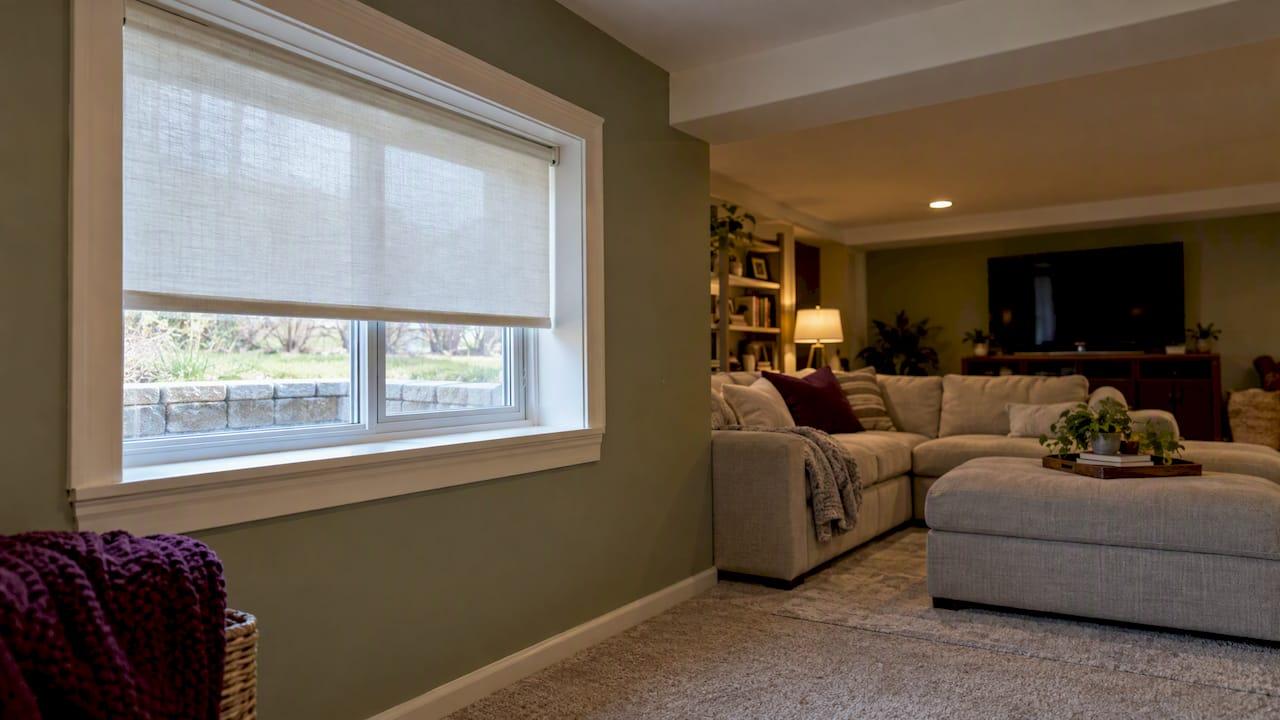
The best way to get basement window privacy is to cover the lower part of the glass and leave the top open for daylight. Top-down/bottom-up shades, light-filtering cellular or roller shades, adjustable faux wood shutters and privacy film all do this. Which one fits depends on how the room is used, how damp it gets and whether children or an escape route are involved. This guide walks through each option, the moisture and safety checks that matter in a below-grade room, and how to handle small windows.
TL;DR
- Basement windows sit at or near ground level, so the goal is usually privacy from the outside while keeping daylight coming in.
- Top-down/bottom-up shades, light-filtering cellular or roller shades, faux wood shutters and removable film are the most practical choices.
- Choose moisture-resistant materials such as aluminum, faux wood or synthetic fabrics, and address damp sources first.
- Go cordless if children ever use the space, and never let a covering block an egress window.
- Made in the Shade Bucks County brings samples to your home for a free in-home consultation, so you can see them against your actual window.
Table of Contents
- Why basement windows need a different approach
- Ways to keep light and add privacy at the same time
- Matching the covering to how you use the room
- Small basement windows: make them look bigger
- Moisture: sort this out first
- Comfort and energy in a cold room
- Child safety: choose cordless
- Egress windows: keep the exit clear
- Our perspective
- How Made in the Shade Bucks County helps
- A simple way to decide
- FAQ
- Sources
Why basement windows need a different approach
A basement window is usually small, set high on the wall and level with your lawn or a window well. Passersby, delivery drivers and neighbors can see straight into the room, even though the window looks tiny from inside. At night the problem reverses: lights on inside make the glass a mirror for anyone outside.
Basements also bring conditions that living-room windows rarely face. They are cooler, more prone to humidity, and often used as a bedroom, playroom, gym or media room. In older Bucks County and Mercer County homes, including mid-century split-levels and stone-foundation farmhouses, the windows may be odd sizes or deeply recessed. That makes a measured, made-to-fit covering more practical than a stock one that almost fits.
So a good basement covering has to do four jobs: block the view in, let light through, tolerate moisture, and stay safe around children and emergency exits.

Ways to keep light and add privacy at the same time
You do not have to choose between a bright room and a private one. Wirecutter's guidance on ground-floor windows points to privacy solutions that admit sunlight while limiting the view in, including removable cling film and top-down/bottom-up shades. It also notes that sheers can handle daytime privacy, with opaque curtains added at night.
Top-down/bottom-up shades
These shades let you lower the top edge instead of raising the bottom. Keep the lower portion covered for privacy and leave the upper portion open so daylight enters above eye level from outside. For a window that sits near the ground, this is often the single most useful feature. Top-down cellular shades work on the same principle, blocking views from above while the bottom stays open for light, depending on how you set them.

See the range of fabrics and lift systems on our window shades page.
Light-filtering cellular and roller shades
Light-filtering fabrics soften daylight and block the clear view in, so you get privacy without a dark room. Roller shades are among the more affordable ways to cover a window, and cellular shades add insulation. Both can be made to fit shallow or oddly sized basement openings, and both can be motorized if a window is hard to reach.
Sheers with a second layer
Sheer fabrics give daytime privacy while keeping the room bright. At night, when interior lights turn the window into a mirror, a second opaque layer closes the gap. Layering is a design skill in itself; our guide to how to layer window treatments explains how to combine the pieces without making a small window look cluttered.
Removable privacy film
Frosted or decorative film sticks to the glass and lets light in while obscuring the view. Wirecutter describes removable cling film as easy to install and easy to take off, which suits a quick fix. Film has one limit worth planning around: it gives you a fixed level of privacy, with no way to open the view or adjust the light during the day. Many homeowners pair it with a shade for flexibility.

Adjustable shutters and blinds
Shutters let you angle the louvers to control light and sightlines at the same time. Faux wood and other moisture-tolerant materials are a sensible fit below grade, and moisture-resistant materials such as aluminum, faux wood or synthetic fabrics are the ones to look for. If you like the look of shutters, explore our faux wood shutters and window blinds. Shutters also fit well in a recessed opening because they can be built to the exact frame.
Permanent options
If you would rather not use any covering, glass block or frosted glazing is a permanent route. Glass block is secure and moisture-resistant, though it is a construction project rather than a decorating one. That is also a reminder that natural light has value in a finished basement. Natural light can influence how buyers see a home, which is one reason to choose coverings that keep as much daylight as your privacy needs allow.
Matching the covering to how you use the room
The right choice follows the room's purpose.
| Room use | Good fit | Why |
|---|---|---|
| Family room or office | Light-filtering roller or cellular shade, top-down/bottom-up | Daylight with a private lower view |
| Bedroom or guest room | Blackout shade, or sheer plus blackout layer | Darkness for sleep, daytime privacy |
| Media room or home theater | Blackout or room-darkening shade | Controls glare on the screen |
| Gym, laundry or humid areas | Faux wood shutters or aluminum blinds | Handle moisture better than most fabrics |
| Playroom or kids' space | Cordless shades | Removes the cord hazard |
| Hard-to-reach window | Motorized shade | Remote or scheduled control |
This matches the practical guidance Wirecutter gives: light-filtering shades, sheers or adjustable shutters for daytime privacy with daylight, and blackout shades or layered curtains for bedrooms and media rooms, with motorized options for hard-to-reach windows.
Small basement windows: make them look bigger
Small windows are the norm below grade, and the covering can change how large they feel. These approaches work with the way the eye reads a wall:
- Mount the covering wider than the glass. An outside mount that extends several inches beyond the frame on each side makes the window read as wider. A made-to-measure fit keeps the edges neat.
- Mount higher than the frame. Placing the headrail or a drapery rod closer to the ceiling draws the eye upward and adds apparent height.
- Keep the shade stacked above the glass. When a shade is raised, a compact headrail leaves more glass exposed than a bulky valance or heavy fabric.
- Use light, solid colors. Pale fabrics that match the wall blend the window into the room instead of outlining it.
- Skip heavy layers. A slim sheer or a single light-filtering shade usually looks better than stacked treatments on a small opening.
Because every basement window in an older home can be a slightly different size, accurate measuring matters more than the style you choose. A quarter inch of error is visible on a small window. That is why Made in the Shade Bucks County measures each opening and installs the treatment itself.
Moisture: sort this out first
Basement humidity is the most common reason fabric coverings fail. Address the moisture source first, such as grading, gutters and dehumidifiers, before installing fabric treatments. If window wells fill with water or condensation runs down the glass, no covering will last.
Once the room is reasonably dry, pick materials that tolerate what is left:
- Aluminum and faux wood blinds and shutters shrug off humidity.
- Synthetic roller and cellular fabrics are easier to keep clean than natural ones. Cellular shades can be cleaned with a vacuum brush or a dry microfiber cloth, according to the same guidance.
- Avoid heavy untreated fabrics against cold glass, where condensation can collect.
Summer in the Philadelphia suburbs is humid, and basements feel it first. If you run a dehumidifier from June through September, choose a covering that is happy to sit in that air year after year. Our guide to bathroom window treatments covers the same humidity range and is useful for any damp room.
Comfort and energy in a cold room
Basement windows lose heat in winter, and a covering can help. The U.S. Department of Energy explains that cellular shades trap air in their honeycomb cells, which reduces nighttime heat loss and cold drafts. The agency promotes insulating window attachments like these as a cost-effective retrofit in cold climates, and Bucks and Mercer County winters qualify.
If warmth matters as much as privacy, a light-filtering cellular shade does both jobs in one product. You can read more on our page about energy saving window treatments.
Child safety: choose cordless
If children ever play, nap or watch TV in your basement, the lift system matters as much as the fabric. The U.S. Consumer Product Safety Commission identifies window covering cords as a major strangulation hazard and recommends cordless products in homes with children. It repeats the point in its advice that cordless window coverings are the safest choice when young children are present.
Basement windows are often low, which puts any cord within a child's reach. Made in the Shade Bucks County offers cordless, child-safe lift options and motorized shades that remove cords entirely. Read more on our child safety options page, or our guide on cordless blinds safety.
Egress windows: keep the exit clear
If your basement has a bedroom, the window may be a required emergency escape and rescue opening. The International Residential Code requires these openings in basement bedrooms, and the operational criteria apply to the window and any installed coverings so the exit path stays usable in an emergency.
In practice, that means choosing a covering you can open fully and quickly, without tools or a key, and without anything left hanging in the opening. Cordless shades that lift clear of the glass, or shutters and blinds that open out of the way, are sensible fits. Check your local requirements with your township building department, since adopted codes vary by municipality.
Our perspective
Basement windows are where homeowners most often settle for a stock blind that almost fits, then wonder why the room still feels exposed and dim. We see it often in Bucks County and Mercer County homes.
Our view is that a covering for a below-grade window should be chosen after someone has measured the actual opening and looked at it in the room's real light. That is why we bring samples to you rather than asking you to guess from a catalog. Seeing a fabric on your own wall, in your own morning and evening light, answers questions a screen cannot.
For most basements, we lean toward a made-to-measure light-filtering shade with a top-down/bottom-up option, or faux wood shutters where humidity is a concern. Add cordless or motorized lift, which can work with Alexa and other major smart-home platforms, and you get privacy, daylight and safety without compromise.
Tony
How Made in the Shade Bucks County helps
Made in the Shade Bucks County has no storefront. Instead, a personal design consultant brings sample collections to your home, helps you compare options against your actual basement windows, and measures each opening. We supply and install custom window shades, blinds, shutters and drapery for homeowners in Bucks County, PA and Mercer County, NJ. Our products carry manufacturer warranties, most with limited lifetime coverage.
Trained professionals handle measuring and installation, so small and awkward basement windows are fitted correctly the first time. The consultation is free. You can request yours here.
A simple way to decide
- Check moisture. If the window or well is damp, fix that first.
- Identify the room's job. Bedroom, media room, playroom or utility space each point to a different covering.
- Confirm egress. If it is an escape window, choose something that opens fully and quickly.
- Decide on cords. If children use the room, go cordless or motorized.
- Pick the privacy level. Lower-half coverage for daylight, full coverage for sleep or screens.
- Measure carefully. Small windows show errors.
FAQ
What is the best basement window covering for privacy and light?
For most basements, a light-filtering cellular or roller shade with a top-down/bottom-up feature gives the best balance. You cover the lower half of the glass for privacy and leave the top open for daylight. Faux wood shutters are a strong alternative where humidity is higher.
Can I use privacy film instead of blinds?
Yes. Removable cling film lets light in while obscuring the view, and it is easy to apply and remove. It gives you one fixed level of privacy, so many homeowners add a shade for flexibility and for blackout at night.
Are cordless blinds necessary in a basement?
If children use the space, yes. The CPSC recommends cordless window coverings in homes with young children because cords are a strangulation hazard. Basement windows are often low enough for little hands to reach, which makes cordless or motorized lift a smart choice.
Can I cover an egress window?
Yes, as long as the covering does not obstruct the escape route. It should open completely and quickly without tools, and nothing should hang in the opening. Confirm local requirements with your township building department.
How do I get a covering that fits a small or odd-sized basement window?
Have it measured and made to fit. Made in the Shade Bucks County offers a free in-home consultation where a design consultant brings samples to your home, measures your windows and installs what you choose. Request your free in-home consultation to get started.
Sources
- Ask Wirecutter: Privacy Solutions for Ground-Floor Windows
- Best Basement Window Treatments for Privacy and Light
- Interior Cellular Shades Boost Home Energy Performance (U.S. Department of Energy)
- Are Your Window Coverings Safe? (CPSC)
- CPSC to Consumers: The Safest Window Coverings When Young Children Are Present Are Cordless
- Significant Changes to the 2018 International Residential Code (ICC)
- How Natural Light Raises Home Value and Buyer Appeal