Pick shades when you need insulation, a soft look, or true blackout. Pick blinds when you need precise tilt-based light control, moisture resistance, or a slim profile that wipes clean. That single rule covers most rooms — but the three quick guides below will settle the rest.
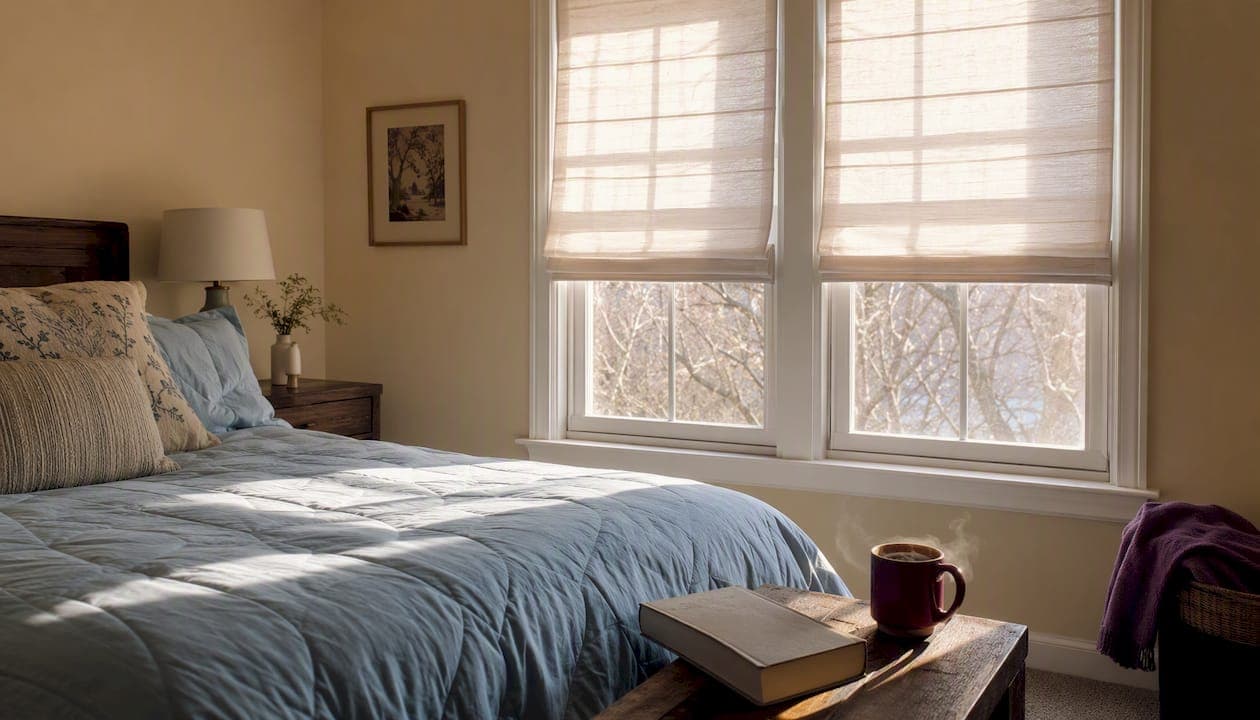
- Bedroom: Cellular or blackout roller shades block light for better sleep, per Sleep Foundation guidance on darkness and rest quality.
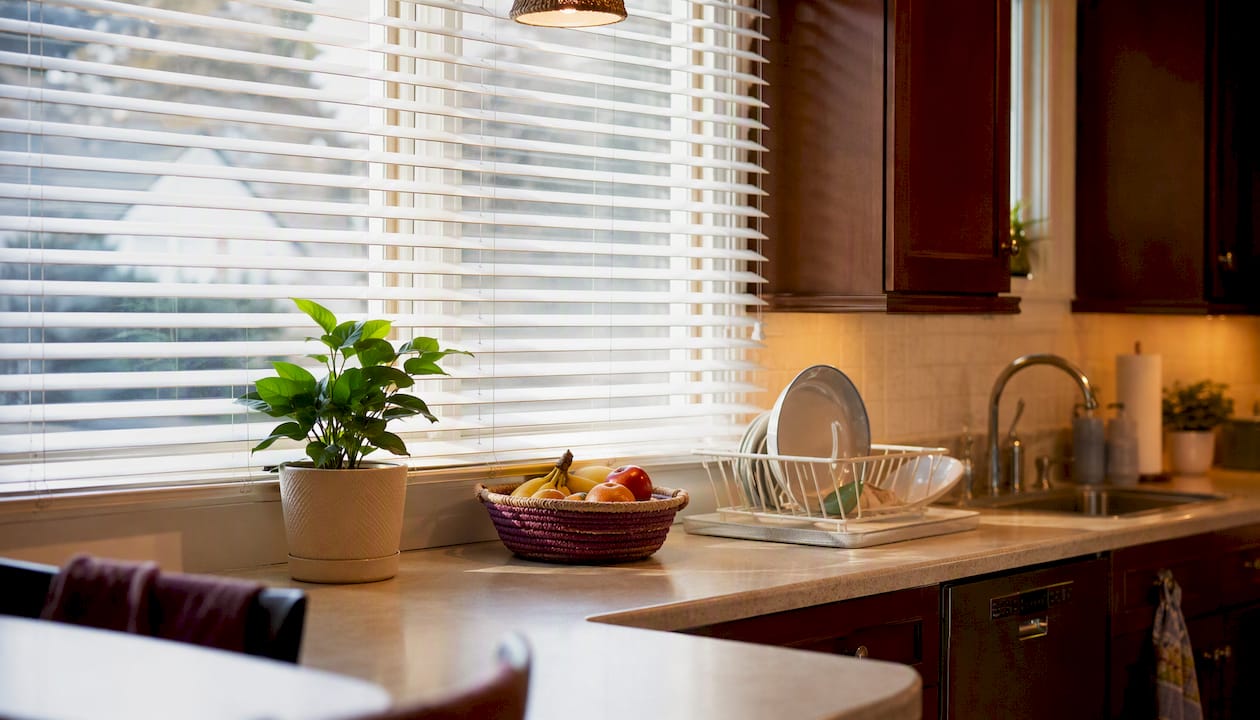
- Kitchen or bathroom: Faux wood or vinyl blinds handle humidity and grease splatter without warping or staining.
- Living room or home office: Either works — blinds for tilt-based glare management, shades for a cleaner aesthetic and added insulation.
The Consumer Product Safety Commission recommends cordless or motorized lifts in any room where children are present, regardless of whether you choose blinds or shades.
Table of Contents
- What is the core difference between blinds and shades?
- Blinds vs shades: a side-by-side comparison
- What types of blinds and shades are available?
- What does custom window treatment installation actually cost?
- Child safety, cleaning, and upkeep
- How do you decide which window treatment is right for you?
- Why professional measurement and in-home samples matter
- Which window treatment should you choose?
- Fundamental construction: slats versus single-piece fabric
- How do blinds and shades compare for light control and privacy?
- How much do cellular shades improve energy efficiency?
- Style, aesthetics, and how window treatments layer with curtains
- Types of blinds and shades: a full breakdown
- Pros and cons: durability, cleaning, and blackout capability
- Cost ranges and installation, including motorization
- Child safety and maintenance: corded vs cordless and motorized
- Room-by-room recommendations
- Key Takeaways
- A local perspective on choosing the right window treatment
- Free in-home consultation with Made in the Shade Bucks County
- FAQ
What is the core difference between blinds and shades?
Blinds are rigid window coverings built from horizontal or vertical slats — typically aluminum, vinyl, faux wood, or real wood — that tilt to control light and raise or lower as a stack. Shades are a continuous piece or layered fabric that rolls, folds, or stacks as a single unit without individual slats.
The mechanical difference matters in practice:
- Blinds: tilt rod or cord rotates each slat independently; a lift cord raises the full stack
- Shades: a single lift mechanism rolls or folds the entire panel upward
- Headrail profile: blind slats stack into a bulkier pile when raised; many modern shades roll into a low-profile headrail that keeps the window view open
- Light leakage: blind slats leave small gaps between each louver; fabric shades seal more completely, especially blackout-lined options
- Materials: blinds use hard materials (aluminum, vinyl, wood); shades use soft fabrics, woven naturals, or coated solar screen mesh
- Cleaning: blinds require wiping each slat individually; shades are vacuumed or spot-cleaned as a panel
Blinds vs shades: a side-by-side comparison
Design experts consistently recommend choosing by room function rather than declaring one option universally better. The table below shows how each performs across the dimensions homeowners care about most.
| Dimension | Blinds | Shades |
|---|---|---|
| Light control / adjustability | Precise tilt-by-tilt control; excellent for gradual dimming | Raise/lower only; light level changes in larger steps |
| Privacy | Good when tilted closed; gaps remain between slats | Strong; blackout-lined options eliminate all light leakage |
| Energy efficiency / insulation | Minimal; open slats allow air movement | Cellular (honeycomb) shades trap air in pockets for measurable thermal improvement; the U.S. Department of Energy identifies them as among the most effective window coverings for reducing energy loss |
| Style / look | Clean, structured, modern or traditional | Soft, fabric-rich; suits minimalist, natural, and layered styles |
| Durability / maintenance | Hard slats resist dents with care; each slat traps dust | Fabric can snag; newer anti-static treatments reduce routine dusting |
| Cost / price range | Budget-friendly in vinyl/aluminum; faux wood and real wood add cost | Wide range; fabric and custom options vary significantly; motorization increases price |
| Installation & motorization | Standard install; motorization available | Standard install; motorized options widely available and Alexa-compatible |
| Child safety / cords | Corded versions carry risk; cordless and motorized options available | Same risk profile with cords; cordless and motorized options available |
| Blackout capability | Partial; slat gaps limit full blackout | Full blackout achievable with lined or blackout-specific fabrics |
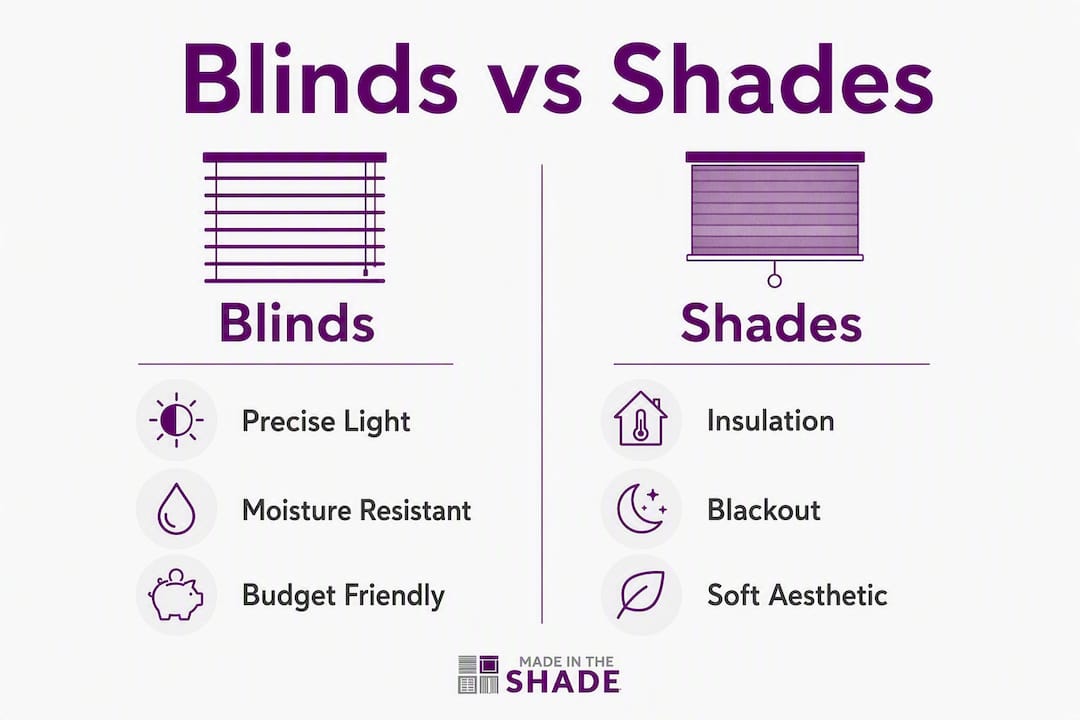
Blinds pros: precise light adjustment, moisture-resistant materials, easy wipe-down, budget-friendly entry point, slim profile when raised.
Blinds cons: slats trap dust between each louver, corded versions pose child-safety risks, limited insulation, partial blackout only.
Shades pros: stronger insulation with cellular options, true blackout capability, cleaner headrail profile, softer aesthetic, anti-static fabric options reduce maintenance.
Shades cons: fabric can snag or stain, raise/lower only (no tilt), higher cost for premium fabrics and motorization.
Cellular (honeycomb) shades create air pockets within the fabric structure that improve a window's thermal performance. The U.S. Department of Energy notes that cellular shades are among the most effective window coverings for reducing heat loss in winter and heat gain in summer.
What types of blinds and shades are available?
Blind types and their best uses
- Faux wood: — looks like real wood, resists humidity, works well in bathrooms and laundry rooms
- Real wood blinds: warm, natural look for living rooms and offices; avoid in high-humidity spaces
- Vertical blinds: designed for wide windows and sliding glass doors; slats rotate and stack to one side
Shade types and their best uses
- Cellular (honeycomb) shades: — single or double-cell construction traps air for insulation; best for rooms where energy efficiency matters
Pro Tip: Schedule your sample viewing at two different times of day — morning and late afternoon — to see how each fabric handles direct sun. What looks right at noon can feel too bright or too dark by 4 PM.
Solar/screen shades deserve a specific mention for rooms with a view. The open-weave construction cuts glare and filters UV rays without turning the window into a wall. For south-facing suburban homes, they let natural light in while keeping the room cooler. Pairing them with outdoor patio shades on a covered porch extends that glare control outside.
Current window treatment trends favor fabric-based shades, reflecting a move toward soft minimalism and natural texture, while blinds hold their ground in rooms where durability and precise control are the priority.
What does custom window treatment installation actually cost?
Several factors shape the final price: material (vinyl costs less than real wood or specialty fabric), custom sizing versus stock dimensions, motorization, and fabric weight or lining. Vinyl and aluminum blinds sit at the budget-friendly end of the window coverings spectrum. Faux wood and real wood blinds add cost. Shade pricing varies widely by fabric choice and custom options, with motorization representing the largest single price increase for either category.
Typical project timeline:
| Stage | Typical duration |
|---|---|
| Free in-home consultation and measurement can typically be arranged promptly | |
| Custom fabrication production lead time varies depending on product and brand, generally taking multiple weeks | |
| Scheduling installation typically occurs weeks after product arrival | |
| Installation appointments usually last between several hours and a full day for most homes |
Before your consultation, have these details ready:
- Window count and approximate dimensions (width × height for each)
- Mount preference — inside the frame or outside over the trim
- Primary function for each room (privacy, blackout, glare control, insulation)
- Whether children or pets are present (determines cord-safety requirements)
- Smart-home platform in use, if motorization is a consideration
Motorized shades now integrate with Alexa and other major smart-home platforms. Cordless lift systems are available for both blinds and shades and carry no strangulation risk. Many suppliers have moved to cordless stock options since 2018, making them easier to source and no longer a premium-only feature.
Child safety, cleaning, and upkeep
Child safety options
The Window Covering Safety Council recommends moving all window treatments with accessible cords out of reach of children under age 6. Three safer alternatives exist for both blinds and shades:
- Cordless lift: spring-loaded mechanism raises and lowers without any hanging cord
- Motorized lift: remote, app, or voice-controlled; no cord at all
- Tensioned cord systems: cord loops are anchored to the wall, keeping them taut and inaccessible
Pro Tip: If you have young children, make cordless or motorized the baseline requirement — not an upgrade. The cost difference is modest compared to the peace of mind.
Cleaning and maintenance
Blinds can be wiped down slat by slat, but each louver is a horizontal dust surface. A full cleaning on a 3-foot-wide blind means wiping 20 or more individual slats. Monthly dusting with a microfiber cloth keeps them manageable; a deeper wipe-down every few months handles grease or grime in kitchens.
Shades require gentler care. A vacuum brush attachment on low suction handles routine dust. Spot-clean fabric panels with a damp cloth and mild detergent. Some newer shade fabrics carry anti-static treatments that actively repel dust, reducing how often cleaning is needed. Annual inspection of the fabric for snags, fading, or lift-mechanism wear keeps shades performing well.
For moisture-prone rooms, faux wood blinds and vinyl blinds are the practical choice. Real wood warps; most fabric shades are not rated for high humidity. The EPA's guidance on mold and moisture is clear that materials in bathrooms and kitchens should resist moisture accumulation.
How do you decide which window treatment is right for you?
Decision checklist
- Primary function: Do you need tilt-based glare control (blinds) or insulation and blackout (shades)?
- View: Do you want to preserve the outdoor view while filtering light? Solar shades do this; most blinds do not.
- Blackout requirement: True blackout needs a lined shade. Blinds cannot achieve it.
- Moisture exposure: Bathroom, kitchen, or laundry room? Faux wood or vinyl blinds only.
- Budget and upgrade path: Starting with cordless and planning to add motorization later? Confirm the mechanism is motorization-ready before ordering.
Questions to ask your installer
- How do you measure for inside-mount versus outside-mount, and what clearance do you need?
- What warranties come with the product, and what do they cover?
- Which smart-home platforms does the motorization system support?
- What is the current production lead time for this product?
- Which child-safety lift options are available at standard pricing?
- What does post-install support look like if a mechanism fails?
Red flags to watch for
- A quoted lead time under one week for custom-fabricated treatments (stock product may be substituted)
- No professional measurement included in the quote
- Warranty language that covers "defects" without specifying what qualifies or for how long
Why professional measurement and in-home samples matter
Measuring a window sounds simple. It rarely is. Inside-mount blinds require precise width deductions to clear the frame; outside-mount shades need enough wall space above and beside the window to cover the casing fully. A headrail that is a quarter-inch too wide will not fit. One that is too narrow leaves a light gap at each side.
Seeing fabric samples in your home is equally important. A shade that looks neutral in a showroom can read warm or cool depending on your wall color, flooring, and the direction your windows face. North-facing rooms in older Bucks County homes read differently than south-facing great rooms with afternoon sun.
Pro Tip: Ask your consultant to hold samples against the actual window at the time of day when you use the room most. A blackout fabric that looks opaque at noon may still let in a glow at 6 AM if the lining is lightweight.
Made in the Shade Bucks County brings samples directly to your home, measures every window on-site, and handles installation with trained professionals. The consultation is free, and motorized and cordless options are available across the full product line, including cellular shades, roller shades, and blinds.
Which window treatment should you choose?
Three clear picks by function:
- Best for insulation and energy savings: — Double-cell cellular shades, which trap air in two layers of honeycomb pockets for maximum thermal performance.
Layering is worth the cost when a single treatment cannot do everything a room needs. A cellular shade paired with drapery gives you insulation plus a soft, finished look. A blind paired with a sheer panel softens the light without sacrificing tilt control. Layering window treatments also adds flexibility — close the shade for blackout at night, open it and tilt the blind for filtered morning light.
The bottom line: choose by room function first, then let style and budget guide the subtype.
Fundamental construction: slats versus single-piece fabric
The slat-versus-fabric distinction is not just visual. It determines how light enters, how the treatment stacks when raised, and how much maintenance it requires. Blind slats rotate on a tilt rod, giving you granular control over the angle of incoming light. That same structure means every slat is a horizontal surface collecting dust, and the stacked pile at the top of the window can block decorative trim or reduce the open view.
Fabric shades move as one piece. When raised, a well-designed roller or cellular shade disappears into a compact headrail. That clean profile is one reason shades have grown in popularity for open-plan rooms where the window itself is part of the design.
How do blinds and shades compare for light control and privacy?
Blinds give you more granular light control. Tilting the slats halfway lets in diffused light without full exposure; tilting them closed blocks most direct sun. The trade-off is that slat gaps always allow some light through, which limits privacy at night when interior lights are on.
Shades control light in broader steps — fully raised, partially lowered, or fully closed. Within that range, fabric opacity does the work. A sheer roller shade softens light without blocking it; a blackout shade eliminates it entirely. For nighttime privacy, a blackout or room-darkening shade outperforms any blind because there are no gaps.
How much do cellular shades improve energy efficiency?
Cellular shades are the strongest performer in the window coverings category for thermal insulation. The honeycomb cell structure traps air between the window glass and the room, reducing heat transfer in both directions. The U.S. Department of Energy identifies cellular shades as one of the most effective window covering options for reducing energy loss. Double-cell construction adds a second layer of air pockets, improving performance further in climates with cold winters or hot summers.
Open-slat blinds offer no comparable insulation. Air moves freely through the slat gaps, and the hard materials conduct rather than resist temperature transfer.
Style, aesthetics, and how window treatments layer with curtains
Blinds read as structured and utilitarian. Real wood blinds bring warmth to traditional interiors; aluminum blinds suit industrial or contemporary spaces. The slat profile is visible whether open or closed, which suits rooms where a clean, defined look is the goal.
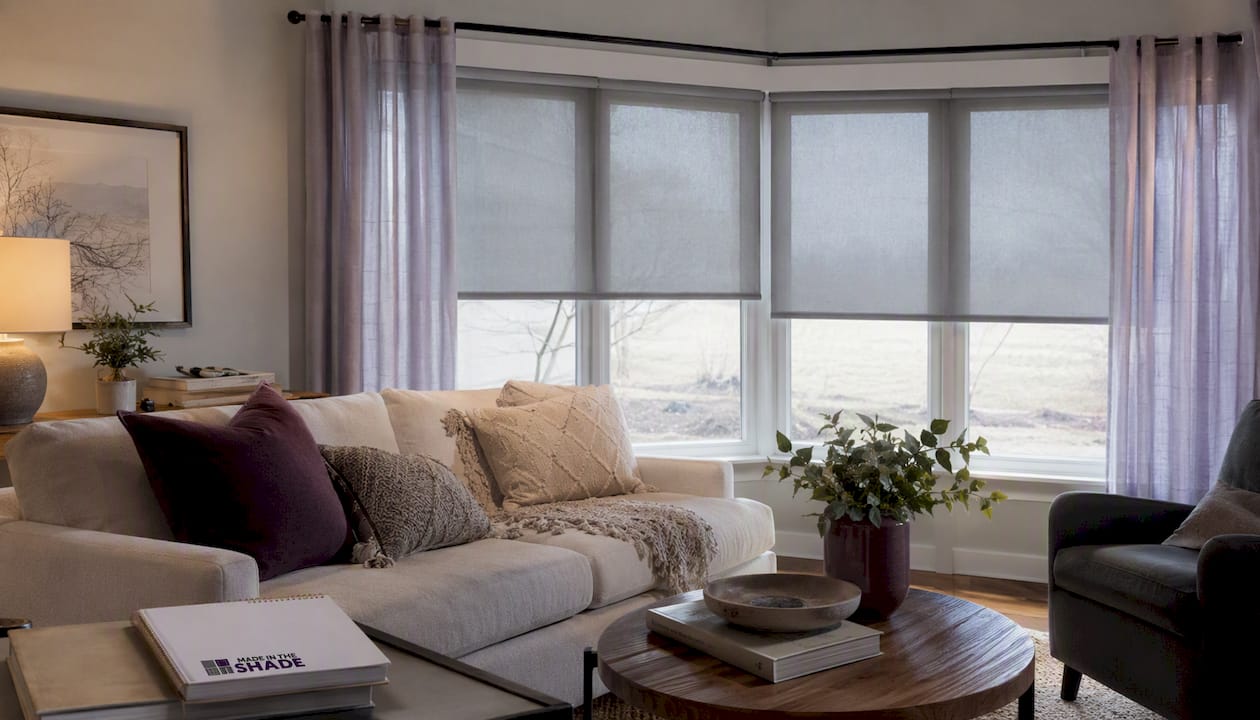
Shades lean softer. Roman shades add fabric folds and texture; woven naturals bring organic warmth; roller shades in solid or patterned fabrics can anchor a room's color palette. The current trend toward natural texture and soft minimalism favors shades, particularly woven and linen-look options.
Layering either treatment with drapery or sheers adds depth and flexibility. A shade handles the functional work — light blocking, insulation, privacy — while drapery frames the window and softens the room. Blinds layer well with sheer panels that diffuse light when the slats are open. Many designers recommend this combination for living rooms where you want both precise control and a finished, layered look.
Types of blinds and shades: a full breakdown
The main shade subtypes each solve a specific problem. Roller shades are the most versatile and the easiest to motorize. Roman shades are the most decorative. Cellular shades are the best insulator. Solar shades are the only option that cuts glare while keeping the view. Woven naturals add texture without blocking light entirely. Blackout shades are the only choice for true light elimination.
For blinds, the subtype decision usually comes down to moisture and budget. Vinyl and aluminum handle humidity and cost the least. Faux wood looks better and handles moisture nearly as well. Real wood is the premium option for dry rooms. Vertical blinds are purpose-built for wide openings and sliding doors.
Pros and cons: durability, cleaning, and blackout capability
Blinds hold up well in high-traffic rooms. Hard slats resist everyday wear, and a damaged slat can often be replaced individually. The cleaning reality is less convenient than it sounds: wiping each slat on a standard window takes time, and dust accumulates quickly on horizontal surfaces. Blackout is not achievable — slat gaps always let in some light.
Shades are more vulnerable to physical damage. A snag or tear in the fabric typically means replacing the panel rather than a single component. Cleaning is gentler and faster for most fabric types, especially those with anti-static or stain-resistant treatments. Blackout is fully achievable with the right lining, making shades the clear choice for bedrooms and media rooms where light elimination matters.
Cost ranges and installation, including motorization
Vinyl and aluminum blinds represent the most budget-friendly entry point in the window coverings category. Faux wood and real wood blinds cost more. Shade pricing spans a wide range depending on fabric, lining, and custom sizing. Motorization adds cost to both categories but has become more accessible as demand has grown.
Motorized shades now integrate with Alexa and major smart-home platforms, and many brands offer app-based control as a standard feature rather than a premium add-on. For homeowners planning a smart-home setup, confirming platform compatibility before ordering avoids a costly retrofit later. Professional measurement and installation are the most reliable way to avoid sizing errors, which are the leading cause of returns and reorders on custom treatments.
Child safety and maintenance: corded vs cordless and motorized
Cordless and motorized lift systems significantly reduce strangulation risks for children. Many manufacturers moved to cordless as their default option after 2018, and the Window Covering Safety Council continues to advocate for cord-free environments in homes with young children. Both blinds and shades are available in cordless and motorized configurations.
Maintenance differences are practical. Blinds need slat-by-slat wiping; shades need gentle vacuuming and occasional spot cleaning. Faux wood and vinyl blinds are the only moisture-safe options for bathrooms and kitchens. Fabric shades in those rooms risk mold and warping unless specifically rated for humidity.
Room-by-room recommendations
Bedroom: Blackout cellular or roller shades. Darkness supports sleep quality, and cellular construction adds insulation against cold nights and early-morning sun.
Bathroom: Faux wood or vinyl blinds. Moisture resistance is non-negotiable; the tilt function provides privacy without blocking ventilation.
Living room: Either works well. Shades suit open-plan rooms where a clean headrail profile matters; blinds suit rooms where precise glare control is the priority. Layering a shade with drapery gives you both.
Kitchen: Faux wood or aluminum blinds. Easy to wipe down after cooking, moisture-resistant, and the tilt function manages afternoon glare without blocking light entirely.
Key Takeaways
Shades outperform blinds on insulation and blackout; blinds outperform shades on tilt-based light control and moisture resistance — and the right choice depends entirely on the room's primary function.
| Point | Details |
|---|---|
| Choose by room function | Blinds for kitchens and baths; shades for bedrooms, living rooms, and energy efficiency. |
| Cellular shades lead on insulation | The U.S. Department of Energy identifies cellular shades as category-leading for reducing energy loss through windows. |
| Blackout requires a shade | Blind slat gaps prevent true blackout; lined or blackout-specific fabric shades are the only reliable solution. |
| Cordless and motorized are safer | Both blinds and shades are available without cords; the Window Covering Safety Council recommends cord-free options in homes with young children. |
| Made in the Shade Bucks County | Offers free in-home consultations with samples, professional measurement, and installation across Bucks County, PA and Mercer County, NJ. |
A local perspective on choosing the right window treatment
Bucks County homes present a specific set of challenges that generic buying guides rarely address. Older colonials and farmhouses in the area tend to have non-standard window dimensions, decorative trim that complicates outside-mount measurements, and single-pane or older double-pane glass that loses heat quickly in January. South-facing great rooms in newer construction face the opposite problem: intense afternoon sun from May through September that fades furniture and raises cooling costs.
Cellular shades address both ends of that seasonal range. In winter, the honeycomb structure reduces drafts at the glass surface. In summer, it slows heat gain before it reaches the room. For south-facing windows specifically, a solar shade layered under drapery gives you glare control during the day and a finished look in the evening without sacrificing the view.
The most common request at Made in the Shade Bucks County is for a treatment that handles privacy and light control without making a room feel closed off. That combination usually points to a light-filtering cellular shade or a solar shade, depending on how much of the view the homeowner wants to keep.
Free in-home consultation with Made in the Shade Bucks County
Choosing between blinds and shades is straightforward once you see the options in your own space, against your actual walls and light conditions. Made in the Shade Bucks County brings the full sample collection directly to your home — no showroom trip, no guesswork about how a fabric will look in your room.
The process is simple: a design consultant visits, measures every window, walks through the options with you, and provides a quote. Professional installation follows once your custom treatments are fabricated. Every product comes with manufacturer warranty coverage, and cordless and motorized options are available across the full line, including cellular shades, roller shades, and blinds compatible with Alexa and major smart-home platforms.
Made in the Shade Bucks County serves homeowners throughout Bucks County, PA and Mercer County, NJ. Request your free in-home consultation to get started.
FAQ
Are blinds cheaper than shades?
Vinyl and aluminum blinds are generally the most budget-friendly stock option. Shades vary widely by fabric and custom sizing, with motorization adding cost to both categories.
Are blinds or shades more stylish?
Neither is objectively more stylish — it depends on the room. Shades suit soft, fabric-forward interiors; blinds suit structured, contemporary, or traditional spaces where a defined slat profile fits the design.
What is the difference between shades and curtains?
Shades are a single fabric panel that raises and lowers within the window frame; curtains are fabric panels that hang from a rod outside the frame and draw to the sides. Many designers layer both for light control and a finished look.
What are the disadvantages of blinds?
Each slat traps dust and requires individual wiping, corded versions pose child-safety risks, and blind slat gaps prevent true blackout. They also offer minimal insulation compared to cellular shades.
Which window treatment is best for a bedroom?
Blackout roller shades or cellular shades with opaque lining are the strongest choice for bedrooms, as they eliminate light leakage and, in the case of cellular shades, improve insulation against cold nights.