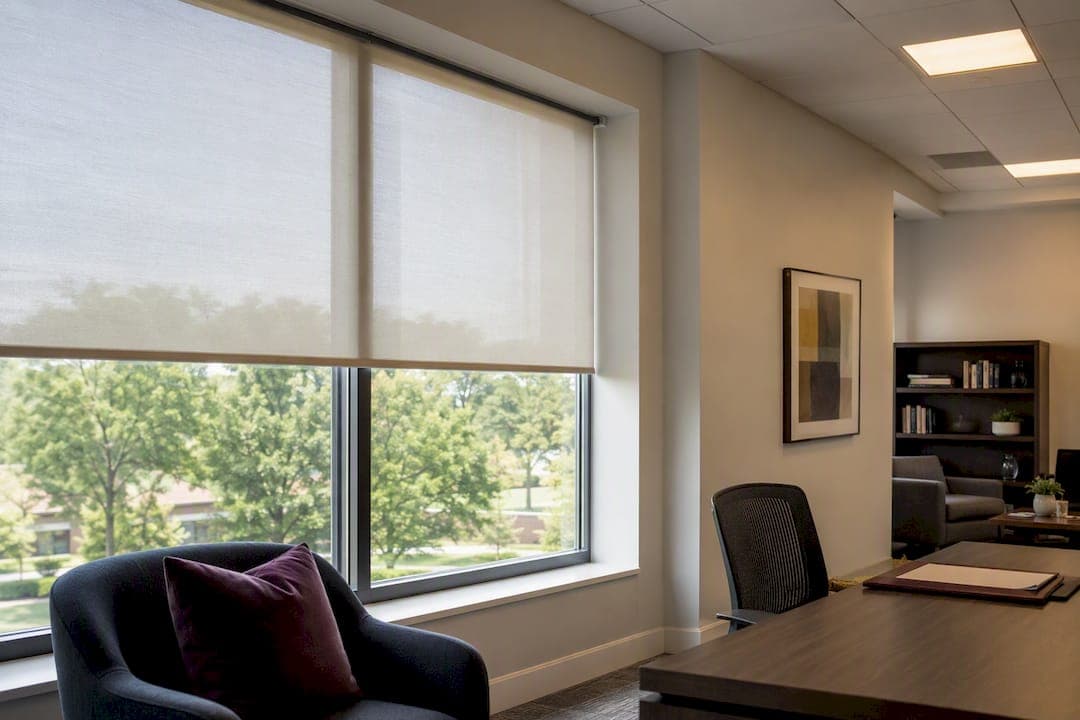
For most commercial spaces, start with solar or roller shades and window film for glare and energy control, then add motorized shades wherever glazing runs large or hard to reach. Metal blinds and panel tracks handle industrial and healthcare durability needs, drapery adds acoustic softening to open-plan offices, and shutters or exterior awnings suit lobbies and heavy sun exposures. Whatever you choose, specify NFPA 701 rated fabrics and cordless or motorized operation from the start.
- Office and open-plan: solar/roller shades with mid-range openness factor for daylight without glare
- Conference rooms: dual shades or blackout roller shades for presentation screens
- Retail: motorized roller shades or window film for storefront glass and merchandise protection
- Healthcare: wipeable blinds or antimicrobial-treated shades for infection control
- Industrial: aluminum blinds or vertical blinds rated for temperature swings and heavy use
- Lobbies and high-exposure facades: shutters, panel tracks, or exterior awnings/screens
The procurement guardrail that trips up more projects than any design choice: fabrics must carry NFPA 701 documentation, and any corded system in a public or child-occupied space now runs against a federal safety standard the CPSC adopted classifying operating cords as a substantial product hazard.
Key Takeaways
Commercial window treatments succeed when fire-code compliance, motorization specs, and space-specific function get decided before fabric selection begins.
| Point | Details |
|---|---|
| Prioritize compliance first | Specify NFPA 701 rated fabrics and cordless or motorized operation before choosing style or color. |
| Match treatment to space function | Use blackout shades for conference rooms, wipeable blinds for healthcare, and solar shades for open offices. |
| Confirm motorization specs early | Verify control protocol and motor sizing during electrical rough-in to avoid costly rework. |
| Choose film for speed, glazing for scale | Window film delivers fast glare and energy fixes; full glazing upgrades pay off best on high window-to-wall-ratio facades. |
| Start with a free consultation | Made in the Shade Bucks County brings samples on-site to verify color and fit before installation in Bucks County, PA and Mercer County, NJ. |
Table of Contents
- Commercial Window Shade Options and Specs Worth Knowing
- How to Match Treatments to Each Type of Commercial Space
- What Window Upgrades Actually Save on Energy
- Getting Motorized Shades Right the First Time
- Safety Codes and Paperwork You Need Before You Buy
- What Actually Happens Between Order and Install
- How Made in the Shade Bucks County Handles Commercial Projects
- What Most Facility Managers Get Wrong About This Project
- See Your Options in Place Before You Commit
- Sources
- FAQ
Commercial Window Shade Options and Specs Worth Knowing
Every commercial window treatment idea below solves a different problem: glare, energy loss, privacy, sound, or curb appeal. Knowing the tradeoffs before you call a vendor saves a round of change orders later.
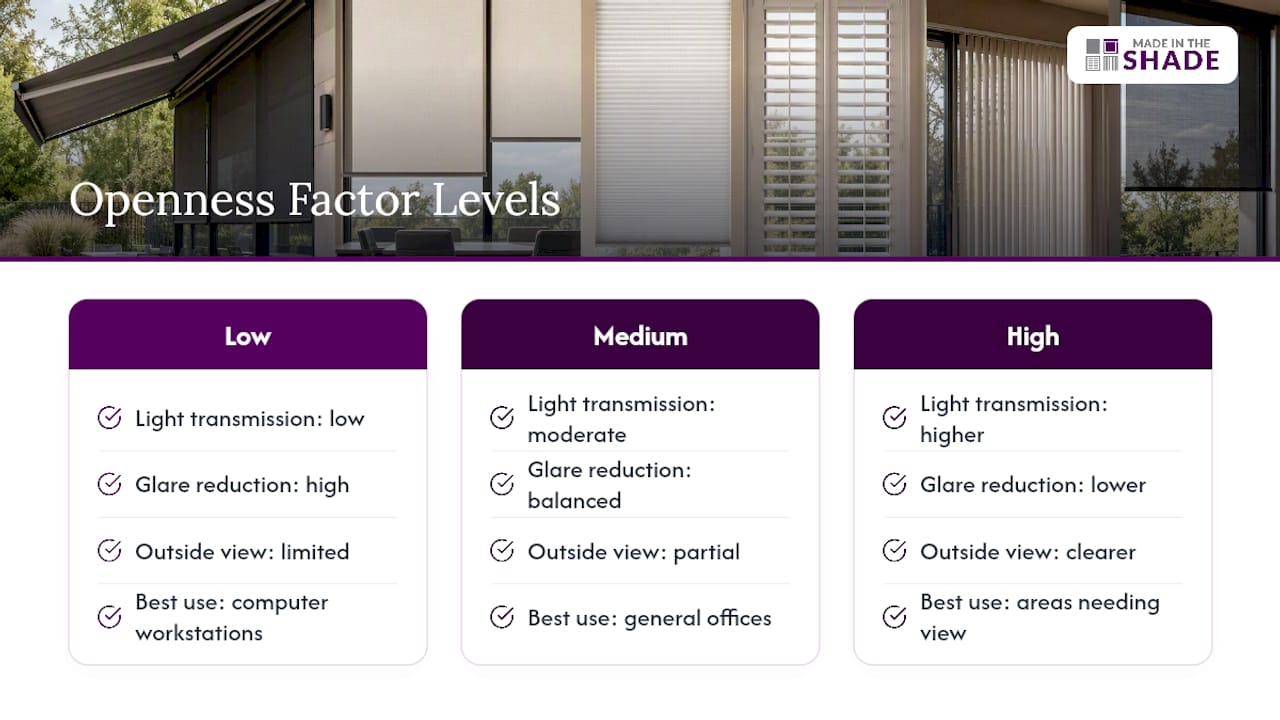
1. Solar and roller shades. These are the workhorse of office window treatment ideas because they cut glare without blacking out a room. Openness factor, which indicates the percentage of fabric that lets light pass, varies typically from low to moderate levels for standard solar screens; select a lower factor for computer-heavy workstations to reduce glare and a higher factor where more outside view is desired. Maintenance is minimal, mostly vacuuming and spot cleaning, and PVC-coated or polyester fabrics hold up well against UV fading.
2. Window film. Film is often the fastest, cheapest fix for an existing glazing problem. It typically installs in a day with minimal disruption, cuts glare and cooling load immediately, and skips the structural work a full glazing replacement requires, according to commercial window film specialists. Its limitation: not every film is compatible with every glass type, and mismatched film on insulated glass units can cause thermal stress cracking. Always confirm glass compatibility before ordering.
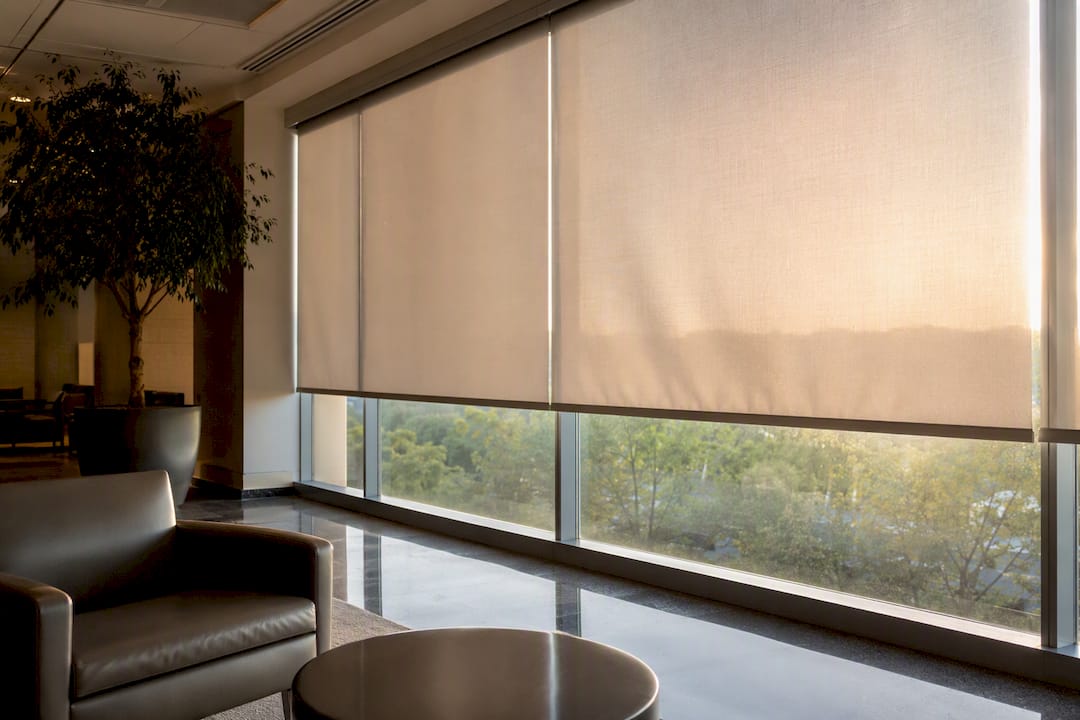
3. Motorized shades. Large storefronts, atriums, and multi-story lobbies are impractical to operate manually. Motorization also solves the cord-safety problem outright and integrates with building automation for scheduled operation.
4. Aluminum and metal blinds. Durable, wipeable, and inexpensive to replace individually, these suit healthcare corridors and industrial floors where cleaning protocols matter more than aesthetics.
5. Vertical blinds and panel tracks. Built for oversized glass walls and sliding glass doors common in conference centers and retail frontage, offering stack-away control that horizontal blinds cannot match at that scale.
6. Drapery. Heavier fabrics absorb sound reflections, which matters in open offices and reception areas with hard flooring and high ceilings.
7. Shutters. A premium, low-maintenance option suited to executive offices and upscale lobbies where a polished, permanent look matters more than daily adjustment.
8. Exterior awnings and solar screens. For south and west-facing facades with heavy sun load, exterior shading intercepts heat before it hits the glass, which interior treatments cannot do.
Pro Tip: Bring fabric and film samples to the actual window before you sign off. Color and translucency shift dramatically under real daylight compared to a swatch under office fluorescents, and staging in place is the only way to catch that before installation.
How to Match Treatments to Each Type of Commercial Space
The right window covering for businesses depends less on style and more on what the room needs to do. An open office lives or dies on glare control at workstations. A conference room needs blackout capability the moment someone plugs in a projector. Retail needs to protect merchandise from fading while still inviting foot traffic. Healthcare facilities need surfaces a housekeeping crew can wipe down between patients. Industrial spaces need materials that survive temperature swings, dust, and heavy daily use without warping.
Material choice follows the same logic: PVC and polyester solar fabrics wipe clean easily for healthcare and food service settings, while natural woven woods or heavier drapery fabrics fit executive spaces where cleanability matters less than appearance.
Before your next vendor meeting, run through this checklist:
- What is the primary function of this room (focus work, presentations, patient care, retail display)?
- What openness factor or blackout level does that function require?
- Does the space need motorization for reach, scale, or automation?
- What cleaning frequency and method will housekeeping actually follow?
- Are there code requirements (fire rating, egress) specific to this occupancy type?
- What is the realistic budget per window, including installation?
What Window Upgrades Actually Save on Energy
Conservative estimates from a Lawrence Berkeley National Laboratory analysis put site energy savings from window upgrades across the commercial building stock at roughly 4% to 6% for a typical building, climbing to nearly 28% for buildings with a high window-to-wall ratio. Electrochromic and other dynamic glazing push those numbers higher still, since they adjust tint automatically rather than relying on a fixed shade position.
Window-to-wall ratio and climate zone drive which upgrade path pays off fastest. A building with modest glazing in a moderate climate may see better ROI from window film or automated shades than from full glazing replacement, since film delivers immediate glare and cooling-load reductions at a fraction of the cost and disruption. Save full window replacement for facades where the glass itself, not just the covering, is the weak link.
Getting Motorized Shades Right the First Time
Commercial motorized shades almost always run hardwired rather than battery powered, given the duty cycle and load demands of larger fabric spans. Confirm this on your electrical rough-in drawings before drywall closes, not after.
- Verify control protocol compatibility (0-10V, DALI, RS-485, or Zigbee) with your building automation and lighting systems before ordering.
- Confirm motor sizing against fabric weight and shade width. Undersized motors are the most common cause of early failure.
- Require submittal drawings showing wiring paths and power requirements before installation begins.
- Ask whether the system integrates with existing BAS scheduling for occupied hours.
Pro Tip: Motorization failures in commercial buildings trace back to undersized motors or mismatched control protocols more often than any other cause. Loop your electrical and controls contractors into the shade submittal review, not just the general contractor.
Safety Codes and Paperwork You Need Before You Buy
Commercial fabric must meet NFPA 701 flame-resistance standards, and most jurisdictions require documentation before occupancy inspection. Request test reports and certificates directly from the manufacturer, not just a verbal assurance from the sales rep.
The CPSC's 2023 rule reclassified operating cords on custom window coverings as a substantial product hazard, a designation that reflects years of documented child strangulation incidents and is backed by ANSI/WCMA A100.1 compliance definitions in the Federal Register rule.
Require these submittals before signing off on a commercial order:
- NFPA 701 test reports and manufacturer certificates for every fabric
- Motor and control wiring diagrams for motorized systems
- Written confirmation of cordless or motorized operation for any public-facing or child-occupied space
What Actually Happens Between Order and Install
- Site survey and measurement. A trained installer measures every opening in place, since stock sizes rarely fit commercial glazing exactly.
- Submittal approval. Fabric samples, NFPA documentation, and motor specs get reviewed and signed off.
- Electrical rough-in. For hardwired motors, wiring and blocking need to happen before walls close, not after.
- Phased installation. In occupied multi-tenant buildings, install floor by floor or after hours to limit disruption to tenants.
How Made in the Shade Bucks County Handles Commercial Projects
Every commercial project starts the same way: a free on-site consultation where an experienced design consultant brings real fabric and film samples to your building. Seeing options against your own glazing and lighting removes the guesswork that ruins so many commercial specs, and it catches color and translucency issues before they become change orders.
Made in the Shade Bucks County brings a full commercial lineup to that consultation:
- Custom shades, including solar, roller, cellular, roman, and woven wood options
- Shutters and blinds built for high-traffic lobbies and durability-focused spaces
- Drapery for acoustic softening in open-plan offices
- Motorized and smart-home-compatible shades that work with Alexa and other major platforms
- Cordless, child-safe lift systems for daycare, healthcare, and public-facing spaces
- Professional measurement and installation, backed by generous manufacturer warranties
Made in the Shade Bucks County serves commercial and residential clients throughout Bucks County, PA and Mercer County, NJ. If your building falls in that footprint, the commercial consultation is the fastest way to get a real quote instead of a guess.
What Most Facility Managers Get Wrong About This Project
Most commercial window treatment decisions get made backward. Someone picks a fabric or a look first, then discovers halfway through procurement that it fails NFPA 701, or that the motor spec doesn't match the electrical rough-in already poured into the walls. The research here points the other direction: settle the compliance and technical constraints first, then choose aesthetics within that frame.
The conventional advice on this topic tends to treat window coverings as a decorating decision with a safety footnote attached. That's backward for commercial work. Cord safety, fire rating, and motor sizing aren't afterthoughts here. They are the spec, and everything else, color, fabric texture, opacity, gets chosen inside those boundaries.
If there's one thing worth prioritizing above all else, it's coordinating your electrical contractor and window treatment vendor before drywall closes. Rework on a hardwired motor system after the fact costs more, in time and money, than almost any other mistake on this list. Get the boring technical questions answered first. The good-looking part is easy by comparison.
— Tony
See Your Options in Place Before You Commit
Made in the Shade Bucks County skips the guesswork that trips up so many commercial specs: instead of picking fabric from a swatch book at a vendor's office, a design consultant brings real samples directly to your building, at no cost, so you see exactly how light, color, and openness behave against your own glazing.
That matters more for commercial projects than almost any other decision point, because a shade that reads correctly in a showroom can look completely different against a west-facing storefront or a fluorescent-lit conference room. Made in the Shade Bucks County's consultants handle the measurement, the NFPA documentation conversation, and the motorization planning during that same visit, so you walk away with a real spec instead of a rough idea. The team works across custom shades, blinds, shutters, and motorized systems, and every installation is backed by manufacturer warranties. For property managers and business owners in Bucks County, PA and Mercer County, NJ, the next step is simple: book a free in-home consultation and get a walkthrough of your specific building's needs.
Sources
- CPSC Approves New Federal Safety Standard for Custom Window Coverings to Prevent Deaths and Serious Injuries from Strangulation
- Energy impacts of nationwide window upgrades in commercial buildings
- Window Treatments for Commercial Construction: Specification, Compliance, and Installation Requirements | Innergy Interiors
- Commercial Window Film Energy Savings: 7 Proven Wins
FAQ
What is the newest trend in window treatments for commercial spaces?
Motorized shades tied into building automation systems are the fastest-growing trend, letting facility teams schedule shade position for glare and energy control without manual adjustment.
What are the trends in window coverings going into 2026?
Expect more automated and app-controlled shading, wider adoption of window film as a low-disruption energy fix, and continued movement away from corded systems toward cordless or motorized operation.
What window treatments are considered outdated for commercial spaces?
Heavy corded blinds and mini-blinds with exposed pull cords are falling out of favor, both for their dated look and because they conflict with current cord-safety guidance from the CPSC.
Are trendy window covering ideas practical for commercial use?
Some are: layered shades and exterior screens both look current and perform well. Purely decorative trends that skip fire rating or motorization needs are not worth pursuing in a commercial building.
Is window film a substitute for motorized shades?
Not exactly. Film handles glare and heat gain passively and installs faster, while motorized shades add adjustable light and privacy control that film cannot provide on its own.
Does Made in the Shade Bucks County handle commercial installations?
Yes. Made in the Shade Bucks County provides free on-site consultations, professional measurement, and installation for commercial clients throughout Bucks County, PA and Mercer County, NJ.