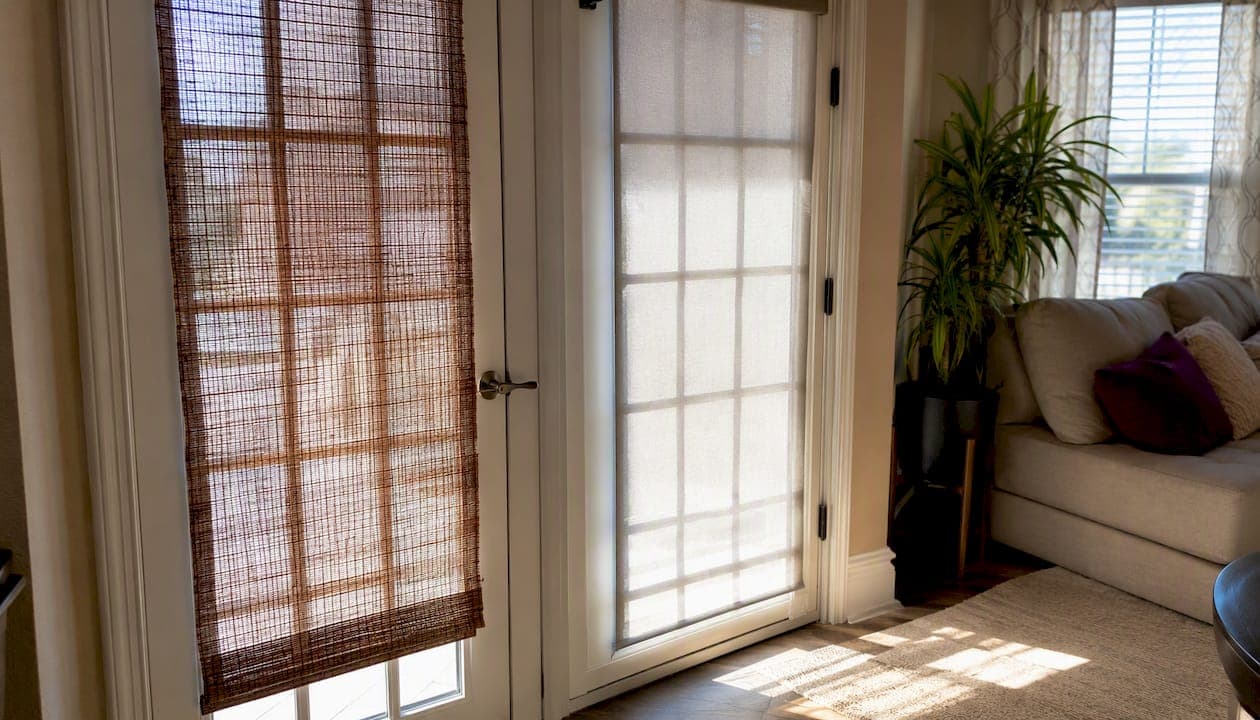
Custom cellular shades, low-profile roller shades, and plantation shutters are the most practical French door window coverings for most homes. They stay out of the door's swing arc, accommodate handle projections, and can be fitted with hold-down brackets to prevent flapping. If you want to skip the guesswork, Made in the Shade Bucks County offers a free in-home consultation for homeowners in Bucks County, PA and Mercer County, NJ.
Quick scenarios:
- Frequently used patio doors: Cordless roller shades or cellular shades with hold-down brackets. Easy to raise and lower dozens of times a day without cord tangles.
- Bedroom French doors needing blackout: Cellular blackout shades or room-darkening roller shades with side channels to eliminate light gaps.
- Historically styled doors in older Bucks County homes: Plantation shutters. They mount to the frame, never swing with the door, and require no daily adjustment.
Pro Tip: Before ordering anything, measure the depth from the glass surface to the back of the door handle. That single number determines whether an inside mount is even possible.
Table of Contents
- What types of French door window coverings actually work?
- How to measure French doors — and the pitfalls to avoid
- What hardware and lift systems work best on moving doors?
- How do you choose the right fabric for privacy and light control?
- DIY or custom: how do you decide?
- What does it cost and how long does it take?
- Why professional measurement and installation matter for French doors
- How do you care for door-mounted window treatments?
- How much do French door window treatments cost?
- Step-by-step measurement guide for French doors
- How to evaluate a vendor and what to ask during a consultation
- Key Takeaways
- What most homeowners get wrong about French door treatments
- Custom French door treatments, measured and installed at your home
- Useful sources
- FAQ
What types of French door window coverings actually work?
Not every window treatment translates cleanly to a door. The glass moves, the handle projects into the room, and the door swings through an arc that can catch anything mounted too far forward. Here is how the main categories stack up.
Plantation shutters mount directly to the door frame or the door itself and never interfere with the swing. Custom shutters can be cut to clear the handle entirely. The downside is upfront cost and the fact that they are a permanent fixture.
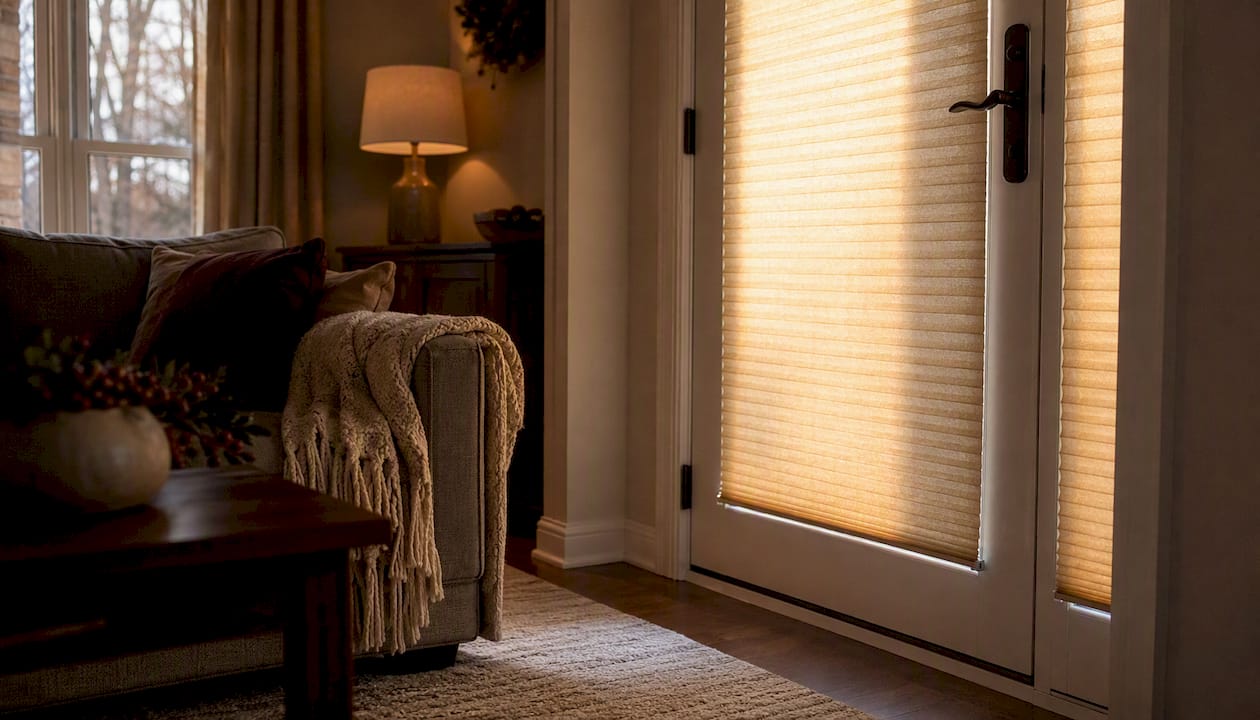
Cellular (honeycomb) shades offer a slim headrail, strong insulation, and a clean look. Cellular shades are a top pick for French doors because hold-down brackets keep them flat against the glass during door movement. The main limitation is that very deep honeycomb cells can add bulk near the handle.
Roller shades are the lowest-profile option. A slim cassette headrail sits close to the glass, and the fabric rolls up completely out of the way. They work well on frequently used doors but offer less insulation than cellular.
Roman shades add softness and texture. They work on French doors when mounted outside the frame, but the fabric folds stack up at the top and can interfere with the top rail of the door if the door has a narrow top panel.
Mini blinds and faux-wood blinds are affordable and widely available, but the slats rattle against the glass when the door opens. Magnetic or clip-on mounting systems that move with the door reduce this problem significantly.
Panel track drapery and decorative door drapes work best on stationary or rarely used French doors. Long panels look elegant but require a track system that clears the door swing, and they are not practical for daily use.
Exterior patio shades apply to French doors that open onto a deck or patio. Weather-resistant fabrics block UV and reduce heat gain before it enters the glass. Made in the Shade Bucks County carries outdoor patio shades designed for exactly this application.
| Style | Best for | Light control | Door operation ease | Child safety | Motorization |
|---|---|---|---|---|---|
| Plantation shutters | Durability, no-swing | Good, adjustable louvers | Excellent | Excellent (no cords) | Limited |
| Cellular shades | Energy savings, slim profile | Blackout to light-filtering | Good with hold-downs | Cordless available | Yes, Alexa-compatible |
| Roller shades | High-traffic doors, minimal profile | Blackout to solar | Excellent | Cordless available | Yes, Alexa-compatible |
| Roman shades | Style, soft look | Light-filtering to room-darkening | Moderate | Cordless available | Yes |
| Mini/faux-wood blinds | Budget, privacy | Good | Fair (rattle risk) | Cordless available | Limited |
| Panel track / drapes | Decorative, low-traffic | Varies | Poor for active doors | Varies | Limited |
The single biggest mistake homeowners make is choosing a treatment they love the look of without checking whether it physically clears the door handle. A beautiful Roman shade that catches the lever every time the door opens will come down within a week.
How to measure French doors — and the pitfalls to avoid
French doors present three measurement challenges that standard windows do not: the handle projects into the room, the frame is often shallower than a window frame, and the door swings through an arc that can catch anything mounted too far out.
Accurate measurement starts with checking frame depth and handle projection before deciding on inside versus outside mount.
Inside mount vs. outside mount
Inside mount sits within the door frame and looks clean. It requires at least 1.5 inches of flat frame depth, and the headrail must clear the handle projection. Many French doors have shallow frames or handles that project too far, making inside mount impossible without a custom cutout.
Outside mount attaches to the wall or door surface above the frame. It covers more glass, hides frame imperfections, and avoids the handle clearance problem entirely. The trade-off is a slightly less tailored look and the need for longer brackets.
Step-by-step measurement checklist
- Measure width at three points: top, middle, and bottom of the opening. Use the smallest measurement to prevent binding.
- Measure height from the top of the frame to the bottom, at the center.
- Measure frame depth (the flat surface available for bracket mounting). Note whether it is less than 1.5 inches.
- Measure handle projection: hold a ruler flat against the glass and measure to the farthest point of the handle. This is your minimum clearance requirement.
- Check the swing arc: open the door fully and note how far it travels. Any treatment mounted outside the frame must clear this arc.
- Record the glass-to-handle-back depth: the distance from the glass surface to the back of the handle hardware. This is the critical number for inside-mount headrail depth.
Common pitfalls:
- Mounting a headrail deeper than the glass-to-handle-back measurement causes the treatment to catch the handle on every open.
- Skipping hold-down brackets on hinged doors (the shade swings freely and bangs against the glass)
- Ordering standard off-the-shelf sizes without accounting for non-square doors
- Ignoring the door's swing arc when planning an outside mount
Pro Tip: A treatment sitting even half an inch too far out from the door surface will catch the door jamb when the door opens. Always measure the swing arc and add that clearance to your outside-mount bracket depth.
What hardware and lift systems work best on moving doors?
The hardware you choose matters as much as the fabric. A beautiful shade with the wrong lift system will either tangle, rattle, or become a safety hazard.
Cordless manual lift is the most practical choice for most French doors. There are no cords to tangle when the door swings, and the shade stays flat against the glass. Cordless systems are also the safest option in homes with children.
Motorized shades (battery-powered or plug-in) are worth considering for frequently used doors. You raise and lower the shade without touching it, which means no cord management and no wear on the fabric from repeated manual operation. Made in the Shade Bucks County's motorized shades are compatible with Alexa and major smart-home platforms, so you can automate them on a schedule or control them by voice.
Hold-down brackets are non-negotiable on hinged French doors. They attach to the bottom rail of the shade and anchor it to the door, preventing the shade from swinging away from the glass when the door moves. Without them, even a cordless shade will flap and clatter. Installation guides consistently list hold-down brackets as the most critical hardware element for door-mounted treatments.
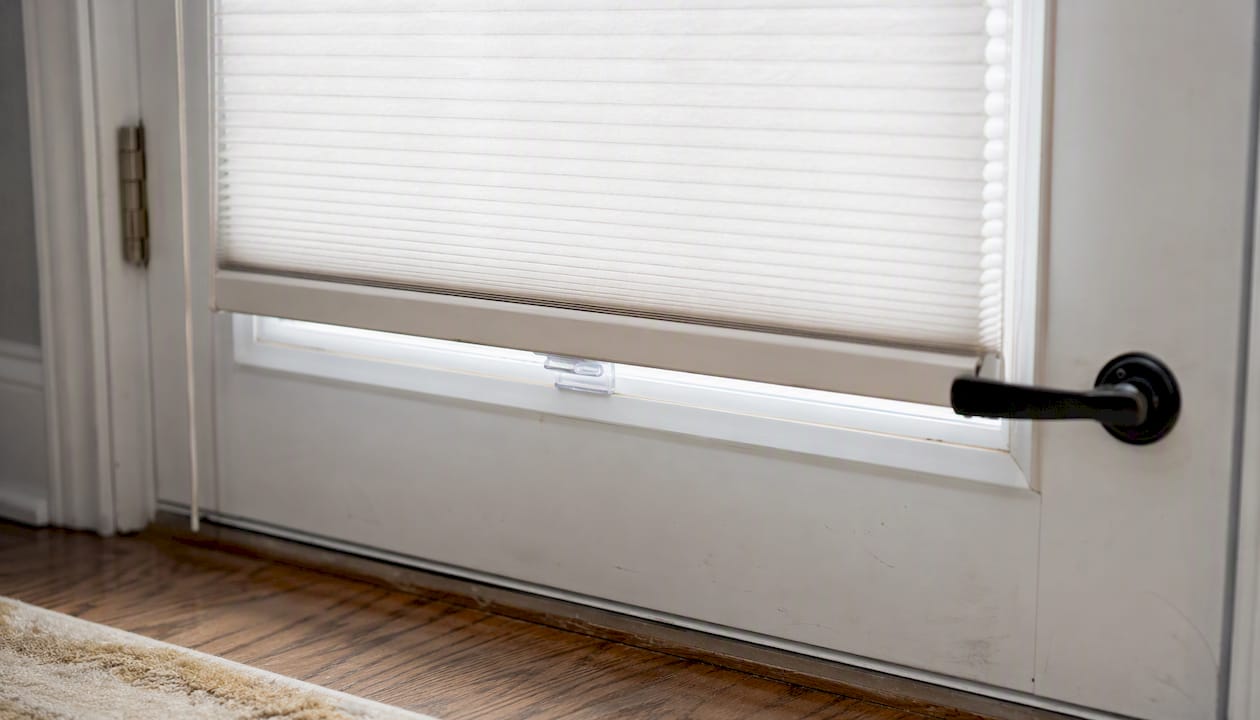
Magnetic and clip-on mounting systems are a practical solution for renters or anyone who cannot drill into the door. Door-mounted systems that move with the door eliminate handle interference entirely. The trade-off is that magnetic mounts are not as secure as screwed brackets on heavy or frequently used doors.
Low-profile headrails and cassettes keep the top of the shade close to the glass, which is critical when the door has a narrow top panel or a handle that sits high on the door.
Child safety note: Corded blinds and shades pose a strangulation risk. Cordless and motorized options meet current child-safety standards and are the recommended choice for any home with young children. Made in the Shade Bucks County carries child-safe options across its full shade and blind range.
How do you choose the right fabric for privacy and light control?
The fabric determines how much light comes through, how much privacy you get, and how much heat the door gains or loses. For Bucks County homes, where summers are bright and winters are cold, the material choice has real energy consequences.
Light-filtering fabrics soften and diffuse daylight while maintaining an outward view. They work well in living rooms and dining areas where you want natural light without glare. Privacy is moderate; silhouettes are visible from outside at night when interior lights are on.
Room-darkening fabrics block most light and provide strong privacy. They suit bedrooms and home offices. A small amount of light may still enter around the edges unless the shade is fitted with side channels.
Blackout fabrics block virtually all light. They are the right choice for bedroom French doors where morning sun is a problem, or for media rooms. Side channels or a cassette headrail eliminate the remaining edge gaps.
Cellular (honeycomb) shades add an insulation layer that standard roller shades do not. The air pockets in the honeycomb structure slow heat transfer, which matters for glass-heavy French doors that can lose significant heat in a Bucks County winter. Cellular shades are consistently recommended for their slim profile and energy-saving properties on French doors. For homeowners focused on utility bills, energy-saving window treatments are worth exploring in detail.
Solar shades are designed for exterior-facing doors. They reduce glare and UV exposure while preserving the outward view. The openness factor (the percentage of light that passes through) ranges from very open (high view, lower privacy) to nearly closed (strong privacy, minimal view).
Faux-wood and water-resistant fabrics suit entryway French doors that face humidity or moisture. Real wood warps; faux-wood holds up.
Sheer shadings balance light diffusion with a soft, decorative look. Hunter Douglas's buyer guide describes handle-friendly low-profile systems that maintain view and light control simultaneously.
| Fabric type | Privacy | Energy savings | View | Maintenance |
|---|---|---|---|---|
| Light-filtering | Moderate | Low | Good | Easy, wipe clean |
| Room-darkening | High | Moderate | Minimal | Easy |
| Blackout | Very high | Moderate | None | Easy |
| Cellular (honeycomb) | Moderate to high | High | Minimal | Gentle vacuuming |
| Solar screen | Low to moderate | Moderate (UV block) | Excellent | Wipe clean |
| Sheer shading | Low | Low | Excellent | Gentle care |
Pro Tip: Order fabric samples and hold them against your French door glass at different times of day before committing. Nearby trees and landscaping can reflect light in ways that make a light-filtering fabric feel much more transparent than the product photo suggests.
DIY or custom: how do you decide?
The answer usually comes down to three factors: handle projection, frame depth, and how often the door gets used.
Signs DIY off-the-shelf will work:
- Standard door width (typically 24–30 inches per panel)
- Frame depth of at least 1.5 inches with no handle obstruction
- Low-traffic door (guest room, rarely used patio)
- Budget is the primary constraint
Signs you need custom or professional installation:
- Handle projects more than 2 inches from the glass surface
- Frame depth is less than 1.5 inches (outside mount required)
- Door is used multiple times daily (wear on hardware accelerates)
- You want motorization or smart-home integration
- The door has a non-standard width or an arched top panel
Off-the-shelf options on Amazon vary widely in mounting hardware quality. No-drill and clip-on solutions exist, but they are not always rated for heavy daily use, and the mounting hardware may not accommodate unusual handle projections.
Questions to ask any vendor:
- Can you cut the headrail to clear my specific handle projection?
- Do you supply hold-down brackets, and are they included in the price?
- What is the minimum inside-mount depth for this product?
- What is the production lead time, and does it include installation scheduling?
- What warranty covers the product and the installation labor?
Pro Tip: A of French door measurement can help you spot handle-clearance issues before you call a vendor. Knowing your numbers in advance makes the consultation faster and more productive.
What does it cost and how long does it take?
Pricing for French door window treatments varies by material, mounting complexity, and whether motorization is included. No specific figures are published here because custom pricing depends on door dimensions, fabric selection, and hardware, but the cost drivers below will help you budget realistically.
Major cost drivers:
- Custom fabric or finish: specialty fabrics (blackout, solar, cellular) cost more than standard light-filtering
- Motorization: battery or plug-in motors add cost per shade; smart-home integration (Alexa-compatible) adds a further premium
- Specialty headrails and low-profile cassettes: slim cassettes designed for door clearance cost more than standard headrails
- Hold-down hardware: typically a modest add-on, but required for every door-mounted shade
- Multi-panel coordination: matching two or more panels on a double French door adds complexity and cost
- Retrofit brackets or thin-door fasteners: hollow-core doors require specific hardware to avoid structural damage
Typical timeline (custom order):
- Free in-home consultation and measurement confirmation
- Order placed with manufacturer
- Production lead time (varies by product and manufacturer)
- Delivery to installer
- Installation appointment (typically a few hours on-site)
On install day, expect the installer to verify measurements, pre-drill carefully (especially on hollow-core doors), mount brackets, hang the treatment, attach hold-down brackets, and test operation. A complete installation guide covers pre-drilling and bracket placement in detail.
Why professional measurement and installation matter for French doors
French doors punish imprecise measurements more than standard windows do. A headrail that sits 3/4 of an inch too deep will catch the handle on every open. A shade without hold-down brackets will bang against the glass and wear out the bottom rail within months. On thin or hollow-core doors, standard screws can compromise the door's structure if the installer does not use the correct fasteners.
Custom-fitted treatments measured and installed by a professional reduce post-install problems significantly. A trained installer accounts for handle projection, frame depth, swing arc, and door construction before a single bracket goes in.
Made in the Shade Bucks County serves homeowners in Bucks County, PA and Mercer County, NJ with free in-home consultations. A design consultant brings samples directly to your home, measures on-site, and confirms handle clearance and mounting options before anything is ordered. Products carry manufacturer warranties, and the installation is performed by trained professionals who handle post-install adjustments.
What professional installation covers that DIY typically does not:
- Custom headrail cutouts to clear specific handle hardware
- Correct hold-down bracket placement to stop rattling
- Proper fasteners for hollow-core or thin-panel doors
- Warranty coordination between the product manufacturer and the installer
- Post-install troubleshooting if the door shifts seasonally
How do you care for door-mounted window treatments?
Routine maintenance extends the life of any treatment, and door-mounted coverings take more mechanical stress than stationary window shades.
By material:
- Plantation shutters: — wipe louvers with a damp cloth. Dust weekly to prevent buildup in the louver grooves.
Troubleshooting common issues:
When to call a professional: headrail replacement, re-threading a cordless lift mechanism, or any motorization repair beyond a battery swap. Bracket re-mounting on a hollow-core door also warrants professional attention to avoid enlarging the screw holes.
How much do French door window treatments cost?
Pricing depends heavily on the type of treatment, the size of each door panel, and whether motorization or specialty hardware is included. The ranges below reflect general market conditions for custom treatments in the United States; actual quotes will vary by vendor, fabric, and installation complexity.
General cost tiers by treatment type:
- Off-the-shelf clip-on or no-drill shades: lowest cost entry point, but limited fit and durability for active doors
- Custom cellular or roller shades (per panel, professionally installed): mid-range; cost rises with blackout fabric, motorization, and low-profile cassette headrails
- Custom plantation shutters: higher upfront investment; no ongoing hardware costs and long service life
- Motorized shades with smart-home integration: premium tier; motorized shade costs vary by motor type, brand, and whether a smart-home hub is required
Potential additional fees to watch for:
- Hold-down bracket hardware (sometimes included, sometimes a line item)
- Retrofit fasteners for hollow-core or thin-panel doors
- Outside-mount extension brackets for shallow frames
- Multi-panel coordination on double French doors
- Post-install adjustment visits if the door shifts seasonally
The most reliable way to get an accurate number is an on-site measurement and quote. Dimensions, handle projection, and mounting complexity all affect the final price in ways that an online configurator cannot fully capture.
Step-by-step measurement guide for French doors
This checklist is designed for homeowners who want to measure before a consultation or before ordering online. Follow every step; skipping the handle projection measurement is the single most common cause of a failed installation.
Tools needed: steel tape measure, pencil, notepad, and a flashlight for checking frame depth.
- Width (inside mount): measure the width of the glass at the top, middle, and bottom. Record all three. Use the smallest number as your order width and deduct 1/4 inch for clearance.
- Width (outside mount): measure the full door panel width and add 1–2 inches on each side for light block and overlap.
- Height (inside mount): measure from the top of the frame to the bottom of the frame at the center. Deduct 1/4 inch.
- Height (outside mount): measure from where you want the top of the treatment to the bottom of the door panel.
- Frame depth: measure the flat mounting surface inside the frame. Less than 1.5 inches typically requires an outside mount.
- Handle projection: measure from the glass surface to the farthest point of the handle hardware. This is your minimum headrail-to-glass clearance.
- Glass-to-handle-back depth: measure from the glass surface to the back of the handle hardware (the side facing the glass). This is the maximum depth your inside-mount headrail can occupy.
- Swing arc clearance: open the door to 90 degrees and measure how far the door edge travels from the wall. Any outside-mount bracket must not extend into this arc.
- Note door construction: solid wood, hollow core, or glass-panel insert. This affects which fasteners the installer will use.
- Photograph the handle hardware: send this to your vendor. Unusual lever styles or surface-mounted hardware may require custom cutouts.
Common pitfalls at each step:
- Step 1: measuring only once and missing a non-square door
- Step 5: not using a flashlight and misjudging shallow frame depth
- Step 6: forgetting to measure handle projection and ordering a standard headrail that hits the lever
- Step 8: skipping the swing arc check and ordering an outside mount that catches the jamb
How to evaluate a vendor and what to ask during a consultation
Not all window treatment vendors have experience with French doors specifically. A vendor who measures standard windows all day may not know to check handle projection or swing arc. Here is how to tell the difference.
Credentials and experience to look for:
- Asks for handle projection and frame depth measurements upfront (not just width and height)
- Offers hold-down brackets as a standard recommendation, not an afterthought
- Can show examples of custom headrail cutouts for handle clearance
- Carries cordless and motorized options with child-safety compliance
- Provides a written warranty covering both the product and the installation labor
Questions to ask during an in-home consultation:
- "How do you handle handle projection on an inside mount?"
- "Do your hold-down brackets work with this specific headrail?"
- "What is the shallowest frame depth you can work with for an inside mount?"
- "What happens if the treatment does not fit after installation?"
- "What is the production lead time, and when can installation be scheduled?"
- "Are your motorized options compatible with Alexa or my existing smart-home system?"
An in-home consultation is more valuable than an online configurator for French doors precisely because the consultant can see the handle hardware, test the frame depth, and confirm the swing arc in person. Glass interior door styles vary widely, and what works on one door may not work on another even in the same home.
Red flags that suggest a vendor is not the right fit:
- Quotes a price without asking for handle projection
- Does not mention hold-down brackets
- Cannot provide a written warranty on installation labor
- Offers only off-the-shelf sizes with no custom option
Key Takeaways
Custom cellular shades, low-profile roller shades, and plantation shutters are the most reliable French door window coverings because they accommodate handle clearance, work with hold-down hardware, and are available in cordless and motorized configurations.
| Point | Details |
|---|---|
| Top treatment choices | Cellular shades, roller shades, and plantation shutters suit most French doors due to slim profiles and hold-down compatibility. |
| Measurement priority | Always measure handle projection and glass-to-handle-back depth before choosing inside vs. outside mount. |
| Hold-down brackets | Required on every hinged French door to prevent rattling and fabric wear. |
| Cordless and motorized options | Eliminate cord hazards and simplify daily operation; motorized versions work with Alexa and major smart-home platforms. |
| Made in the Shade Bucks County | Offers free in-home consultations with on-site measurement for homeowners in Bucks County, PA and Mercer County, NJ. |
What most homeowners get wrong about French door treatments
The conventional advice is to pick a style you like and order it. That works for windows. For French doors, the mechanical reality of a moving door changes the equation entirely.
The handle projection measurement is the one number that determines whether a treatment is even possible in an inside mount. Most homeowners skip it because it is not on the standard measurement card. They order a shade, it arrives, and the headrail sits right on top of the lever. The shade goes back. The process starts over.
The second thing people underestimate is how much daily use matters. A shade on a bedroom window gets raised once in the morning and lowered once at night. A shade on a patio French door might move ten or fifteen times a day. That mechanical stress adds up fast on a product that was not designed for it, especially if hold-down brackets are missing and the bottom rail is swinging freely.
The in-home consultation model exists precisely because these details cannot be captured in an online form. A consultant who can see the door, check the handle, and test the frame depth in person will get the order right the first time.
Custom French door treatments, measured and installed at your home
French doors deserve a treatment that was sized for them, not adapted from a standard window order. Made in the Shade Bucks County brings the full sample collection directly to your home in Bucks County, PA or Mercer County, NJ, so you can see fabrics in your own light, confirm handle clearance in real time, and get an accurate measurement before anything is ordered.
The free in-home consultation includes:
- On-site measurement of every door panel, including handle projection and frame depth
- Fabric and material samples across cellular, roller, Roman, solar, and sheer options
- Hardware review covering hold-down brackets, low-profile headrails, and motorization
- Motorization demo with Alexa and smart-home platform compatibility confirmed on-site
- Installation timeline estimate and written warranty details
Request your free consultation and have a trained design consultant measure your French doors and bring the right options directly to you.
Useful sources
The following resources were used in preparing this guide. Each covers a specific aspect of French door window treatment selection, measurement, or installation.
- Window Coverings For French & Patio Doors | Complete Guide
- How to Choose the Best French Door Window Treatments — Graywind
- Window Blinds for French Doors: Blinds vs Curtains? — VelaBlinds.com
- How to Install French Door Blinds | Step-by-Step Guide & Tips
- Shade For French Door
- How To Choose Window Treatments for French Doors | One ..
- Window Coverings for French Doors — Hunter Douglas
FAQ
What is the best window covering for French doors?
Custom cellular shades and low-profile roller shades are the top choices for most French doors because they fit close to the glass, work with hold-down brackets, and are available in cordless and motorized configurations that suit daily use.
What can you use instead of curtains on French doors?
Plantation shutters, cellular shades, and roller shades are all practical alternatives to curtains on French doors. Unlike curtains, they do not swing with the door or interfere with the handle when the door opens.
What is the best blind option for French doors?
Cordless cellular shades or slim roller shades with hold-down brackets are the most functional blind-style options for French doors. Door-mounted blind systems with magnetic or clip-on hardware are a good choice for anyone who cannot drill into the door.
How do you cover French door glass for privacy?
Room-darkening or blackout roller shades, cellular shades, or plantation shutters all provide strong privacy on French doors. For nighttime privacy without losing daytime light, a light-filtering shade with a solar fabric maintains an outward view while blocking the view in from outside during daylight hours.
Do French door window treatments need hold-down brackets?
Yes. Hold-down brackets anchor the bottom rail of a shade or blind to the door, preventing it from swinging away from the glass when the door moves. Without them, the treatment will rattle, wear prematurely, and may void the product warranty.