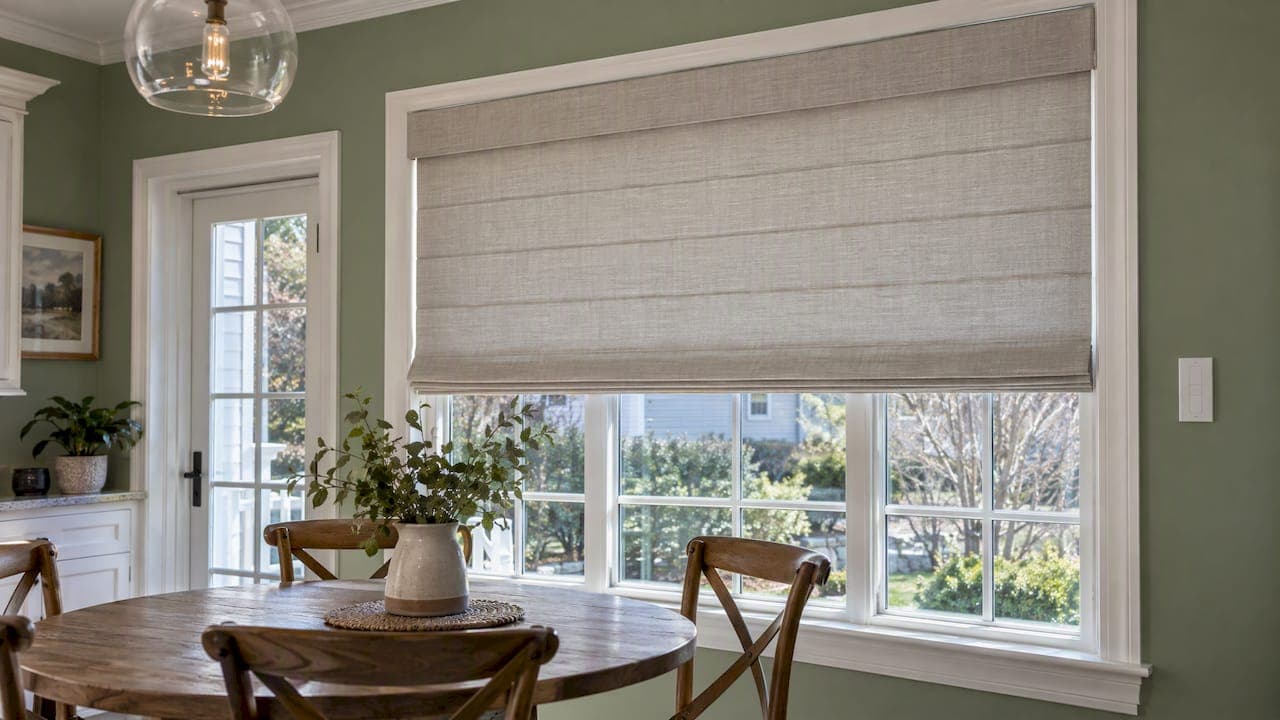
Motorized shades in New Jersey typically cost somewhere between $300 and $1,800 per window installed, according to 2026 industry estimates. Many homeowners land between $600 and $900 per window for a custom-fit, mid-range shade with professional installation. The spread is wide because the motor, the fabric, the window size and the way the shade is powered all change the quote.
This guide explains each of those pieces so you can read a quote line by line. It also covers where hardwiring turns a simple job into an expensive one, what smart-home control adds, and where the savings are.
TL;DR
- Expect roughly $300 to $1,800 per window for installed motorized shades, with $600 to $900 common for a mid-range custom shade (2026 industry estimates).
- Power source is the biggest swing. Battery or rechargeable motors keep installation simple. Hardwiring in a finished home can add a lot of labor.
- Wide windows (72 inches and up) can raise the per-shade price by 40% to 80%.
- Ask for cordless, child-safe lift on every custom order, motorized or not.
- Made in the Shade Bucks County gives free in-home consultations in Bucks County, PA and Mercer County, NJ, so you see samples and a written quote in your own rooms.
Table of Contents
- What motorized shades cost per window in 2026
- The five things that set your price
- Example budgets for a New Jersey home
- Do motorized shades pay for themselves?
- Safety: cordless is part of the price conversation
- Where to save without cutting corners
- Our perspective
- Get a measured quote in your home
- FAQ
- Sources
What motorized shades cost per window in 2026
Published cost guides do not agree to the dollar, and that is normal. One recent guide puts typical installed cost at $300 to $1,200 per window, with custom sizes, premium fabrics and smart features pushing it past $1,500. Another puts whole motorized shade projects between $800 and $6,000. These are national figures, not New Jersey quotes, so treat them as a range for planning, not a price list.
The same source breaks the per-shade numbers down by style:
| Item | Typical figure (2026 estimates) |
|---|---|
| Motorized roller shade | $150 to $350 per shade |
| Cellular (honeycomb) shade | $250 to $600 per shade |
| Premium collections | $500 to $1,200 per shade |
| Professional labor | $75 to $250 per shade |
| Four-window living space | $1,200 to $7,200 total |
| 15 to 20 windows | $6,000 to $15,000 total |
Figures from Danbury Renovation's 2026 cost guide. They are industry estimates, not Made in the Shade Bucks County pricing.
Made in the Shade Bucks County does not publish a price list, because every shade is custom-sized and priced to the window. The way to get a real number is a measured quote, which is what the free in-home consultation produces.

The five things that set your price
1. Battery, rechargeable or hardwired
Home renovation cost writers call the choice between battery and hardwired motors the biggest variable in cost and long-term convenience. Battery-powered shades need no electrician. Hardwired motors suit windows you open and close daily, but they need power planned at the window.
The labor gap is where budgets surprise people. Retrofitting hardwired shades in an existing house means fishing wire through finished walls, which is slow, can damage drywall and can roughly double the cost compared with new construction. That matters in the Mercer County and Bucks County housing mix of older colonials, mid-century splits and established twin and Cape Cod homes, where walls are already closed up. In a house like that, battery or rechargeable shades are usually the practical choice. Hardwiring makes the most sense in a renovation or new build, when the walls are open anyway.
Batteries are not a hidden cost trap. Most battery motors run 6 to 12 months between charges, depending on use. Our guide to motorized shade batteries and runtimes explains how to plan for that.

2. Window width and height
Size drives price more than most people expect. Wide windows of 72 inches or more often need heavier-duty motors and custom fabric cuts, which can add 40% to 80% per shade compared with standard openings. Picture windows, bay windows and sliding doors fall in this group, so a family room with a wall of glass will cost noticeably more per opening than a bedroom with two standard double-hung windows.
For wide sliding doors, you can compare options in our piece on sliding door window treatments.
3. Shade style and fabric
A basic roller is the least expensive entry point. Cellular shades cost more but earn it in energy performance (more on that below). Roman shades, sheers, layered looks and woven woods are priced by fabric and construction. You can browse the styles Made in the Shade Bucks County supplies on the window shades page, and drapery that can be motorized is covered on the drapery page.
Blackout fabrics, light-filtering fabrics and solar screens all behave differently and are priced differently. Choose by room: blackout for bedrooms and nurseries, light-filtering for living areas, solar screens where glare hits a screen or television.
4. Smart-home control
A remote is usually included with a motorized shade. App and voice control normally require a bridge or hub, or a Matter-compatible setup. Made in the Shade Bucks County specializes in motorized shades that work with Alexa and other major platforms. Our overview of smart shade integration, Matter or a hub lays out the two paths.
Basic battery shades are straightforward to install. Installers typically spend 30 to 60 minutes mounting and testing one on an accessible window. Smart integration adds bridge setup and programming time, and complex whole-home systems can add $500 to $1,500 in programming. Most homes that simply want Alexa voice control and schedules sit far from that high end.
5. How many windows you do at once
Installers often charge a flat fee per window or a project minimum. That makes it more cost-effective to order several shades together, and experts advise bundling window treatments into one project to lower per-window labor. If you plan to motorize your whole main floor eventually, quote it all at once, then phase the install if the budget needs it.
Example budgets for a New Jersey home
The numbers below apply the 2026 estimates above to common situations. They are illustrations, not quotes.
- Two bedrooms, four standard windows, battery power, mid-range fabric. At $600 to $900 per window, the planning range is $2,400 to $3,600.
- Living room with a 6-foot-plus picture window. Expect that one opening to cost 40% to 80% more than a standard window of the same style.
- Hard-to-reach high windows over a stairwell. These are the best case for motorization, since you stop using a ladder. Price them as individual openings, since access and size both matter.
- A full first floor of 15 to 20 windows. Industry estimates run $6,000 to $15,000, and the bundled install is where the per-window labor savings come from.
A useful rule: set your budget by room priority. Start with the windows you operate most, the ones with the worst glare, and the ones that are hard to reach.
Do motorized shades pay for themselves?
Motorized shades are mostly a convenience and safety purchase, but the right style can earn some money back. The U.S. Department of Energy says well-fitted cellular shades can cut heating energy use by up to 20% compared with no window covering. Motorization helps because shades actually get closed at dusk and opened for winter sun, on a schedule, instead of when someone remembers.
New Jersey has hot, humid summers and cold winters, so there is a use in both seasons: close shades on south and west windows during summer afternoons, then open them on winter mornings to let in free heat. Look for the AERC label, a third-party energy rating for window attachments, when comparing products on energy claims. Our energy-saving window treatments page covers the options in more detail, and our motorized shade benefits guide explains how automation supports savings.
We will not promise a dollar figure of savings for your home. It depends on your windows, your orientation and how you live.
Safety: cordless is part of the price conversation
Motorized shades have no pull cords, which is a real advantage in homes with small children. The U.S. Consumer Product Safety Commission cites more than 230 strangulation-related incidents involving window covering cords since 2009 and says cordless is the safest option. Stock products are now largely cordless, but custom orders can still come with cords, so the CPSC advises you to specify cordless when you order.
If you are choosing between motorized and manual cordless lift for a nursery or playroom, ask for both quotes. Our child safety options page lists the cordless lift choices.
Where to save without cutting corners
- Use battery or rechargeable motors in finished rooms instead of hardwiring.
- Motorize selectively. Put motors on large, high or frequently used windows and keep manual cordless shades on small ones.
- Bundle the order so labor and minimums are spread across more windows.
- Skip the complex hub if voice control through Alexa or a Matter setup is all you want.
- Match fabric to room. Premium collections belong where you will notice them most.
Outdoor spaces follow similar logic. If you are planning a covered porch or deck, our guide to outdoor shade budgets in New Jersey shows size examples.
Our perspective
We bring the showroom to your home, and that changes how a price conversation goes. Fabric looks different on your window at 4 p.m. than under store lights, and a measured quote on your actual openings beats a calculator range every time.
What we see homeowners get wrong most often is power. They assume everything must be wired, or they assume batteries are a hassle. The honest answer is in between: batteries or rechargeable motors suit most retrofits, and wiring is worth planning only when a wall is open. We also bring up cordless, child-safe lift at the start, not the end, because on custom orders it has to be requested.
Our team measures every window and installs every shade, and most manufacturer warranties on what we sell include limited lifetime coverage. We will tell you when a manual cordless shade is the better buy for a particular window.
— Tony
Get a measured quote in your home
Made in the Shade Bucks County serves homeowners, realtors and commercial clients in Bucks County, PA and Mercer County, NJ. A personal design consultant brings sample collections to your home, helps you choose between battery and hardwired motors and smart-home options, and measures your windows. Our measuring and installation services cover the whole job, from measurement to the final test of each shade.
If you want to see how pricing works in more detail first, read how motorized shade quotes are built or what raises a quote in Bucks County.
FAQ
How much does it cost to have motorized blinds installed?
Industry estimates for 2026 run from $300 to $1,800 per window, with $600 to $900 common for mid-range custom shades. Professional labor alone is estimated at $75 to $250 per shade. Your exact figure depends on window size, fabric and power source.
Are motorized shades worth it?
They are worth it when you have hard-to-reach windows, children at home, or want scheduled shading for comfort. Cellular styles can also help with heating, as the Department of Energy notes. For small, easy windows, manual cordless shades may be the better value.
Are motorized blinds expensive?
They cost more than manual versions, and wide windows and hardwiring raise the price further. Battery-powered shades keep installation simple and avoid electrician and wall work. Ordering several at once also lowers the labor per window.
Do motorized shades work with Alexa?
Many do. Made in the Shade Bucks County specializes in motorized shades that work with Alexa and other major platforms, usually through a bridge, hub or Matter setup. Your consultant can confirm what fits your home during the visit.
Sources
- How Much Do Motorized Shades Cost? 2026, Danbury Renovation
- Motorized Window Shades Installation Cost in 2026, Cost to Renovate
- Interior Cellular Shades Boost Home Energy Performance, U.S. Department of Energy
- Hunter Douglas Receives First-Ever Energy Performance Rating for Window Attachments, U.S. Department of Energy
- Prevent Child Strangulation: Go Cordless with Window Coverings, CPSC
- Window Covering Cords, CPSC