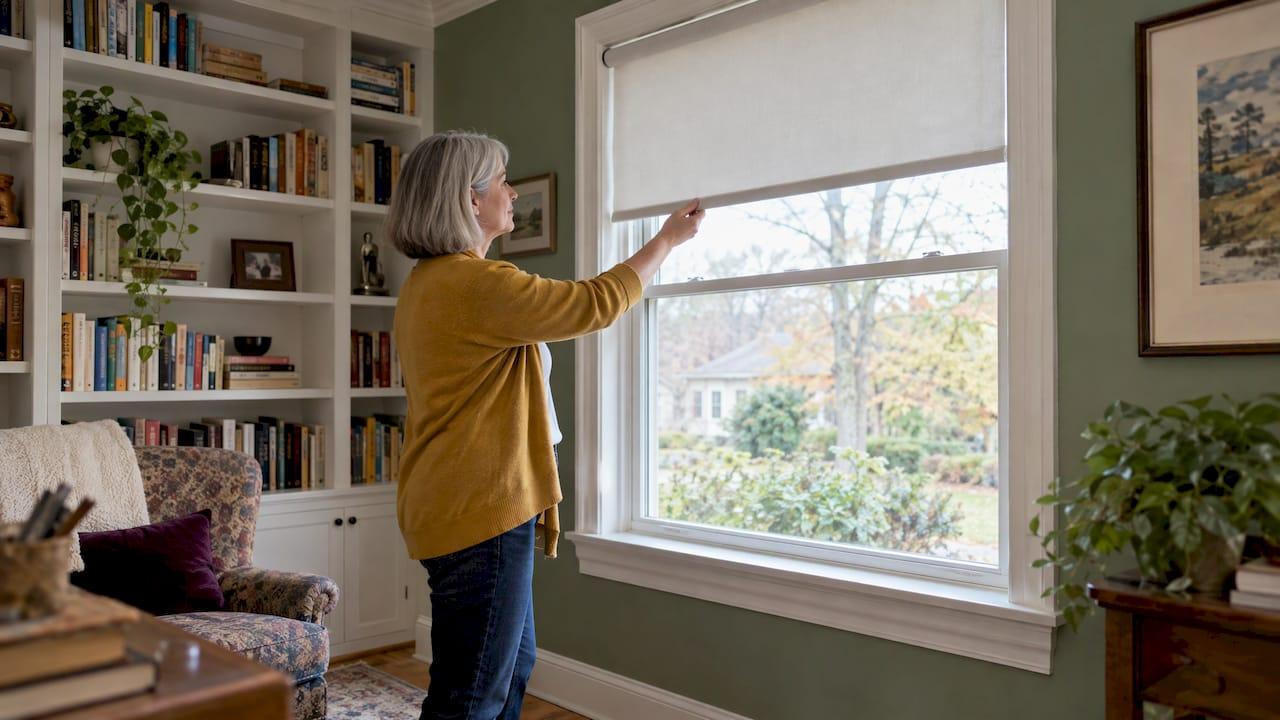
A roller shade is a single piece of fabric that winds around a tube at the top of the window. It is the simplest custom shade there is, and the right fabric, mount and lift system make it work well in nearly any room. For Bucks County and Mercer County homes, the choices that matter are how much light the fabric lets in, how the shade fits the window, and how it lifts, especially if children live in the house. Made in the Shade Bucks County brings sample collections to your home, so you can judge fabrics against your own windows and light, at no cost.
TL;DR
- A roller shade is one flat panel of fabric on a roller tube. It has clean lines and takes little wall or window space.
- Light filtering fabrics soften sun and keep daylight and privacy by day. Blackout fabrics block nearly all light. Solar fabrics cut glare and heat while preserving the view.
- Custom window coverings made after May 30, 2023 must meet federal cord-safety rules. Cordless and motorized roller shades are the simplest way to meet them.
- Accurate measuring and a choice between inside and outside mount decide how the shade looks and how well it blocks light.
- Motorized roller shades can work with Alexa and other major smart-home platforms.
Table of Contents
- What roller shades are and how they work
- The three fabric families: light filtering, blackout and solar
- What roller shades do well, and how to get the most from them
- Energy savings in a Pennsylvania and New Jersey climate
- Child safety: what the federal rule requires
- Motorized and smart roller shades
- How to choose roller shades for each room
- Measuring and mounting
- Care and cleaning
- Perspective
- Bring roller shades to your windows
- FAQ
- Sources
What roller shades are and how they work
A roller shade is a flat sheet of fabric attached to a tube. When you lower the shade, the fabric unrolls over the glass. When you raise it, the fabric winds back onto the tube and sits in a slim roll at the top of the window. There are no slats, folds or pleats, so a closed shade looks like a smooth, quiet panel.
The lift can be a continuous loop, a spring, a cordless system, or a motor. The fabric, not the mechanism, sets how the shade treats light, so most of your decision is about fabric and fit.
That simplicity is why roller shades suit so many homes around the Philadelphia suburbs. They look right in a 1920s Doylestown twin with original double-hung windows, a Newtown colonial, a Yardley townhome, or a newer Hamilton Township build with wide picture windows. The shade can disappear into the window frame or become a clean, modern accent.
The three fabric families: light filtering, blackout and solar
Most roller shade questions come down to this choice. Here is how the families compare.
| Fabric | What it does | Best rooms |
|---|---|---|
| Light filtering | Diffuses daylight, softens glare, gives daytime privacy | Living rooms, kitchens, home offices, dining rooms |
| Blackout | Blocks nearly all light for sleep and screens | Bedrooms, nurseries, media rooms, shift workers' rooms |
| Solar | Cuts glare and heat while keeping the view | Sunroom, south and west windows, sliding doors |
Light filtering roller shades
Light filtering is the most searched fabric type, and for good reason. The fabric lets daylight pass through while scattering it, so a room stays bright without hot spots on floors and furniture. By day, you get privacy from the street because people outside see the shade, not into the room. After dark with lights on, silhouettes can show through, so bedrooms and bathrooms often pair filtering with a second layer or choose a different fabric.
Filtering fabrics come in a range of colors and textures. Lighter colors give a glowing, airy look. Deeper colors cut more light and glare.
Blackout roller shades
Blackout fabric is made to stop light from passing through. It is the usual choice for bedrooms, nurseries and any room where you sleep when the sun is up. Light can still slip around the edges of the shade, so the mount and the width matter. An outside mount that overlaps the frame covers more of that gap than an inside mount.
Solar roller shades
Solar shades are woven to reduce glare and solar heat while keeping a view of the yard or street. The key number is the openness percentage: a lower percentage blocks more light and heat, and a higher one keeps more view and brightness. Our solar shade percentages room guide explains how to match a percentage to each room.

Combining layers
You do not have to choose only one. Some homeowners put a light filtering shade and a blackout shade on the same window, or pair a roller shade with drapery. See our guide to layering window treatments for how that works.
What roller shades do well, and how to get the most from them
Clean look. One flat panel, no slats to dust or tilt. They suit modern, transitional and traditional rooms alike.
Privacy and light control. Pick the fabric for the room, and the shade does the same job every day. Raise it halfway to bring daylight in at the top of the window while keeping the lower half private.
Easy upkeep. Fabric roller shades can be dusted or vacuumed with care to avoid excess moisture, and vinyl roller shades can be wiped with a damp cloth, according to Prudent Reviews. Without slats or folds, there is very little surface to clean.
Compact stack. The rolled shade takes little room at the top of the window, which helps where trim is shallow or where you want the glass mostly clear when open.
Pairing with other treatments. Roller shades work well under drapery or valances when you want both function and softness. Wide spans, such as big sliders and picture windows, can use a vertical-style or layered approach; we cover that in sliding door window treatments.

Energy savings in a Pennsylvania and New Jersey climate
Our summers are humid and sunny, and our winters are cold. Roller shades help most with the sun. According to efficientwindowcoverings.org, roller shades can reduce solar heat gain by 20% to 60% in cooling conditions, depending on fabric color and openness. That makes fabric choice on south and west windows a practical decision, not only a style one.
For a broader look at how window coverings fit into a home's energy picture, see our pages on energy saving window treatments and energy efficient options. Window coverings are one part of the system; the roof is another, and this overview of energy efficiency for shingle roofs shows how the two work together to keep a house comfortable.
Child safety: what the federal rule requires
If you have children, or grandchildren who visit, the lift system matters as much as the fabric. Pull cords and continuous loops have been a strangulation hazard. The Consumer Product Safety Commission (CPSC) identified 209 reported fatal or near-miss incidents among children eight and younger between January 2009 and December 2021, 100 of them fatal.
In response, a federal rule now covers custom window coverings made after May 30, 2023. They must meet the stock-product cord-safety requirements: no operating cords, inaccessible cords, or cords no longer than 8 inches in any position, as set out in the Federal Register rule.
The industry standard, ANSI/WCMA A100.1-2022, covers roller shades and adds details:
- Cordless products, including motorized ones, must have no operating cords.
- Custom continuous-loop systems must include a tension device, a loop restraining device, or a rigid cord shroud.
- Battery-powered remote controls must meet the requirements in 15 USC 2056e, which are meant to reduce the risk of button or coin-cell batteries being swallowed by children 6 or younger.
In practice, ask for a cordless or motorized lift for any room a child uses, and keep the remote out of small hands. Made in the Shade Bucks County offers cordless, child-safe lift options, and we explain them on our child safety options page and in our cordless blinds safety guide. You can also browse our cordless and child-safe window treatments.
Motorized and smart roller shades
Roller shades are among the best candidates for motorization. The shade travels straight up and down, so a motor lifts it smoothly without a cord. Made in the Shade Bucks County specializes in motorized and smart-home-compatible shades that work with Alexa and other major platforms.
Motorization is worth considering when:
- Windows are tall or hard to reach. Stairwell windows, two-story foyers and high transoms are easier with a remote or a voice command.
- A child-safe home is a priority. There is no cord to reach, and a motor removes the loop entirely.
- You want schedules. Shades can lower on a summer afternoon to cut glare and rise in the morning without anyone touching them.
- Rooms are large. A bank of shades on a wall of windows can move together.
Before you choose, decide which voice assistant or smart-home platform you already use, and whether you want battery or hard-wired power. Your consultant can talk through both options with you in the room, standing at the actual window. Any remote that uses a button or coin cell should be stored out of reach of young children, in line with the standard above.
How to choose roller shades for each room
- Start with what the room does. A bedroom needs darkness. A kitchen needs daylight and easy cleaning. A home office needs glare control for screens. A family room often needs both.
- Match fabric to exposure. South and west windows take the hottest sun in the afternoon, so a lower openness solar or filtering fabric helps. North windows usually benefit from fabrics that keep as much daylight as possible.
- Think about privacy at night. If a window faces a neighbor or the street, light filtering alone may not be enough after dark. A blackout shade or a second layer solves it.
- Choose the lift. Cordless or motorized in rooms where children sleep or play. Motorized for hard-to-reach or large windows.
- Pick color and texture. Light colors brighten and widen a room. Mid-tones hide the faint marks that show on white. Dark fabrics cut glare, which suits media rooms and offices.
- Plan for layers. If you want softness, add drapery. If you want sleep-ready darkness plus daytime light, pair two shades.
First-time homeowners often ask about budget. Custom roller shades are priced by size, fabric and lift, and pricing is quoted after we measure, so we do not publish a figure here. A free in-home consultation gives you a quote based on your actual windows and the product you choose.
Measuring and mounting
Mounting is the choice that most affects the final look.
Inside mount. The shade sits within the window frame. It looks tidy and shows off the trim. It needs enough frame depth for the shade hardware, and the window needs to be reasonably square. Small gaps at the sides are normal, so for full darkness, an outside mount may suit better.
Outside mount. The shade is mounted on the wall or trim above the window and extends past the frame. It covers more of the opening, blocks more light at the edges, and can make a window look taller and wider. It is a good answer for shallow frames or windows with cranks and handles that would block an inside mount.
What goes wrong when you measure on your own:
- Windows are rarely perfectly square, especially in older Bucks County homes where settling over decades shifts the frame. Measurements need to be taken at several points.
- Depth is easy to overlook. A frame that looks deep enough may not clear a window crank or a lock.
- Custom shades are made to your numbers, so a small error becomes a shade that does not fit.
This is why we handle it. Every project at Made in the Shade Bucks County is measured and installed by trained professionals, so the shade is built to your windows and mounted level and secure. Our products carry manufacturer warranties, most with limited lifetime coverage.
Care and cleaning
Roller shades are easy to keep clean. Dust the fabric regularly with a soft brush or vacuum attachment on low. For fabric, avoid excess moisture; vinyl shades can be wiped with a damp cloth, per Prudent Reviews. Roll the shade fully up and down occasionally to make sure it moves smoothly, and check that nothing in the window is catching the fabric edge.
Perspective
Most people who call us expect to pick a color. What they actually end up deciding is how a room feels at different hours: bright at breakfast, calm in the afternoon, dark at bedtime.
That is why we bring samples to you. A fabric looks different in a sunlit Newtown kitchen than it does on a screen or a store shelf. You hold it against your own window and your own walls, and see how it handles your light.
We also think roller shades are one of the best places to start with cordless and motorized lifts. The shade is a clean panel, the motion is simple, and a family with small children gets a safe answer without compromising the look. Add Alexa or another smart-home platform, and the shades work on their own schedule.
Measuring and installation are part of the job, handled by trained professionals, because a well-made shade only looks right if it fits right.
Tony
Bring roller shades to your windows
Made in the Shade Bucks County serves homeowners, realtors and commercial clients throughout Bucks County, PA and Mercer County, NJ. We bring the showroom to you, with a personal design consultant, sample collections and measuring, and the consultation is free. Explore our window shades, or read about our commercial window treatments if you manage a property.
If you are comparing options, our window blinds and shutters are on hand at the same consultation.
FAQ
What are roller shades?
A roller shade is one panel of fabric that winds around a tube at the top of a window. You lower it to cover the glass and raise it to roll the fabric up. The fabric you choose sets whether it filters light, blocks it, or cuts glare.
What is the difference between light filtering and blackout roller shades?
Light filtering fabric lets in softened daylight and gives privacy during the day. Blackout fabric is made to block nearly all light, which makes it the usual choice for bedrooms and nurseries. For edge-to-edge darkness, an outside mount that overlaps the frame helps.
Are roller shades safe for homes with children?
Custom window coverings made after May 30, 2023 must meet the federal cord-safety rule, which calls for no operating cords, inaccessible cords, or cords no longer than 8 inches. Cordless and motorized roller shades are the simplest way to meet it. Keep any remote with a button or coin-cell battery out of reach of young children.
Can roller shades be motorized?
Yes. Made in the Shade Bucks County offers motorized and smart-home-compatible shades that work with Alexa and other major platforms. Your consultant can walk through power and control options at your windows.
Do roller shades help with energy costs?
They can reduce solar heat gain by 20% to 60% in cooling conditions, depending on fabric color and openness, according to efficientwindowcoverings.org. Fabric choice on sun-facing windows matters most.
Sources
- Cellular vs. Roller Shades: 7 Differences & How to Choose, Prudent Reviews
- Interior roller shades, efficientwindowcoverings.org
- Safety Standard for Operating Cords on Custom Window Coverings, Federal Register
- ANSI/WCMA A100.1-2022 Standard for Safety of Window Covering Products
- Energy Efficiency for Shingle Roofs
Ready to see roller shades against your own windows? Request your free in-home consultation and we will bring the samples to you.