Which window treatments work best for sliding doors?
Sliding doors are not standard windows, and treating them like one is where most homeowners go wrong. The best sliding door window treatments move with the door, clear the handle, and span widths that can hit 12 feet or more. Here are the top options:
- Vertical blinds: The classic choice. Vanes rotate for light control and stack neatly to one side when the door opens.
- Panel track blinds: Wide fabric panels that glide on a track, ideal for contemporary interiors and oversized openings.
- Cellular (honeycomb) shades: Vertical-operating versions like Vertiglide offer superior energy efficiency with their honeycomb construction, especially in climates with extreme heat or cold.
- Drapery: Floor-to-ceiling panels create a dramatic, layered look. Work best on doors used less frequently.
- Plantation shutters: Durable and timeless, with bifold configurations that clear the opening cleanly.
What separates these from generic window coverings is their ability to accommodate the sliding motion without snagging on hardware or blocking the door's path.
Table of Contents
- Popular styles and materials for sliding door coverings
- Functional considerations that actually matter for sliding glass doors
- How your door's traffic patterns should drive your treatment choice
- Why professional measurement and installation make or break sliding door treatments
- Child and pet safety considerations for sliding door treatments
- Compatibility with sliding door hardware and space requirements
- Custom sliding door treatments, measured and installed for you
- Key Takeaways
Popular styles and materials for sliding door coverings
Sliding doors are typically the largest window in a room, which means their treatments carry real design weight. Choosing the right style is as much about the room's atmosphere as it is about function.
Vertical blinds remain the most practical choice for high-traffic doors. Modern versions come in fabric, faux wood, and PVC, with textures that read as soft furnishings rather than office fixtures. Fabric vanes in linen or sheer weaves diffuse light beautifully while maintaining privacy.
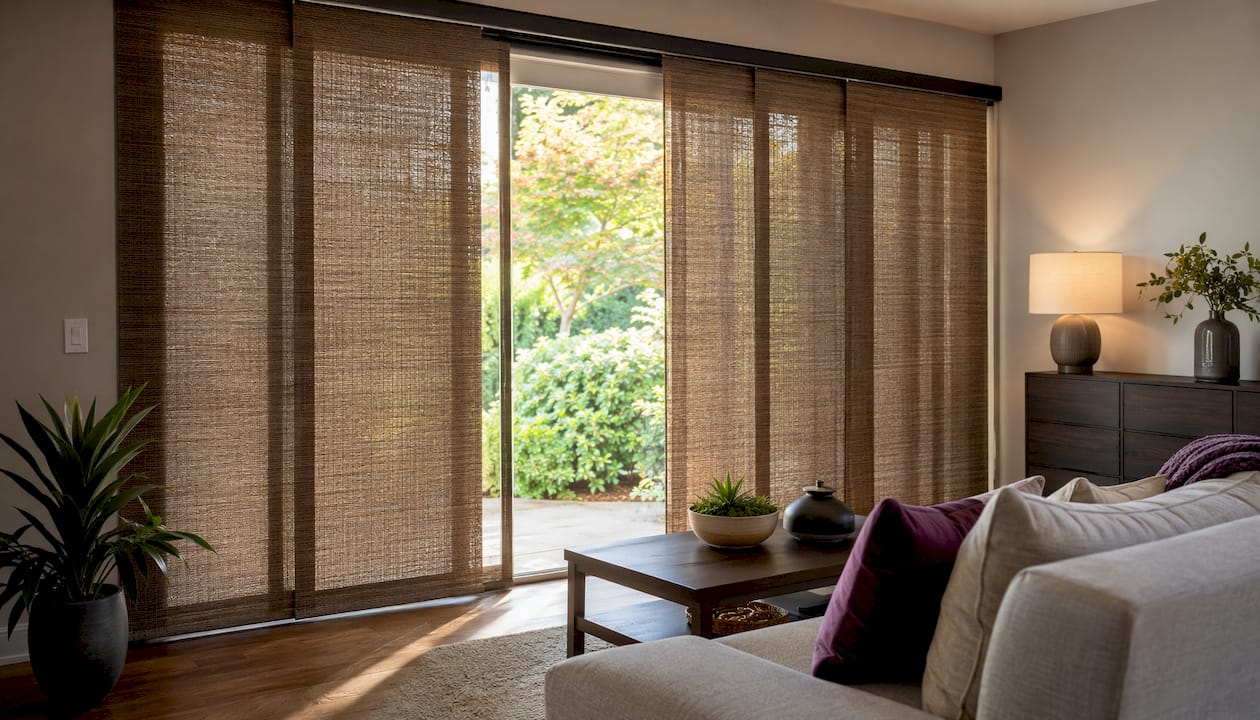
Panel track systems suit open-plan spaces where the door is part of a larger wall of glass. Panels in woven wood, solar screen, or solid fabric slide independently on a track, giving you precise light control across the full width.
Cellular shades in a vertical configuration bring a clean, tailored look. The honeycomb cells trap air, which matters for rooms that face west or back onto a patio exposed to afternoon sun.
Drapery is the most flexible style option. Linen, velvet, and cotton blends all work, and coordinating fabric color and texture with adjacent windows creates a cohesive room rather than a mismatched one. Avoid matching the mechanical style of nearby blinds or shades — the operational differences make that approach look forced.
- Sheer fabrics: soft privacy, maximum natural light
- Blackout liners: full privacy, strong insulation
- Woven wood: warm, organic texture for casual or coastal interiors
- Faux wood: moisture-resistant, ideal for doors near pools or kitchens
Pro Tip: Treat your sliding door as a design statement, not just a functional covering. Designers consistently note that the treatment should frame the view and enhance the room's atmosphere, not simply block it.
Functional considerations that actually matter for sliding glass doors
Privacy and light control are the obvious concerns, but sliding doors introduce a few challenges that standard windows do not.
Handle clearance is the most common cause of treatment failure. Standard bracket depths can cause snagging or binding when the hardware projection is not accounted for in the measurement. A treatment that looks perfect in a showroom can bind against the handle on day one.
Insulation is where cellular shades earn their price. The honeycomb structure creates a thermal barrier that reduces heat transfer through the glass, cutting heating and cooling costs in rooms with large glass exposures. For doors facing south or west, this is not a minor detail.
Durability matters more on a door than on a fixed window. Treatments on high-traffic sliding doors get touched, pulled, and bumped daily. Vertical blinds and shutters handle this well; delicate roman shades do not.
- Privacy: look for treatments with full-width coverage and no center gap
- Light control: layered options (sheer plus blackout) give the most flexibility
- Insulation: cellular and honeycomb constructions outperform standard fabrics
- Durability: PVC, faux wood, and aluminum hold up to daily contact
- Cleaning: most vertical blinds and panel tracks wipe clean with a damp cloth; fabric panels may need spot cleaning or occasional dry cleaning
Pro Tip: For doors that face a bright exposure, consider a motorized treatment that adjusts with a remote or smart home app. You get precise light control without touching the fabric repeatedly, which extends its life significantly.
How your door's traffic patterns should drive your treatment choice
High-traffic doors need durable, easy-slide options like sliding panels or vertical blinds. A door the family uses a dozen times a day to reach the backyard is a completely different problem than a door that opens twice a week onto a formal terrace.

For busy entry points, the treatment needs to move fast and stay out of the way. Vertical blinds stack to one side in seconds. Panel tracks glide smoothly and hold their shape. Both handle daily use without warping, fraying, or losing their alignment.
Less-used doors open up more options. Drapery, roman shades, and woven wood panels all work well when the door is primarily a view and a light source rather than a constant exit point. You can prioritize aesthetics and insulation over speed of operation.
- Daily family traffic: vertical blinds, panel tracks, or shutters
- Occasional use: drapery, cellular shades, woven wood panels
- Formal or decorative doors: floor-to-ceiling drapes with a fixed side panel
- Pet and child households: cordless or motorized options to eliminate cord hazards
Pro Tip: Coordinate fabric color and texture with adjacent windows rather than matching the mechanical style. A linen drapery panel next to a linen roller shade reads as intentional; a vertical blind next to a horizontal blind just looks like two different rooms.
Why professional measurement and installation make or break sliding door treatments
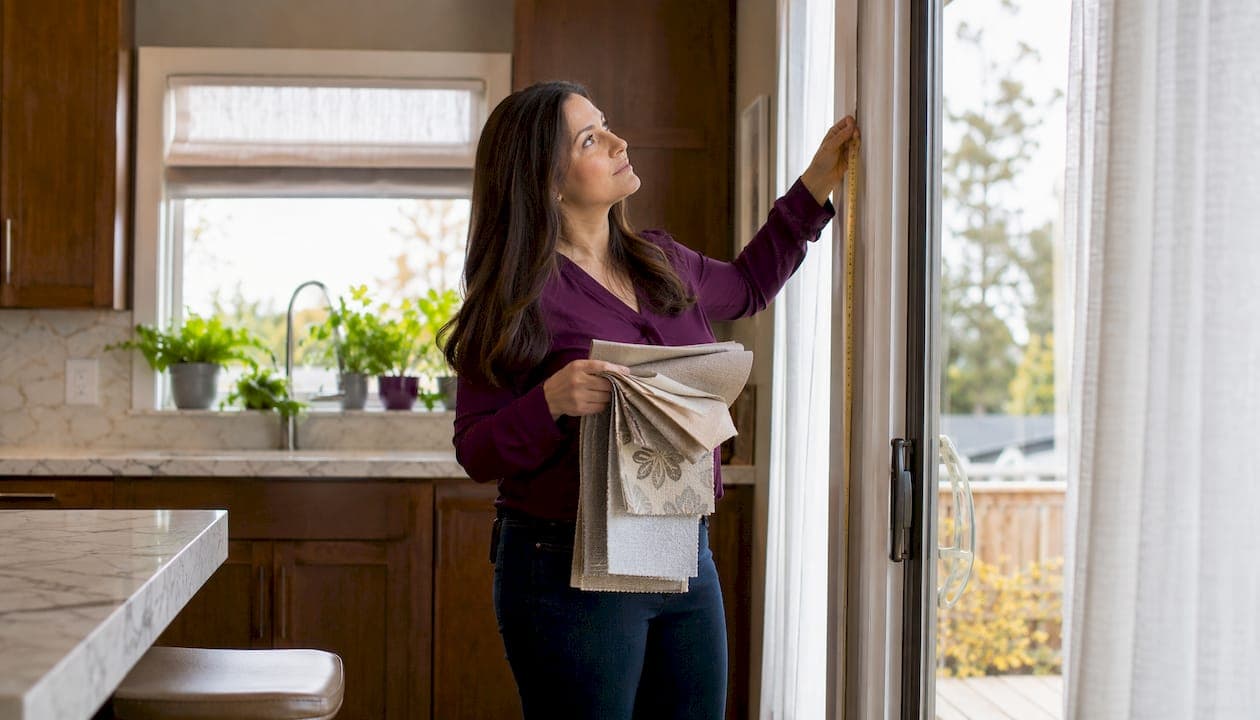
Precise trim-to-trim measurement is not optional for sliding doors. The handle projection, the track depth, and the door's travel path all affect which treatments fit and how they operate. A professional measures all three before recommending anything.
Professional in-home consultation is the standard approach for sliding doors precisely because the variables are so specific to each installation. Bracket placement, fabric weight, and vane width all interact in ways that are hard to assess from a product page.
- Accurate handle clearance measurement prevents snagging and binding
- Custom sizing eliminates gaps at the edges that compromise privacy and insulation
- Professional installation preserves manufacturer warranty eligibility
- Expert design guidance matches treatment to door mechanics, not just aesthetics
- Bundled service means one point of contact for measurement, product selection, and fitting
Expert standard: Professional installation is the recognized best practice for sliding glass door treatments, where handle projection and track geometry require on-site assessment before any product is specified.
Child and pet safety considerations for sliding door treatments
Cords are the primary hazard. Traditional corded blinds and shades create a strangulation risk for young children and a chewing target for pets. Motorized and cordless options eliminate this entirely, and they are now available across most treatment categories including vertical blinds, cellular shades, and panel tracks.
For pets that push against or paw at treatments, durability of the bottom rail and vane material matters. PVC and aluminum vertical blinds withstand contact far better than fabric. Shutters are the most pet-resistant option overall, since the louvers are rigid and the frame is fixed.
Cordless lift systems and motorized controls are the practical solution for most households with children or pets. The window motorization options available through professional installers include battery-powered and hardwired systems that work with voice assistants and smart home platforms.
Compatibility with sliding door hardware and space requirements
Track systems, door handles, and frame depth all constrain what fits. A treatment mounted inside the frame must clear the handle without binding. One mounted outside the frame needs enough wall space on the stack side to hold the panels when the door is open.
Panel track systems require ceiling or wall space for the track itself, typically 3–4 inches of depth. Vertical blinds need a headrail that clears the door frame and handle. Shutters require a frame that fits within the door's jamb depth, which varies by door manufacturer.
Before selecting any treatment, measure the handle projection from the door face, the available stack space on the open side, and the headrail clearance above the door frame. These three numbers determine which treatments are physically possible in your opening, and skipping any one of them is how you end up with a return.
Custom sliding door treatments, measured and installed for you
Choosing the right treatment for a sliding glass door is straightforward once you know the measurements and the traffic patterns. Getting those details right without professional help is where most buyers run into trouble.
Mitsbuckscounty brings the entire selection process to your home. A design consultant arrives with sample collections from industry-leading brands, measures your door's handle projection and track geometry on the spot, and recommends treatments that fit your door's mechanics and your room's style. Every installation comes with manufacturer warranty coverage, and there is no guesswork about whether the treatment will clear the handle or stack properly.
If you are ready to stop second-guessing measurements and start seeing real options in your own space, schedule a free in-home consultation with Mitsbuckscounty. You can also browse layering options for sliding doors on the website before your appointment.
Key Takeaways
The most effective sliding door window treatments combine handle-clearance precision, traffic-appropriate durability, and energy-efficient materials, with professional measurement as the non-negotiable foundation.
| Point | Details |
|---|---|
| Treatment type drives function | Vertical blinds and panel tracks suit high-traffic doors; drapery and cellular shades work best for occasional-use doors. |
| Handle clearance is critical | Standard bracket depths often cause snagging; precise measurement of hardware projection prevents binding and treatment failure. |
| Energy efficiency is material-dependent | Cellular honeycomb shades create a thermal barrier that reduces heat transfer through large glass exposures. |
| Safety requires cordless or motorized options | Motorized and cordless treatments eliminate cord hazards for children and pets across all major treatment categories. |
| Mitsbuckscounty | Offers free in-home consultation, precise measurement, and professional installation with manufacturer warranty coverage for sliding door treatments. |