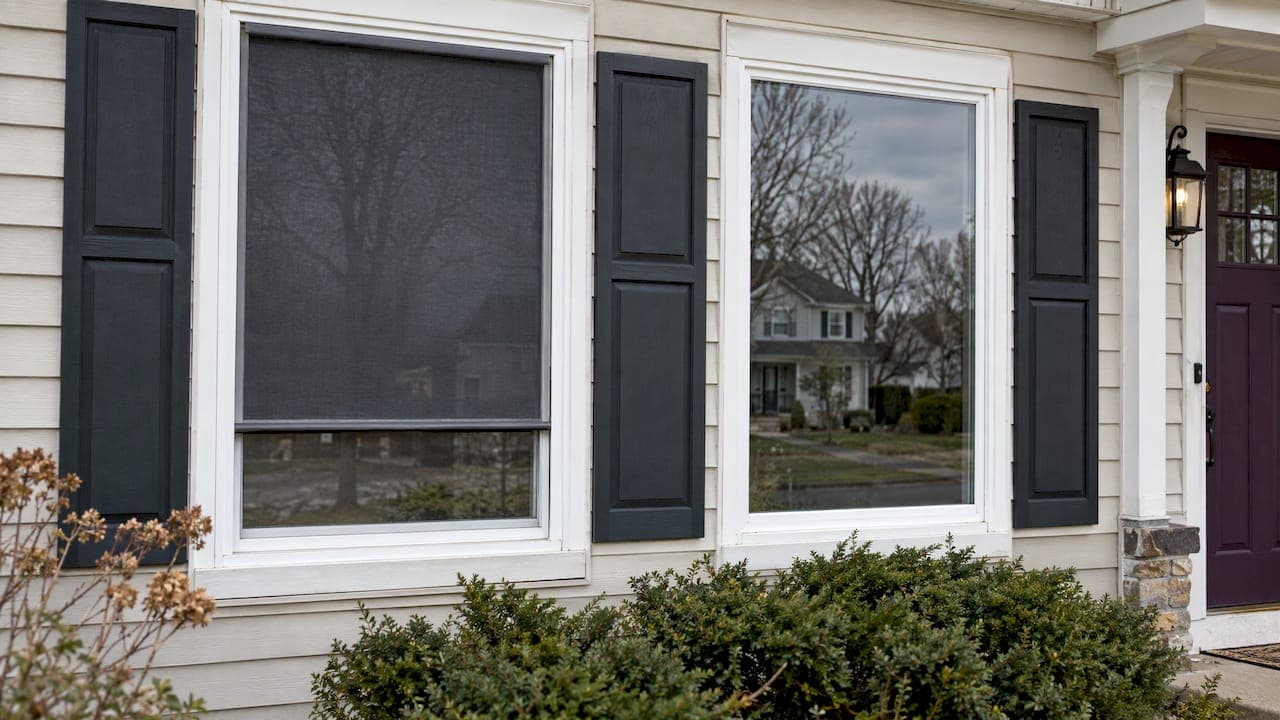
Solar screens usually do more to cool a sunny room because they stop the sun outside the glass, and you can take them down or raise them when you want winter sun. Window film is a permanent layer on the glass. It works in every season, whether you want that or not. Which one is right depends on the window, the direction it faces, and how much you value your view and your winter sunshine.
This guide compares the two on heat, glare, views, privacy, installation, upkeep and the risks that come with each. It also covers interior options such as blinds, cellular shades and curtains, because many homeowners end up weighing those too. We wrote it for homeowners in Bucks County, PA and Mercer County, NJ, where summers are hot and humid and winters are cold enough that giving up free solar heat has a real cost.
TL;DR
- Exterior solar screens block solar heat before it reaches the glass. The U.S. Department of Energy says exterior attachments are generally more effective at cutting cooling loads than interior ones.
- Window film stays on the glass all year. That helps in July and can cost you free passive heat in January, which matters in a heating-dominated climate like ours.
- Film is not right for every window. Low-E coatings, double panes, failed seals and the window maker's warranty all need checking before it goes on.
- Adjustable treatments, such as cellular shades, solar shades, shutters and awnings, let you choose sun or shade day by day.
- Not sure? A free in-home consultation with Made in the Shade Bucks County lets you compare real samples against your own windows.
Table of Contents
- What each option actually is
- Heat control: why location matters
- Side-by-side comparison
- Views, daylight and privacy
- What to check before putting film on your windows
- Cost: what to expect
- Other comparisons homeowners ask about
- Which one fits which window
- Our perspective
- See it on your own windows
- FAQ
- Sources
What each option actually is
Solar screens are tightly woven mesh panels or roller screens that sit outside the window. They absorb or reflect a share of the sun's energy before it touches the glass. The U.S. Department of Energy's Building America resource notes that exterior roller solar screens reduce heat and glare while keeping an outward view, and that because they are adjustable, you can raise them when the sun is not hitting the window.
Window film (often called tint) is a thin, adhesive-backed sheet applied to the glass. Films range from lightly tinted to reflective to nearly clear, and they work by reflecting or absorbing part of the sunlight passing through. The same federal guidance describes film as a retrofit that is not adjustable, may change the view, can reduce daylight, and has to be chosen to suit the existing window.
Interior shades, blinds and curtains sit inside the room. They are the most flexible and the most decorative, and they are where most homeowners start. They are also the least efficient at stopping heat, for a simple reason we will get to below.

Heat control: why location matters
The sun's heat has to get through the glass to warm your room. A treatment outside the glass intercepts that heat first. A treatment inside the glass lets the heat pass through the window, then tries to manage it in the room.
The Department of Energy puts it directly: exterior treatments such as solar screens and awnings are generally more effective at reducing cooling loads because they block solar radiation before it enters the glass. Film sits on the glass itself, so it falls between the two. It cuts the energy coming through, but the glass still absorbs part of what the film does not reflect.
Two practical points follow.
- Orientation decides the payoff. The same federal study ranks west-facing windows as the top priority for heat reduction, followed by south-facing windows. A treatment on a north-facing window will rarely earn back what it costs.
- Use matters as much as product. The same study found that how people actually operate adjustable attachments can have a large effect on energy performance. A shade you never close does nothing. Film does not depend on you remembering, which is its genuine advantage.
The winter tradeoff in our climate
Heat control is only half the year. Penn State's housing research center points out that in heating-dominated U.S. climates, some attachments, including heavy films, can raise total energy use by blocking beneficial passive solar heat in winter. Federal guidance likewise says film is generally most appropriate in warm-to-hot climates and can increase winter heating needs.
Bucks County and Mercer County sit squarely in the mixed zone. We want shade in August and sun on a February afternoon. A treatment that cannot change with the season gives up one of those. If you are weighing the wider picture of efficient, thoughtful home choices, these eco-friendly home design ideas are a reasonable companion read on balancing seasonal tradeoffs.
Side-by-side comparison
| Factor | Exterior solar screens | Window film | Interior shades and blinds |
|---|---|---|---|
| Where it works | Outside the glass | On the glass | Inside the room |
| Blocks heat before the glass | Yes | Partly | No |
| Adjustable by season or hour | Yes, can be raised or removed | No, always on | Yes |
| Outward view | Partly preserved | May be altered, reduces daylight | Open for view, closed for privacy |
| Glare control | Good | Good, with a darker look | Good, depends on fabric |
| Privacy | Limited, depends on weave and light | Daytime privacy with reflective films | Strong when closed |
| Winter solar gain | Can be raised to admit it | Reduced all year | Can be opened |
| Main risk | Reduced airflow when deployed | Glass compatibility and warranty | Lower heat-blocking value |
Views, daylight and privacy
This is where homeowners often change their minds after a first sample.
Solar screens let you see out while softening glare and heat. Federal guidance notes they preserve a partial outward view and can be lifted when the sun is not striking. They do reduce airflow while deployed and generally block less heat than a solid shading product.

Film is a permanent change to how the glass looks and how much daylight comes in. The same guidance says film may alter views and reduce daylight. Dark or mirrored films give daytime privacy, but the effect flips at night: with lights on inside, people outside can often see in. For night privacy you still need a covering inside.
Blinds and shades are the only option of the three that you can open fully for views and daylight or close fully for light blocking and privacy. Sheer shades can admit diffuse daylight while keeping a softened view. In many homes, privacy matters more than a clear view of the street, so a treatment that lets you pick is often worth more than a perfect view you cannot turn off.
If glare on a screen is your main complaint, for example in a home office, see our guide to glare-reducing window shades for home offices.
What to check before putting film on your windows
Film is not a stick-it-on-and-go product, and this is the part most comparison pages skip. Different window constructions react differently to the heat that film traps in the glass.
The International Window Film Association's guidance warns that heat-absorbing solar films can increase thermal stress risk in some window assemblies. Before film goes on, a careful assessment looks at:
- single, double or triple-pane construction
- Low-E coatings and where they sit in the glass
- clear or tinted glass, and whether it is annealed, heat-treated or laminated
- existing film already on the glass
- failed seals, cracks, chips or loose panes
- damaged frames or sills
If any of that is uncertain, use the film maker's guidelines and a qualified installer. The film industry association itself says scheduling a visit is likely the fastest way to see the expected benefits for your specific windows, and that you should ask whether your windows are suitable.
Warranty
Check your window manufacturer's warranty before anything is applied. Bob Vila reports that some window manufacturers may exclude damage caused by aftermarket film. That is a condition in certain warranties, not a rule for every window, but it is easy to check and expensive to learn about afterward. This is especially relevant to newer double-pane or Low-E windows that many homes in our suburbs have had replaced over the past two decades.
Installation quality
Consumer Reports notes that installation technique is critical to film performance and lifespan. Poor squeegeeing can leave bubbles, edge gaps or peeling. Film is also difficult to take off if you change your mind, so it is a decision to make carefully rather than quickly.
Cost: what to expect
Film, screens and shades are priced very differently, and prices vary with window size, glass type, the product tier and how many windows you do. We do not publish a price list, because custom window treatments are measured and quoted for your specific windows. What we can say is that you should compare quotes on a like-for-like basis: the same windows, the same orientation, installation included, and the warranty terms in writing.
Two things belong in any comparison beyond sticker price:
- Seasonal cost. A treatment that blocks winter sun may cost you in heating what it saves in cooling.
- Longevity and coverage. Ask what the warranty covers and for how long. Many of the manufacturer warranties on the products we install include limited lifetime coverage, and we explain exactly what applies to each product during the consultation.
Other comparisons homeowners ask about
Blinds or shades versus window film
Blinds and shades win on flexibility and on privacy. Film wins on being permanent and invisible to daily routine. Interior products do not stop heat at the glass, but good ones still help. A 2021 Department of Energy factsheet found that cellular shades saved up to 20% of heating energy and up to 15% of combined heating and cooling energy compared with no shades in its tested scenarios. They also filter glare and give privacy. That year-round benefit is hard for film to match in a climate with real winters.
For homeowners who want shade without losing the view, solar shades are worth looking at. The openness percentage controls how much light and view you keep, and our solar shade percentage guide explains how to choose by room.
Blackout curtains versus window film
Blackout curtains block light completely and help with sleep, but they do nothing about heat at the glass and they stay closed to work. Film cannot make a bedroom dark. If you want both daytime heat reduction and a dark room at night, layering is the usual answer: a heat-control layer plus a light-blocking layer. We cover this in our guide to layering window treatments.
Sheer curtains versus window film
Sheers soften daylight and add daytime privacy without darkening a room. They offer very little heat control. Film does more for heat, but cannot soften or dress a window. Sheers also pair well with heavier drapery for a layered look, which you can see in our drapery options.
Which one fits which window
Use these as starting points, not rules.
- West-facing living room with afternoon glare. Exterior treatments do the most. For a patio door or deck-facing window, outdoor patio shades or a retractable awning stop the sun before it reaches the glass, and you can retract them in winter.
- South-facing windows you want to use in winter. Choose something adjustable. You want summer shading and the option of winter sun. Film works against that.
- Bedrooms. Privacy and light control come first. Cellular shades or drapery layered with a lighter treatment usually serve better than film.
- Home office. Glare on the screen is the problem. A solar shade with the right openness reduces glare while keeping the view.
- Hard-to-reach or fixed windows. Film can make sense where nothing else fits, provided the glass passes the compatibility check above.
- Bathrooms. Moisture is the issue, so material choice matters more than anything. See bathroom window treatments.
- Storefronts and commercial glass. Privacy film has a legitimate commercial role; our storefront window privacy guide covers it.
Our perspective
We do not sell window film, so we are not going to pretend it never works. In the right window, in a hot climate, installed well, it solves a real problem. Our concern is that homeowners in Bucks and Mercer counties often buy it as a permanent fix for a seasonal problem.
What we see in homes here is that the best result usually comes from matching the treatment to the window rather than choosing one product for the whole house. A west-facing family room gets something that stops heat early. A bedroom gets privacy and light control. A home office gets glare control that keeps the view. A patio door gets outdoor shading that comes down in July and goes away in January.
Two more things we recommend to everyone. First, choose motorization where windows are big or hard to reach. A shade that moves on a schedule or with a voice command, including through Alexa and other major smart-home platforms, actually gets used, and use is what saves energy. Second, if children or pets are in the house, choose cordless, child-safe lift options from the start.
Bring the actual samples to the actual window at the actual time of day. That is why we do consultations in your home: a swatch under a showroom light tells you very little about how a fabric performs on a sunny afternoon.
— Tony
See it on your own windows
Made in the Shade Bucks County brings the showroom to you. A personal design consultant visits your home with sample collections, looks at how the sun moves across your rooms, and helps you compare window shades, blinds, shutters, drapery and outdoor shading side by side. Every project is measured and installed by trained professionals. Our energy saving window treatments page shows the products most relevant to heat and cooling comfort. Ready to start? Request your free consultation.
FAQ
Are solar screens better than window film?
For stopping heat, usually yes. Exterior screens intercept the sun before it reaches the glass, while film works on the glass itself. Screens are also adjustable, so you can remove or raise them in winter. Film can still be the better fit for windows where nothing exterior can be mounted.
Does window film hurt my windows?
It can in some cases. Heat-absorbing films may raise thermal stress in certain window assemblies, and some window warranties exclude damage from aftermarket film. Check your window manufacturer's warranty and have the glass assessed before film is applied, especially for double-pane and Low-E windows.
Will window film make my house colder in winter?
It can. Film stays on the glass year-round, so it also reduces the free solar heat that enters on cold, sunny days. In heating-dominated climates, federal and university guidance both say some films can increase heating needs, which is why an adjustable treatment is often a better match for our region.
What is the best option for a west-facing window?
West-facing windows are the top priority for heat reduction, followed by south-facing ones. An exterior treatment such as an outdoor shade or awning does the most, and an interior solar shade or cellular shade is a good adjustable option when exterior mounting is not practical.
Can I combine film, shades and curtains?
You can layer interior treatments freely. Adding film to a window that already has Low-E glass or a double-pane unit needs a compatibility check first. If you want heat control and privacy together, a solar shade or cellular shade under drapery is a common pairing.
Sources
- Energy Savings from Window Attachments, U.S. Department of Energy
- Window Attachments for Solar Control and Energy Efficiency, Building America Solution Center
- Interior Cellular Shades Boost Home Energy Performance, U.S. Department of Energy
- Retrofit Solutions for Energy Efficiency, Penn State Partnership for Home Research
- Avoiding Glass Failure, International Window Film Association
- Before You Buy Window Film, International Window Film Association
- Tinted Home Windows: All You Need to Know, Bob Vila
- Best Window Films for a Cooler Home, Consumer Reports
- Eco-Friendly Home Design Ideas That Actually Work, Cozee Bay