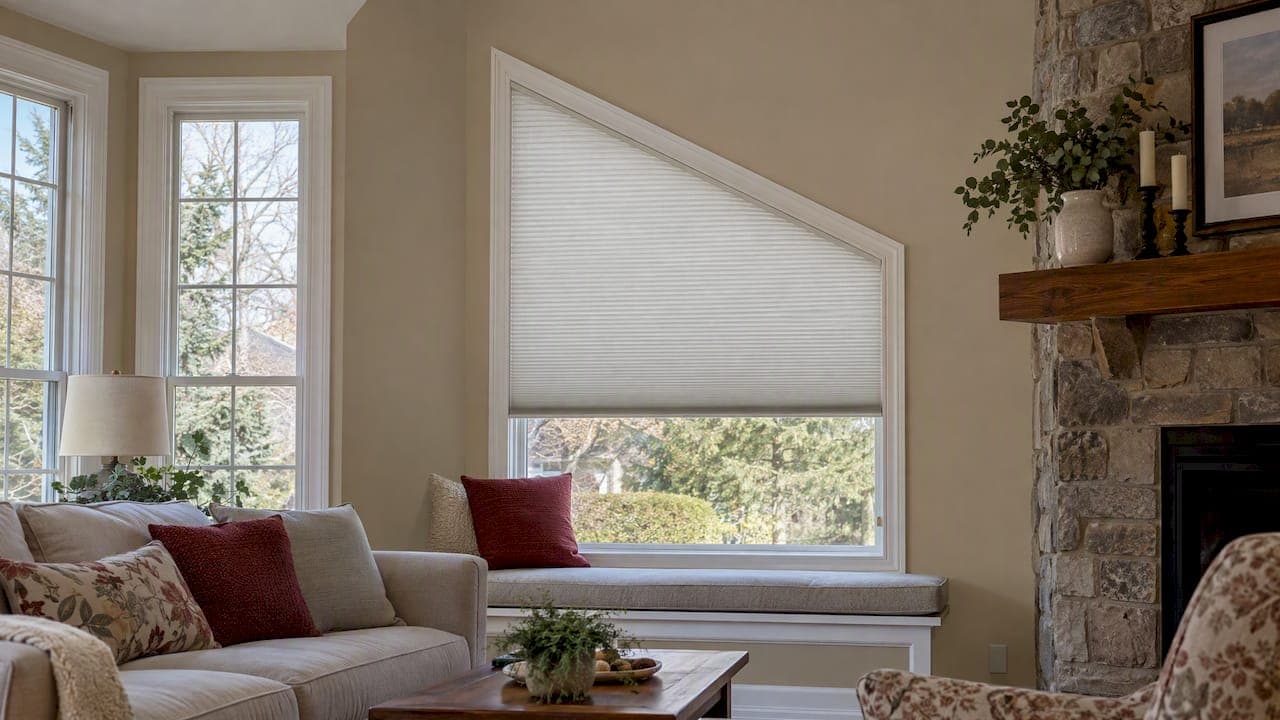
A trapezoid window has a slanted top edge, and a standard blind or curtain rod does not fit it. The usual answers are a custom-shaped shade cut to the angle, a fixed covering for the angled top paired with an operable shade below, a shutter built to the slope, or a layered setup that treats the window as two zones. The right choice depends on how much light you want to control, whether you need privacy, whether you can reach the window, and who lives in the house.
This guide is for homeowners in the Philadelphia suburbs who have angle-top or triangle windows over a great room, stairwell, or entry. It explains the options, what to measure, and what to ask before you order. Made in the Shade Bucks County serves homeowners in Bucks County, PA and Mercer County, NJ.
TL;DR
- Trapezoid, angle-top and triangle windows can all be covered. The covering is made to the window's exact angles, so it is custom by nature.
- The most common approach is two zones: a fixed or specialty-shaped covering for the angled top and an operable shade or blind for the rectangular section below.
- Choose the fabric for the job: cellular for insulation, solar fabrics for glare and view, and blackout or shutters for privacy and sleep.
- Choose cordless or motorized lift. It keeps cords away from children and pets, and it solves the problem of reaching a tall window.
- A free in-home consultation lets you see samples against your own light and walls before you commit.
Table of Contents
- What a trapezoid window actually is
- Your main options
- Can you cover only the bottom half?
- Light, privacy and glare
- Energy efficiency in a Pennsylvania and New Jersey climate
- Child safety and cordless operation
- Motorized and smart options for hard-to-reach windows
- What to measure and check before you order
- What affects the cost
- Our perspective
- See it in your own home
- Frequently asked questions
- Sources
What a trapezoid window actually is
A trapezoid window has four sides, with at least one slanted. In many homes the slant follows the roofline, so you see it in vaulted living rooms, sunrooms, stair landings, and the gable ends of Cape Cods and newer colonials in Bucks County. A triangle window is the same idea taken further, with the slant meeting at a point. Many homes also stack a trapezoid over a standard rectangular window, which is why homeowners say "angle top."
Each shape has two jobs that rarely agree:
- The angled piece is usually high, hard to reach, and often catches the low sun that causes glare and fading.
- The rectangular piece below is where you want everyday control, such as privacy, opening and closing, and a clear view.
Good solutions respect both. A treatment that handles only one leaves you with either a bare triangle of glare or a window that never fully opens.
Your main options
Fixed shades for the angled top
If you never need to raise the top section, a fixed covering is the simplest answer. It is cut to the exact angle and mounted inside the frame, so it stays put. This works well for a high triangle that mainly causes glare or heat gain. Because it does not move, there is no cord, no motor, and no moving parts to maintain.
The tradeoff is that you cannot open it for the view or for winter sun. If you want that flexibility, look at the next option.
Custom-shaped operable shades
A shade can be fabricated to follow the slanted edge and still raise and lower. Roller, cellular, and pleated styles are all made in custom shapes for specialty windows. Where the shade slopes, it is typically held steady along the angle so the fabric tracks cleanly as it moves. The exact system depends on your window's geometry and the movement you want, which is why the consultant measures the opening before recommending a style.
Operable shades suit homeowners who want to open the top for light in January and close it in August. For tall windows, pair this with motorization, discussed below. Browse our custom window shades to see the styles we offer.
Shutters built to the slope
Shutters can be made to follow an angle, including angled tops and two-panel angle-top layouts. They are a strong choice where you want privacy and light control with a finished, architectural look, and they suit older Bucks County homes with traditional trim. Louvers tilt to direct light, so one treatment handles glare, privacy, and ventilation of view. See our wood shutters and faux wood shutters for material choices.

Vertical blinds for tall, sloped glass
When a window runs from floor to a rising peak, vertical blinds can follow the slope with vanes of different lengths. Rotating vanes give you extra light control, and the opacity of the vane material sets how much light comes in. They are practical for big sliding-door-and-transom combinations. Our vertical blinds page covers what is available.
Drapery and layered looks
Drapery does not fit a slanted top, but it can frame the window. A common solution is to hang a treatment on the rectangular section below and leave the angled top covered by a fixed shade, or to mount drapery hardware above the whole opening so the panels sweep past the angle. Layering a soft treatment over a shade adds warmth and sound absorption. For ideas, read how to layer window treatments, and see our drapery options.
Can you cover only the bottom half?
Yes, and many people do, but you should know what happens. A common DIY fix is a roller shade on the lower rectangle only. It helps with privacy and some glare, but the sun still pours through the top triangle, especially in summer when the angle of the light is high and the window is hard to ignore.
A better plan is a two-zone treatment:
- Top zone: a fixed shade, or a custom-shaped shade on a slope system, in a fabric that matches or complements the lower shade.
- Bottom zone: any operable style, such as a cordless cellular shade, a blind, or a shutter panel.
The two zones should be chosen together so the fabric color and the light levels match. When they are chosen separately, the top and bottom can end up looking like two different windows, and the gap between them lets light leak. A consultant can lay samples of both against your window so you see the pairing before you order.
Light, privacy and glare
Angle-top windows are often the brightest in the house because they sit high and face open sky. Think about what you need in each room.
| Goal | Good fit | Why |
|---|---|---|
| Cut glare, keep the view | Solar or light-filtering fabric | Softens bright light while you still see out |
| Full darkness for sleep | Blackout fabric or shutters | Blocks nearly all light |
| Privacy with some daylight | Light-filtering cellular or tilted shutters | Diffuses light, hides detail |
| Control light through the day | Shutters or rotating vertical vanes | Louvers or vanes adjust the angle |
| Insulation | Cellular shades | Air pockets add a layer at the glass |
If you also care about privacy beyond the window itself, such as sightlines into a home office from the street, you can combine shading with layouts that block sightlines using plants or screens. For high angled windows, though, privacy is rarely the issue. Glare, fading, and heat are.
Energy efficiency in a Pennsylvania and New Jersey climate
Our winters are cold and our summers are humid, so a window covering has to work both ways. The U.S. Department of Energy modeled interior cellular shades and found they saved up to 20% of heating energy and up to 15% of combined heating and cooling energy compared with having no shade. That is a modeled result, and your home will differ, but it shows why cellular is a common choice for large panes.
The DOE also notes that results vary by climate. In its review of window attachments, northern and many central climates benefit most from insulating properties and balanced solar control, while cooling-dominated climates gain more from blocking solar heat. The same publication says exterior attachments are generally better for cooling savings but can increase heating energy, so no single product is best everywhere.
For a Bucks County home, that points to a balanced answer: an insulating shade you can open in winter for free solar warmth and close on summer afternoons. An operable top section makes that possible, and motorization makes it easy to do on a schedule. Our energy saving window treatments page goes deeper.
Child safety and cordless operation
If children or pets live in your home, cords are the first thing to rule out. The U.S. Consumer Product Safety Commission says that operating cords on stock window coverings must be cordless, no more than 8 inches long, or inaccessible, and that custom products must also address hazardous inner cords and loops. The same guidance says products that do not meet the ANSI/WCMA A100.1-2018 provisions are treated as substantial product hazards.
In practice, that means asking for cordless or motorized lift on every window, including the high ones. The CPSC separates manual cordless systems, operated by a handle or by hand, from motorized systems run by a motor and controls such as a remote or wall switch. Both remove the loose cord. For windows you cannot reach, motorized is the practical answer.
Read our guides on child safety for windows and cordless blind safety for parents if you are childproofing a nursery or family room. If a nursery has an angled window, see safe nursery window treatments.

Motorized and smart options for hard-to-reach windows
An angled window two stories up is where motorization pays for itself. Instead of a pole or a ladder, you use a remote, a wall switch, or your voice. At Made in the Shade Bucks County, we specialize in motorized and smart-home-compatible shades that work with Alexa and other major platforms, and we offer cordless, child-safe lift options.
Practical benefits for an angle-top window:
- You can set the top and bottom shades to move together or separately.
- Schedules can lower shades before the afternoon sun hits and raise them at night.
- No cord means nothing for children or pets to reach.
- Operating a high window stops being a chore, so you actually use it.
Power is something to settle early. A motorized shade needs either a battery, a plug, or hardwiring, and the best choice depends on how close an outlet is and whether the ceiling is open. Your consultant will talk through the options for your space.
What to measure and check before you order
Irregular windows are unforgiving, and this is why professional measuring matters. If you want to understand the process or prepare for your consultation, here is what is worth noting.
- Every side of the shape. For a trapezoid, that means the long side, the short side, the width, and the slant. For a triangle, all three sides.
- The angle. The slope matters as much as the lengths. Two windows with the same width and height can have different angles.
- Inside or outside mount. Check whether the frame is deep enough to hold a shade inside, and whether trim, a grid, or a handle gets in the way.
- The lower section. If a rectangular window sits below, note whether there is a transom bar or mullion between them and where it falls.
- Access. Note how high the window is, whether there is a staircase below, and how you would reach it.
- Power. Note where the closest outlet is, and whether you want hidden wiring.
- Sun direction. Notice when the glare hits, because that determines fabric choice.
Because a custom shaped shade is made to your exact dimensions, an error of even a small amount can mean a remake. For that reason we do not suggest measuring specialty shapes on your own and ordering online. Our team measures every project and installs it with trained professionals.
What affects the cost
We do not publish prices, because every angled window is different. These factors usually move the total:
- Size and shape complexity. A large trapezoid with a steep slant takes more material and more fabrication than a small one.
- Number of zones. Two treatments for one window cost more than one, though they often work better.
- Material. Cellular, solar fabric, wood, and faux wood all price differently.
- Operation. Cordless manual lift is one level, and motorized with smart-home control is another.
- Height and access. High windows may need extra installation time and equipment.
- Number of windows. Treating several windows in one project is often more efficient than doing them one at a time.
When you get quotes, ask each provider to itemize the top zone, the bottom zone, the lift system, and installation. That makes it easy to compare real offers. Our consultation is free and carries no obligation, and we give you a written proposal.
Our perspective
We see angle-top windows in a lot of Bucks County and Mercer County homes, and the same mistake comes up again and again: homeowners treat the window as one problem when it is two. The slanted top wants a quiet, low-maintenance answer. The part below wants something you can use every day.
We also think the room should lead the decision, not the catalog. A sunroom that bakes in July needs something different from a stairwell that mainly needs privacy at night. That is why we bring samples to your home instead of asking you to imagine them in a showroom. You can hold a fabric up to your own glass, at the hour of day when the light is hardest, and see what it does.
Finally, we do not compromise on safety. Any window we treat for a family with young children gets a cordless or motorized option. For tall windows that is also simply more convenient.
— Tony
See it in your own home
Made in the Shade Bucks County has no storefront. Instead, a personal design consultant comes to your home with sample collections, measures your windows, and helps you choose shades, blinds, shutters, or drapery that work for your shapes, your light, and your family. Installation is handled by trained professionals, and our products carry manufacturer warranties, most with limited lifetime coverage.
If your windows are unusual, that is a good reason to start with a consultation. Request a free consultation and we will look at your angles in person.
Frequently asked questions
Can a trapezoid window have a shade that moves?
Yes. Shades can be made to the slanted shape and operated manually with a cordless system or by motor. For a stationary section, a fixed shade is simpler. Your consultant can tell you which fits your window's angle and how you use the room.
What is the best covering for a triangle window?
It depends on the goal. A fixed shade is the simplest for cutting glare, a cellular shade adds insulation, and a shutter gives you louvers you can tilt. Triangles high on a wall are usually best handled with a fixed or motorized option, since you will not want to reach them.
Are cordless shades available for angled windows?
Yes. Cordless manual and motorized lift systems are both options, and they remove the loose cord that creates a hazard for children. Federal guidance on window covering cords sets limits on stock products and addresses inner cords on custom ones, so ask for cordless on every window.
Will covering an angled window save energy?
Possibly. The Department of Energy's modeling found that interior cellular shades reduced heating and combined energy use, though results vary by climate and how the shades are used. In our region, an insulating shade you can open and close with the seasons is a sensible choice.
Can I measure it myself?
You can note rough dimensions to prepare, but we recommend professional measuring for any specialty shape. Because the covering is cut to your exact angles, a small error can mean a remake. Our team measures every project.
Sources
- Window Coverings 15(j) Rule Business Guidance, CPSC
- CPSC Staff Statement on Final Cordless Window Coverings Cost Analysis
- Interior Cellular Shades Boost Home Energy Performance, U.S. Department of Energy
- Energy Savings from Window Attachments, U.S. Department of Energy
- Privacy layouts to block sightlines