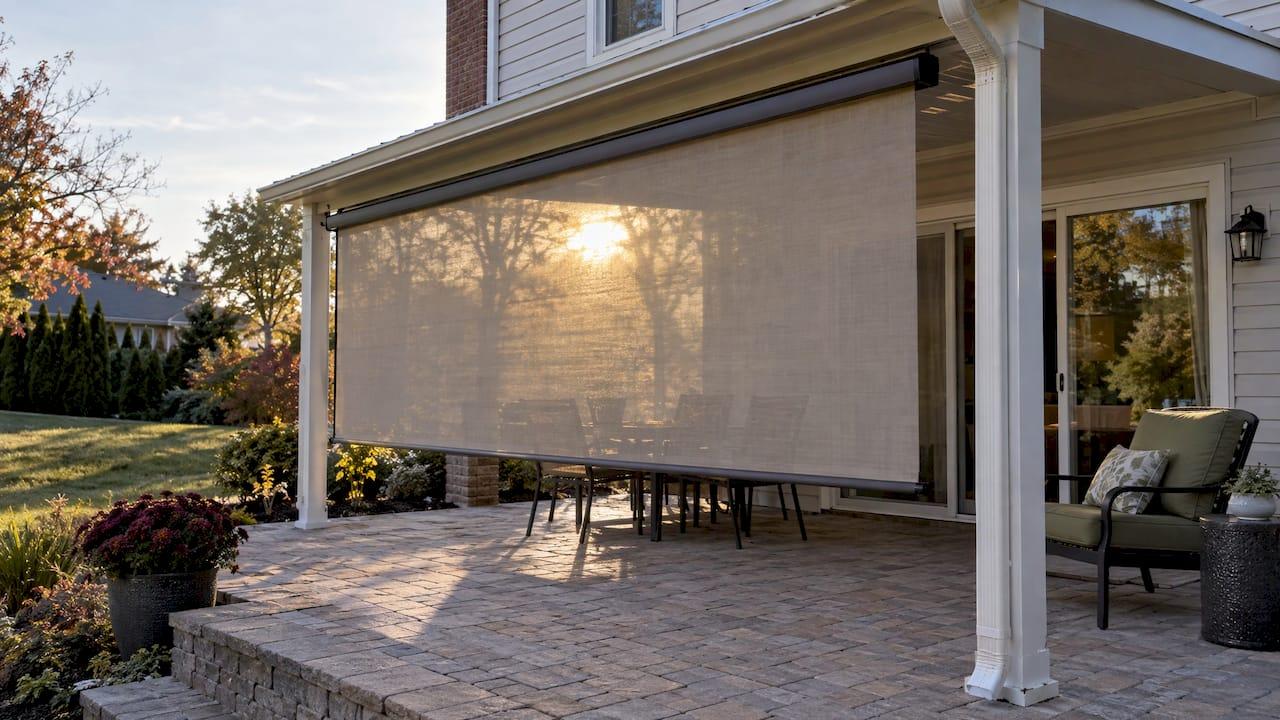
A west-facing patio needs vertical shade at its western edge, not just a roof overhead. In the late afternoon the sun sits low and shines straight under any overhang, so the fix is a shade that drops down to meet that light. In Bucks County and Mercer County, motorized exterior shades or a retractable awning with a drop front are the usual ways to get there. Made in the Shade Bucks County measures, supplies and installs these systems after a free in-home consultation.
TL;DR
- West-facing patios heat up and glare most from mid-afternoon into the evening, when the sun is low and a roof or pergola cannot stop it.
- Vertical shade (an exterior roller shade, a drop valance or a side screen) works where horizontal cover fails.
- Choose fabric by how much view and breeze you want to keep, and shade only the exposed side rather than boxing the patio in.
- Motorization, with Alexa and other smart-home platforms, lets the shade lower itself before the glare starts. Cordless, child-safe operation is available.
- Made in the Shade Bucks County brings samples to your home, measures the opening and installs the shades. The consultation is free.
Table of Contents
- Why a west-facing patio is so hard to shade
- First, confirm which way your patio really faces
- The shade types that work for west sun
- Fabric, openness and the view
- How much difference does shading make for the house?
- Motorized and smart shades: beat the glare before it starts
- A simple plan for choosing your west-facing patio shade
- What about a cheaper fix?
- Our perspective
- Get a west-facing patio shade planned around your home
- FAQ
- Book your free in-home consultation
- Sources
Why a west-facing patio is so hard to shade
Most people shade a patio by looking up: a pergola, an awning or an umbrella. That works well when the sun is high. On a west-facing patio, the trouble arrives hours later, when the sun drops toward the horizon and shines almost horizontally into the space.
Research from the Florida Solar Energy Center on passive design explains the geometry. It reports that significant direct solar heat gain on west walls occurs between roughly 2:00 and 5:30 pm, when the sun is low and roof overhangs are ineffective. The same research recommends vertical devices such as screens, shutters and exterior roll blinds for east- and west-facing surfaces.
In plain terms: a roof blocks light that comes from above. Low western light comes from the side. It passes beneath the front edge of an awning or pergola and lands on your chairs, your table, your sliding door and your face.
That is why a patio can feel comfortable at noon and unusable at 5 pm, which is exactly when many families want to eat dinner outside.
What it looks like in the Philadelphia suburbs
Summers in Bucks County and the Mercer County area are hot and humid, and evening is when most households use the patio. Many suburban homes here have a rear deck or paver patio behind a colonial, twin or split-level house, often with a sliding glass door onto it. When that rear wall faces west, the sun hits the door glass and the patio at the same time. The room behind the door warms up, and the patio becomes too bright to sit on.
The low sun also moves through the year. Its angle is lowest in winter and highest in June, so a shade that is perfect in July may need adjusting in September, when the sun slides lower and further south. Shades you can raise and lower, or that move on a schedule, handle that change better than a fixed panel.
First, confirm which way your patio really faces
Before choosing anything, check the actual direction. Many houses sit slightly off the compass grid, and a patio that looks west may face northwest or southwest. The difference changes which corner takes the hardest sun.
Stand on the patio at about 4 pm on a clear day and notice where the glare enters. Note which side of the patio gets it, and whether it comes through a nearby tree or fence. If you want a refresher on how a home's orientation affects light and heat, this guide on judging a house by the direction it faces explains the basics of compass orientation.
Then note three things:
- Where the glare lands. Is it on the seating area, the dining table, or the door glass?
- What you want to keep. A garden view, a pool, a fire pit or a play area that you need to watch.
- What the shade can attach to. A solid house wall, a covered porch frame, a pergola or posts at the patio edge.
These answers decide the product. They are also the first things we ask about in a consultation.
The shade types that work for west sun
The common thread is vertical coverage on the western side. Here is how the main options compare for a west-facing patio.
| Option | Best for | How it handles low sun |
|---|---|---|
| Motorized exterior roller shade | Covered patios, porches, screened areas, sliding door walls | Drops straight down along the open side to block low sun. Retracts when you want the view. |
| Retractable awning with a drop front | Patios beside a solid house wall | The awning covers the overhead sun, and the front drop catches the low sun. |
| Side screens or tracked panels | Patios needing side coverage next to an awning or pergola | Fills the gap along the western edge. |
| Outdoor drapery | Pergolas and porch frames where you want a softer look | Pulls across when the sun is low and opens to frame the view. |
Exterior roller shades
An exterior roller shade is a fabric panel that rolls down from a housing at the top of the opening. On a west-facing patio, this is often the most direct answer, because it hangs exactly where the low sun enters. It can be raised fully on cool days or cloudy afternoons.
For covered patios, porches and sliding door walls, it sits inside or just outside the frame and leaves the patio open on the other sides. You can learn more about the outdoor shade options we offer.
Retractable awnings with a drop front
A retractable awning gives you overhead cover and, when you add a vertical front, side protection too. This pairing matters on a west exposure. The overhead section handles the high sun at midday, and the vertical drop handles the low sun at the end of the day. Because the awning retracts, the patio is open to the sky when you want it.

If your patio sits against a solid wall, this is a natural fit. Our retractable awnings page shows the range.
Side screens and outdoor drapery
Where you already have a frame, such as a pergola or porch posts, shades can attach along the western side. Outdoor drapery can also work on an existing frame. It gives you a softer look and slides open to bring the view back.
The key is to treat the west side as the priority. Shading the other three sides of a patio rarely helps with late-day glare.
Fabric, openness and the view
Most people worry that a vertical shade will turn the patio into a dim box. It does not have to. Outdoor solar fabrics are woven so that you can see through them from inside, while the weave reduces glare and blocks part of the sun's energy.
The main choice is openness, which is the share of the fabric's surface that is open weave. Lower openness blocks more sun and glare but gives you a softer, less clear view. Higher openness keeps the view crisper but lets more light through. Darker colors usually cut glare more and are easier to see through than light ones, while lighter colors reflect more light and can look brighter from the outside.

A practical way to choose is to sit where you normally sit and look where you normally look. Does the glare hit your eyes, the table or the door glass? Do you want to see a garden, a pool or the neighbor's yard? That determines how much openness you can afford.
In a consultation, we bring outdoor shade samples to your patio so you can hold each one up at the actual window, door or frame and watch how it behaves in your own afternoon light. That is a much better test than a swatch under store lighting, and we have no storefront anyway.
Don't wrap the whole patio
It is tempting to shade every side. Usually one well-placed vertical line is enough. Keeping one edge open helps airflow and keeps the patio from feeling like a hot room with no ceiling. If your patio faces a view you love, choose a shade that can retract, so the view is available again whenever the sun is gone.
How much difference does shading make for the house?
Shade helps the home as well as the patio. When the sun is stopped outside, less heat reaches the glass doors and windows that open onto the patio, and the rooms behind them stay cooler in the afternoon.
The U.S. Department of Energy's building technologies office has presented work from Lawrence Berkeley National Laboratory on affordable shading, which cites field-demonstrated energy savings of 3% to 30% from shading measures. Actual results depend on the home, the windows and the climate, so treat this as a range, not a promise.
For eco-conscious homeowners, this is a real benefit. An exterior shade on the west side of the house cuts heat before it reaches the glass, which is more efficient than trying to cool the room after the sun has entered. If you also want to reduce heat inside, our energy saving window treatments page covers the interior side, and solar shades for UV blocking can protect floors and furniture near the patio door.
Motorized and smart shades: beat the glare before it starts
On a west-facing patio, timing matters. The glare arrives at a predictable hour, and nobody wants to walk out in the heat to crank a shade down. Motorization solves this.
With motorized shades you can lower the screen with a remote, a wall switch or your phone. Our shades work with Alexa and other major smart-home platforms, so you can say a command or build a routine that lowers the shade in the afternoon. You can also raise it again in the evening when you want the sunset.
To keep a home safe for kids, cordless and child-safe lift options are available. This matters if you have young children or grandchildren, because dangling cords are a hazard. A cordless or motorized shade removes the cord from the picture.
A simple plan for choosing your west-facing patio shade
- Observe the sun. Spend a late afternoon on the patio and note where the glare lands and when it starts.
- Pick the priority side. For most west patios, this is the western edge or the sliding door wall. Check the northwest corner too, since the summer sun sets north of due west.
- Decide what to keep. Decide on the view, the breeze and the daylight you want to retain, and choose a fabric openness to match.
- Choose the mounting. Solid wall, porch frame, pergola or posts determines whether you need a roller shade, an awning with a drop front or tracked side screens.
- Choose the control. Motorized, with a timer or smart-home routine, or a cordless manual lift.
- Get the opening measured properly. Outdoor shades are made to size. A shade that is a bit too narrow leaves a stripe of sun along the edge, which is exactly where the low sun finds its way in.
- Install it securely. The shade needs to be anchored well so that it handles wind and daily use.
Steps 6 and 7 are where do-it-yourself projects most often go wrong. At Made in the Shade Bucks County, trained professionals measure each project and install it, so the finished shade fits the opening you actually have.
What about a cheaper fix?
A temporary fabric panel or a patio umbrella will give you some relief for a season. Both tend to struggle with low western sun, because an umbrella's canopy is overhead and a loose panel moves with the wind. If you want comfort every summer evening, a made-to-measure shade on the western side is what resolves the problem, and it lasts. Our products carry generous manufacturer warranties, most with limited lifetime coverage.
Our perspective
We hear the same thing from west-facing homeowners: the patio is lovely until about 4 pm, and then it is too bright to enjoy. Usually they have already added an umbrella or an overhead cover, and it did not help, because the sun was coming in from the side.
Our advice is to stop thinking about the roof and start thinking about the western edge. A vertical shade, sized to the opening and set up so it lowers when the glare begins, changes how the whole space feels. Add motorization and the shade becomes something you never have to think about.
We also like to treat the patio and the house together. A shade that stops the sun outside also helps the sliding door and the rooms behind it, and cordless, child-safe operation means the family can use it without worry.
That is why we do this in your home, not in a showroom. We bring samples, hold them up to your actual afternoon sun, measure and install. You see what you are getting before you decide.
Tony
Get a west-facing patio shade planned around your home
Made in the Shade Bucks County offers custom outdoor shades, retractable awnings and motorized, smart-home-compatible options for homeowners in Bucks County, PA and Mercer County, NJ. A personal design consultant brings sample collections to your home, helps you choose the product, and our trained professionals measure and install it. See our outdoor patio shades in Bucks County for examples.
If the patio is part of a bigger project, we also supply interior shades, blinds, shutters and drapery. You can start on our custom window treatments page.
FAQ
Why doesn't my pergola or awning help in the late afternoon?
A pergola or awning blocks sun that comes from above. In late afternoon the sun is low in the west and shines in from the side, under the front edge. Florida Solar Energy Center research notes that overhangs are ineffective on west walls in the afternoon, and recommends vertical devices instead. A shade or drop front on the western side closes that gap.
What is the best shade for a west-facing patio?
For most patios, a vertical exterior shade on the western side, either a roller shade or a retractable awning with a drop front. Pick the one that matches what you can attach to: a covered porch or sliding door wall suits a roller shade, and a solid house wall suits an awning. A consultation lets you compare both in your own light.
Will a shade make my patio too dark?
Not if the fabric is chosen well. Solar fabrics are open-weave, so you can see through them. Lower openness cuts more glare, and higher openness keeps the view clearer. Shading only the western side, and keeping the other sides open, preserves light and breeze.
Can I control the shades from my phone or by voice?
Yes. Our motorized shades are smart-home compatible and work with Alexa and other major platforms. You can set them to lower on a routine or operate them with a remote. Cordless, child-safe lift options are also available.
Does a consultation cost anything?
No. The in-home consultation is free. We bring the samples to you in Bucks County, PA or Mercer County, NJ, discuss your patio and your goals, and measure the space. You can request a free consultation whenever you are ready.
Book your free in-home consultation
If your west-facing patio is too hot or too bright to enjoy after mid-afternoon, Made in the Shade Bucks County can bring the showroom to you. Request your free in-home consultation, and we will look at your patio in your own afternoon light, with samples in hand.
Sources
- Concepts in Passive Design #2, Florida Solar Energy Center
- Saving Lives Through Affordable Shading, U.S. Department of Energy / Lawrence Berkeley National Laboratory
- Judging a house by the direction it faces