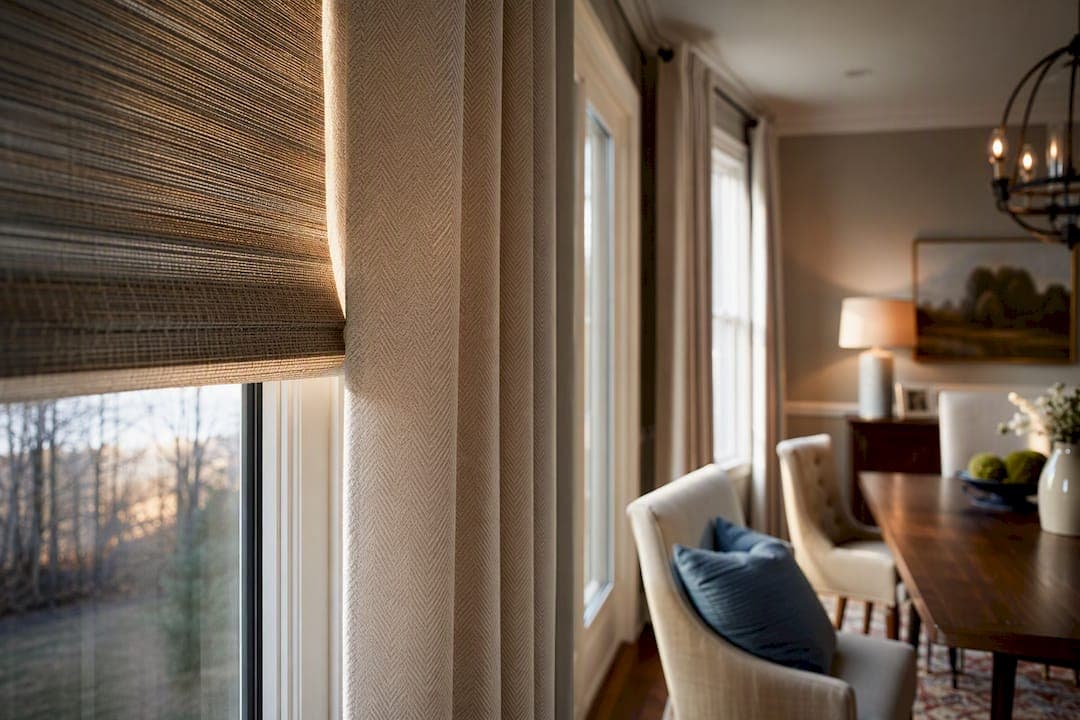
In 2026, window treatments are defined by warm natural textures and layered, motorized solutions that combine design with measurable energy benefits. Standards from ENERGY STAR and the Attachments Energy Rating Council now sit alongside design direction from names like Martha Stewart, and homeowners are pairing both. This guide breaks down the trend clusters, the research behind them, and how a local custom window treatment provider helps translate them into your own home.
TL;DR:
- Cellular shades and exterior shades can save homeowners up to 34 percent on HVAC costs with proper operation, especially when motorized and programmed.
- Woven wood shades and linen drapery are increasingly favored for their texture, warmth, and sustainability, with recycled fabrics gaining popularity.
- Outside-mounted roman shades and layered treatments improve coverage, light control, and style, making windows appear larger and more polished.
- Battery and solar motors offer flexible, low-maintenance solutions for retrofits, while hard-wired motors are most reliable during new build or renovation projects.
- A professional in-home consultation is recommended to select materials, ensure precise measurements, and optimize energy efficiency, especially for layered window treatments.
Table of Contents
- What Are the Top Window Treatment Trends for 2026?
- How Should You Choose Motorized and Smart Window Treatments?
- Which Materials Define 2026 Window Fashion Styles?
- How Do You Layer Shades, Sheers, and Drapery for 2026?
- What Colors and Hardware Finishes Are Trending in 2026?
- Do Cellular Shades and Storm Windows Actually Save Energy?
- How Do You Apply These Trends Room by Room?
- Why a Free In-Home Consultation Beats Guesswork
- Prioritizing Energy and Comfort Without Losing the Look
- Book Your Free In-Home Consultation
- Sources
- FAQ
What Are the Top Window Treatment Trends for 2026?
Homeowners scanning for window treatment trends 2026 are really asking one question: what should replace the flat white blinds and exposed cords from the last decade? Here's the shortlist.
- Motorized and smart shades — convenience and energy control in one motor.
- Linen and woven wood textures — warmth that replaces cold, synthetic finishes.
- Layered treatments — sheers, shades, and drapery combined for depth and function.
- Outside-mounted roman shades — a tailored, furniture-like look with better coverage.
- Warmer palettes and bronze hardware — earth tones and metal finishes as window "jewelry."
- Energy-saving cellular shades — insulation you can actually measure.
- Café curtains and reworked valances — traditional softness returning with modern proportions.
Some of these are purely aesthetic, some are purely functional, and the strongest choices, like cellular shades and motorization, do both at once.
How Should You Choose Motorized and Smart Window Treatments?
Motorization has moved from luxury add-on to baseline expectation, and the decision now is which power source and platform fit your home. Battery-powered motors work well for retrofits since there's no wiring involved, while solar-charged motors suit south-facing windows that get consistent sun. Hard-wired motors deliver the most reliable long-term performance but require an electrician and are best planned during a remodel or new build.
Smart-home compatibility matters as much as the motor itself — for more on integrating shades with your home automation system, see SmartSavvyHome. Look for shades that work with Alexa and other major platforms, support scheduling, and can be grouped with existing routines rather than requiring a separate app.
- Battery motors: easiest retrofit, periodic recharging required.
- Solar motors: low maintenance on sunny exposures, minimal upkeep.
- Hard-wired motors: most dependable, best planned during construction or renovation.
- Cordless, child-safe lift options: standard now on both motorized and manual shades.
Pro Tip: If you're planning a renovation, ask your electrician to run low-voltage wiring behind the drywall before it closes up. It costs little now and saves a retrofit headache later.
Which Materials Define 2026 Window Fashion Styles?
Linen and cotton have overtaken synthetic blends as the material of choice for drapery, prized for their texture and the way they soften light without blocking it entirely. Woven wood shades, meanwhile, are showing up in more refined weaves than the chunky bamboo styles of years past, giving living rooms and home offices an organic look that still feels tailored.
Sustainability is shaping material choices too, with recycled-content fabrics and low-VOC finishes becoming a real factor in purchasing decisions, not just a marketing footnote.
- Linen and cotton drapery: best in living rooms and bedrooms, less ideal near constant moisture.
- Refined woven woods: strong fit for offices and dining rooms; wipe clean rather than wash.
- Recycled-content and low-VOC fabrics: worth asking about when comparing eco-friendly window options.
- Kitchens and bathrooms: favor moisture-resistant faux wood or vinyl over natural fiber blends.
How Do You Layer Shades, Sheers, and Drapery for 2026?
Layering is the signature move behind this year's warmer, more finished look, and it solves a real problem: no single treatment handles privacy, light control, and style equally well. Sheers paired with a solar shade and blackout lining give you daytime privacy, nighttime darkness, and a soft frame around the window all in one setup. Woven wood shades under flowing drapery panels create a similar effect with more texture and warmth.
Outside-mounted roman shades are gaining ground because they visually expand the window and reduce light gaps compared with inside-mounted versions, a detail Martha Stewart's design panel flags as one of the defining moves of the year. Ripple fold and pinch-pleat headers are also replacing flat panel drapery for a more tailored silhouette, and valances are back in a leaner, less fussy form than the last time they were popular.
- Sheer plus solar shade plus blackout lining: full-day light control.
- Woven wood shade under drapery: texture and warmth together.
- Outside-mounted romans: better coverage, more polished proportions.
- Ripple fold or pinch-pleat headers: a cleaner update on traditional valances.
For a full walkthrough of pairing combinations by room, see how to layer window treatments.
What Colors and Hardware Finishes Are Trending in 2026?

Cool gray is losing ground to warm clay, mushroom, and muted greens, a shift that mirrors the broader move toward earthy interiors across furniture and paint as well. These tones read as calmer and more livable than the stark whites and grays that dominated the past several years.
Hardware finishes are following the same warm direction, with bronze and brushed brass replacing chrome and matte black as the go-to choice, functioning almost like jewelry for the window.
- Warm clay or terracotta drapery paired with bronze rods: strong in living rooms.
- Mushroom-toned roman shades with brushed brass hardware: fits bedrooms and home offices.
- Muted green woven shades: pairs well with wood tones in kitchens.
Do Cellular Shades and Storm Windows Actually Save Energy?
Yes, and the range is wider than most homeowners expect. DOE-backed modeling puts annual HVAC savings from insulated cellular shades at roughly 10 to 34 percent depending on climate and installation, while low-e storm windows land in a similar 10 to 33 percent range. Exterior shades add another layer, cutting seasonal cooling loads by an estimated 12 to 25 percent.
| Treatment type | Estimated savings | Measurement basis |
|---|---|---|
| Insulated cellular shades | 10–34% | Annual HVAC savings |
| Low-e storm windows | 10–33% | Annual HVAC savings |
| Exterior shades | 12–25% | Seasonal cooling savings |
The Attachments Energy Rating Council issues Warm Climate and Cool Climate ratings that let you compare attachment products the same way ENERGY STAR ratings compare storm windows. Savings depend heavily on consistent operation, DOE and Lawrence Berkeley National Laboratory research notes, which is exactly where scheduled automation earns its keep. A motorized cellular shade that closes at sunset without anyone remembering to do it captures savings a manual shade often misses.
See our energy-saving window treatments page for more on matching shade type to your home's exposure.

How Do You Apply These Trends Room by Room?
Trend lists are useful, but the real question is what to put on your own windows this year.
- Living room: Layer drapery over a solar or cellular shade for both style and daytime glare control.
- Bedroom: Cellular blackout shades under linen drapery balance sleep quality with softness.
- Kitchen: Café curtains or a moisture-resistant faux wood blind handle splashes without sacrificing style.
- Home office: Woven wood shades cut glare on screens while keeping the room warm rather than clinical.
- Large windows and sliders: Motorized shades or exterior screens matter most here, since manual operation on oversized glass is where automation pays off fastest.
If your budget is limited, put the money into insulation and motorization on your largest, sun-facing windows first. Save the decorative valances and hardware upgrades for smaller windows where the aesthetic impact matters more than the energy math.
Why a Free In-Home Consultation Beats Guesswork
Layering, motorization, and material choice all depend on details you can't judge from a catalog: how light moves through your specific room, whether your walls can support outside-mounted hardware, and which motor type fits your window size. A free in-home consultation brings fabric and material samples to your home so you can see them in your own light before deciding.
Professional measurement matters even more with layered setups, since sheers, shades, and drapery all need to align without gaps. Professional installers and manufacturer warranties protect that investment once it's on your wall.
Prioritizing Energy and Comfort Without Losing the Look
The biggest homeowner value comes from combining insulation, motorization, and layered natural fabrics rather than treating them as separate decisions. The common mistake is chasing a trending fabric or color first and figuring out function later. Start with performance, then layer in the aesthetic. It's far easier to make an insulated cellular shade look warm than to make a beautiful drape perform like insulation.
— Tony
Book Your Free In-Home Consultation
A local provider offers a service where a design consultant brings real fabric and material samples directly to your home, so you see how warm linen, woven wood, or a bronze-hardware roman shade actually looks in your light, at no cost. For Bucks County, PA and Mercer County, NJ homeowners planning a 2026 refresh, this matters most on larger windows and layered setups where a photo online simply can't tell you enough.
Before your visit, jot down which rooms you're focused on, snap a few photos of your current windows, and note whether motorization or a specific palette is a priority. From there, your consultant can walk you through options like motorized shades with Alexa compatibility and cordless, child-safe lifts, or browse the full range of window shades suited to your home's style. Every project includes professional measurement and installation, backed by manufacturer warranties. Request your free consultation and start planning your windows for 2026.
Sources
FAQ
What Window Treatments Are Out of Style in 2026?
Stark white blinds, exposed lift cords, and heavy, ornate valances with excessive trim are fading out. Manual cords are being replaced across the board by cordless and motorized lift systems, which are now considered the baseline rather than an upgrade.
What's the Difference Between Inside Mount and Outside Mount Shades?
Inside-mount shades sit within the window frame for a clean, built-in look, while outside-mounted shades hang over the frame. Outside mounts are trending for 2026 because they make windows look larger and close light gaps that inside mounts can't fully cover.
Are Motorized Shades Worth It for Energy Savings?
Motorized shades help you actually capture the savings that manual shades often miss, since scheduled closing at sunset or during peak heat keeps insulation working consistently. Combined with insulated cellular fabric, this pairing supports the 10 to 34 percent HVAC savings that DOE modeling associates with consistent operation.
How Much Does Made in the Shade Bucks County Charge for a Consultation?
The in-home design consultation is free, with a consultant bringing samples directly to your home in Bucks County, PA or Mercer County, NJ. Pricing on shades, blinds, or drapery is provided during that visit and is available on the Made in the Shade Bucks County site.
Can I Add Smart Shades to an Older Home Without Rewiring?
Yes. Battery-powered and solar-charged motors let you add smart, app- or voice-controlled shades to existing windows without running new wiring, making them the practical choice for most retrofits. Hard-wired motors are better reserved for renovations or new construction where an electrician is already on site.