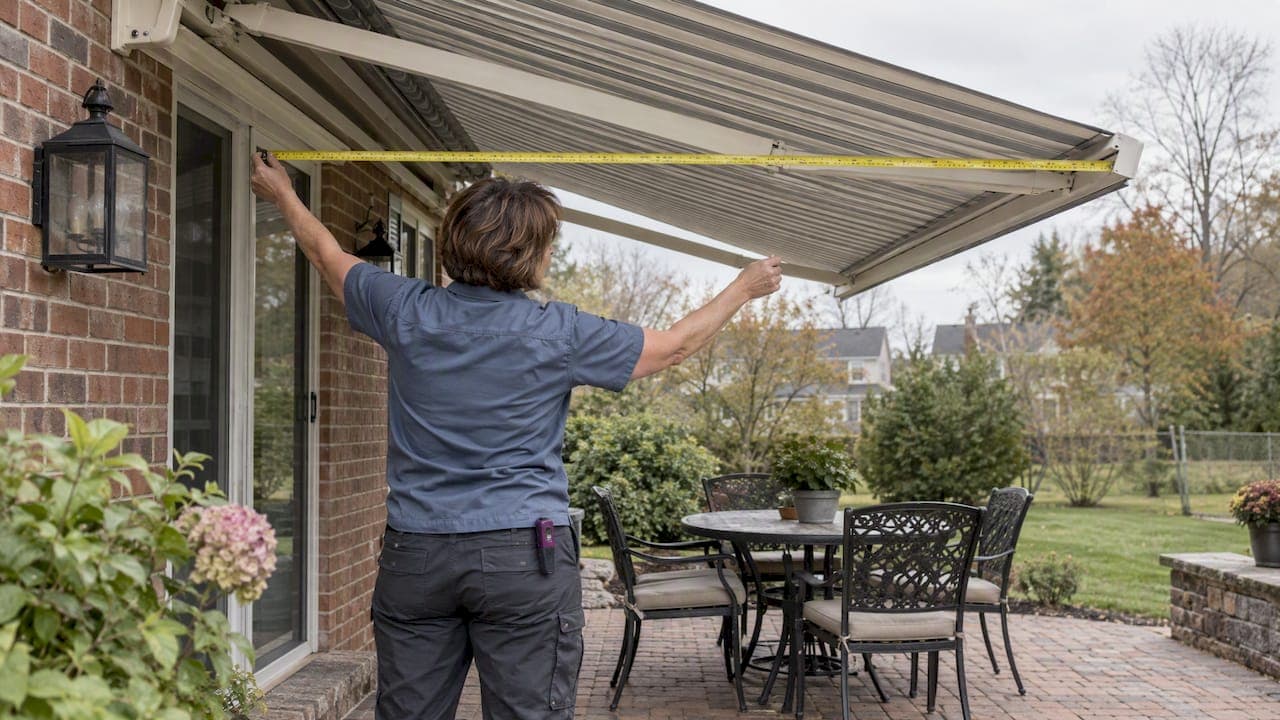
Whether you need a permit for an awning in Bucks County depends on the awning and on your township. Pennsylvania's state code exempts small window awnings from a building permit. Each of Bucks County's municipalities can still require a zoning permit or apply stricter rules. A large retractable patio awning is a different question from a small awning over a window.
This guide explains the state rule, where local rules take over, what to ask your township office, and how to avoid delays. It is written for homeowners in Bucks County, PA. It is general information, not legal advice, and your township's building or zoning office has the final say on your address.
TL;DR
- Pennsylvania's Uniform Construction Code exempts window awnings that are supported by an exterior wall, project no more than 54 inches and need no additional support.
- That is a state exemption. Your township or borough can add zoning, setback, lot coverage or electrical requirements.
- Larger retractable patio awnings, freestanding frames and motorized units are more likely to draw questions than a small window awning.
- If you live in an HOA or townhome community, you may need written board approval even when the township needs nothing.
- The property owner is responsible for permits. A good installer helps with the paperwork, but call your municipal office before you sign.
Table of Contents
- The state rule: the 54-inch window awning exemption
- Why your township can say something different
- Building permit, zoning permit, electrical permit: three different questions
- What the application usually looks like
- HOAs and townhome communities
- What happens if you skip a required permit
- Perspective: what we see in Bucks County homes
- Choosing an awning that keeps the permit question simple
- How we help: free in-home consultation
- A simple checklist before you order
- FAQ
- Sources
The state rule: the 54-inch window awning exemption
The Pennsylvania Uniform Construction Code (UCC) lists projects that do not need a building permit. One of them is window awnings supported by an exterior wall that do not project more than 54 inches and do not require additional support. The same exemption appears in the state's UCC administration chapter.
Three conditions all have to be true:
- The awning is supported by the exterior wall of the house.
- It projects 54 inches (4.5 feet) or less from that wall.
- It needs no extra support, such as posts, a added frame or reinforcement of the wall.
If any one fails, do not assume the exemption covers you. A wide patio awning that extends 10 or 12 feet from the back of a Levittown-style ranch or a Newtown colonial is well past 54 inches. A window awning is also a different product from a patio awning, so read the wording of the rule closely before applying it to your project.
Why your township can say something different
The state code sets a baseline. According to the state, over 90% of Pennsylvania's 2,562 municipalities administer and enforce the UCC, either with their own staff or through certified third-party agencies. Municipalities can also adopt their own ordinances. The state lists municipal code change ordinances that include Bucks County townships such as Bensalem.
In practice, a Doylestown Borough rowhouse, a Bensalem split-level and a Newtown Township twin can each get a slightly different answer. Dense older boroughs often have tighter setbacks, historic district review and sidewalk or right-of-way rules. Suburban townships tend to focus on lot coverage, setbacks and permanent structures in the yard.
This is a general pattern, not a promise about any one office. The only reliable answer comes from the municipality where the house sits. If you want a neutral explanation of why requirements vary from one town to the next and how to confirm yours, this guide on permits for backyard structures walks through the same questions.
Building permit, zoning permit, electrical permit: three different questions
Homeowners often say "awning permit" as if it were one thing. Your project can touch up to three separate approvals.

Building permit (UCC)
This covers structural safety. A small wall-mounted window awning within the 54-inch exemption does not need one under state rules. A larger awning, a frame that needs posts or a roof-like structure may.
Zoning permit
Zoning looks at where the structure sits on the lot, not how it is built. Middletown Township's zoning permit application asks for the site address, parcel number, owner, contractor and the type of work. The township's Building & Zoning page lists separate applications for building, electrical, mechanical and other permits.
Zoning staff typically want a site plan showing existing and proposed structures and impervious surfaces such as patios and driveways. An awning that sits on posts over a patio, or that changes drainage, can count toward lot coverage calculations even when no building permit is needed. Setback distances from property lines matter too.
Electrical permit
A manual crank awning has no wiring. A motorized awning with a hard-wired motor, a new outlet or a switch on the wall involves electrical work. Whether that work needs its own permit depends on the scope and on the municipality, so ask when you call.
| Project | Likely question | What to confirm |
|---|---|---|
| Small window awning, 54 inches or less, wall-mounted | State building permit exemption may apply | Whether your township adds zoning or other rules |
| Retractable awning over a patio or deck | Zoning, setbacks, possibly building review | Projection, mounting, lot coverage, setbacks |
| Motorized awning with new wiring | Electrical work | Whether a separate electrical permit is required |
| Freestanding or post-supported frame | Treated more like a structure | Building and zoning permits |
| Any awning in an HOA or townhome community | Association approval | Written board approval and guidelines |
The table is a planning aid, not a ruling. Final classification rests with your municipal officials.
What the application usually looks like
Using Middletown Township as one example, the process begins with contact with the Building & Zoning office. The township describes the first step as calling or contacting the department, where staff explain the requirements for your property and the work planned. Other townships run similar processes, and some now accept applications online.
Have this ready when you call:
- Your address and tax parcel number.
- A short description: awning type, width, projection from the wall, mounting method, fabric or frame material.
- Whether it is motorized and whether new wiring is needed.
- A sketch or survey showing the house, patio and property lines.
- The contractor's name and registration details if an installer is applying.
Fees vary by municipality and scope. As one data point, Middletown Township's published fee list included a $100.00 fee for certain accessory structure applications in 2025. Your township's schedule may differ, so ask for the current figure.
HOAs and townhome communities
A township approval does not replace association approval. Many Bucks County townhome and planned communities have written rules on awnings. For example, Newtown Gate's guidelines for retractable fabric awnings over patios say installations may be approved by the Board of Directors if they meet its published requirements.
If you live in a community like that, get the guidelines before you choose a color or size. Ask for approval in writing before installation. Boards often care about fabric color, mounting location, size and whether the awning is retracted when not in use. Our guide to awning fabrics for Bucks County climate and retractable use can help you pick a fabric that fits typical association color rules.
What happens if you skip a required permit
Pennsylvania is clear that the owner carries the responsibility. The state's UCC permit guidance says a permit is needed before starting construction work when one is required, and that building code officials can issue stop-work orders and take legal action when required work is done without one. Permits generally lapse if work does not begin within 180 days or is abandoned for 180 days.
The practical risks are more ordinary than a lawsuit: a stop-work order halfway through an install, a fee to correct the paperwork, or a question at resale. Realtors and buyers' inspectors sometimes ask about permits for exterior additions. Having a clear record of what your township said is cheap insurance.
Perspective: what we see in Bucks County homes
We sell and install awnings and patio shades, so people ask us about permits almost every time. Here is our honest view.
Most of the confusion comes from treating all awnings alike. A small wall-mounted awning over a kitchen window and a wide retractable awning over a deck are not the same project. We measure every job on site, so we know the projection, the mounting surface and the layout of the patio before anyone talks about paperwork. That is when the permit question becomes concrete rather than theoretical.

Our advice is simple. Decide on the size and mounting first. Then call your township's building or zoning office with those details, not with a vague question. Ask three things: is a building permit needed, is a zoning permit needed, and is any electrical permit needed for a motor. Write down the name of the person and the date. If you are in an HOA, send the board your request in writing at the same time.
We will not claim a permit is never needed, and we will not tell you one is always needed. The owner is responsible, and the township decides. What we can do is give you accurate dimensions, mounting details and product information so your application is complete the first time. If you plan a motorized awning, we can also explain how it connects with smart-home systems such as Alexa, so any electrical question is clear before you call.
— Tony
Choosing an awning that keeps the permit question simple
Some choices make approval easier, whatever your township says.
- Keep the projection modest. If a window awning fits the 54-inch limit, you stay inside the state exemption, though your township still has the last word.
- Mount to the house. Wall-mounted units avoid the posts and footings that make something look like a structure.
- Think about the right-of-way. On a lot near a sidewalk, anything projecting over public property raises separate questions that your municipality handles.
- Plan the wiring early. If you want a motorized awning, tell the township and your installer where power will come from.
- Match your HOA's color palette. Choosing fabric from the start saves a resubmission.
Budget matters too. Our pages on retractable awning cost and outdoor shades budgets explain what drives the price. If your property turns out to need a permit, factor in the municipal fee and the time it takes. Also consider whether outdoor patio shades could meet your goal. They attach differently from a projecting awning, and some homeowners find them a simpler fit for a covered porch or patio.
How we help: free in-home consultation
Made in the Shade Bucks County has no storefront. We bring samples to your home and measure the space. A personal design consultant walks you through retractable awnings and fabrics, motorization options, and the mounting and projection details your township will ask about. The consultation is free, and measurement and installation are handled by trained professionals.
We do not file permits for you as a guarantee of approval, and the final responsibility stays with the owner. But we can give you the exact specifications you need to ask the right questions. We serve homeowners across Bucks County, PA and Mercer County, NJ. If you also have a property in New Jersey, see why New Jersey homeowners get different awning permit answers.
A simple checklist before you order
- Measure the wall, the patio and the distance to your property line.
- Decide on the projection and mounting method.
- Check your HOA guidelines, if any, and request written approval.
- Call your township or borough office and ask about building, zoning and electrical permits.
- Note the answer, the date and the name of the person you spoke with.
- Sign with your installer only once you know which approvals apply.
- Keep copies of approvals with your home records.
If an application is required, allow for processing time. Spring is when many homeowners in the Philadelphia suburbs start thinking about patio season, and municipal offices tend to be busier then. Calling in late winter gives you room.
FAQ
Do I need a permit to put up an awning in Bucks County?
Not always. Pennsylvania's code exempts window awnings supported by an exterior wall that project 54 inches or less and need no extra support. Your township can still require a zoning permit or have stricter rules, and larger patio awnings are more likely to need review. Call your municipal office to be sure.
What can a homeowner do without a permit in Pennsylvania?
The state's code lists specific exemptions, including small window awnings that meet the 54-inch limit, and the exact list is in Chapter 403 of the UCC. Municipal zoning rules apply separately. Even exempt work may need a zoning permit, so confirm locally.
What is the penalty for building without a permit in Pennsylvania?
Under the UCC, code officials can issue stop-work orders and legal action can follow when required work is done without a permit. Fees and corrective steps vary by municipality. The owner is the one responsible, so ask your township about its specific penalties.
Who is responsible for getting the permit, me or the installer?
The property owner is responsible for making sure required permits are in place. An experienced installer can prepare dimensions and paperwork and often applies as the contractor. Confirm in writing who is applying before work starts.
Does my HOA need to approve an awning even if the township does not?
Yes, if your community rules require it. Associations can set color, material and location rules on top of municipal law. Ask the board for the guidelines and get approval in writing.
Ready to talk through your patio or windows? Request a free in-home consultation with Made in the Shade Bucks County, and we will bring the samples to you.
Sources
- Pennsylvania Code: UCC permit exemptions (window awnings)
- Pennsylvania UCC Chapter 403, Administration (PDF)
- Apply for a Uniform Construction Code Building Permit, Commonwealth of Pennsylvania
- Uniform Construction Code, Pennsylvania Department of Labor and Industry
- Municipal Code Change Ordinances, Pennsylvania Department of Labor and Industry
- Building & Zoning, Middletown Township
- Apply For a Permit, Middletown Township
- Zoning Permit Application, Middletown Township (PDF)
- Retractable Fabric Awnings over Patios, Newtown Gate
- Do you need permits for backyard storage?