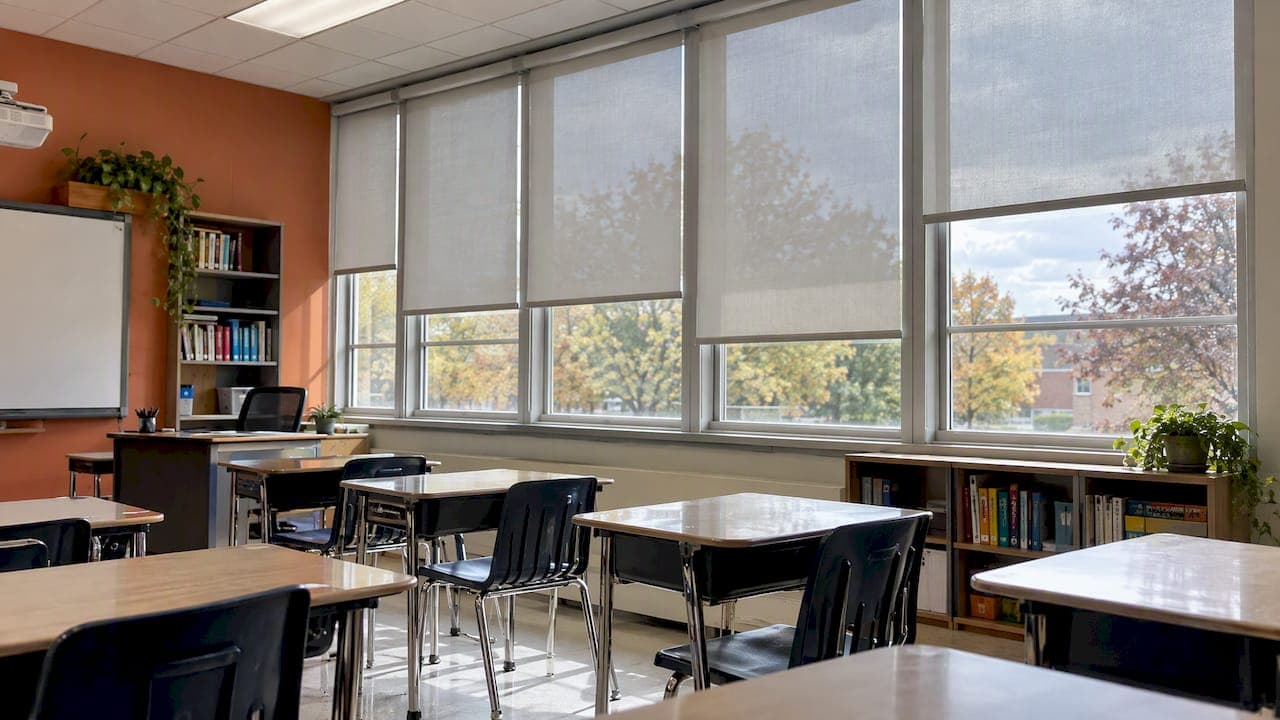
The best classroom window shades are usually roller shades with a light-filtering fabric, paired with a darker option where a room needs to be dimmed for projection or rest. Add simple operation, durable materials and, for door glass, a covering that can block the view quickly. The right mix depends on which way the windows face, what happens in the room, and who runs the shades every day.
This guide covers school classrooms, preschools, daycare rooms, tutoring centers, church education rooms and home learning spaces. It draws on published school design standards and daylighting research, then explains how a custom, professionally measured install works for properties in Bucks County, PA and Mercer County, NJ.
TL;DR
- Roller shades are the standard classroom choice in published school specifications. The openness of the fabric is picked by window orientation, and blackout is kept for rooms that need it.
- South-, east- and west-facing windows need more control than north-facing ones, for both glare and heat.
- Classroom-door glass should have a covering that can block the view quickly. Check the choice with your local first responders and code officials.
- Cordless or motorized operation, durable fabric and a clear owner for daily use matter more than the shade itself.
- Made in the Shade Bucks County measures, supplies and installs custom shades after a free in-home or on-site consultation.
Table of Contents
- What classroom shades have to do
- Types of shades used in classrooms
- Glare control without losing daylight
- Window orientation: which windows need the most help
- Heat, energy and comfort
- Door windows and classroom safety
- Materials, controls and child safety
- What to settle before measuring and installing
- Our perspective
- Plan your classroom shades with a local team
- FAQ
- Sources
What classroom shades have to do
A classroom shade works harder than a living room shade. It has to cut glare on a whiteboard or screen, keep the room from overheating, protect privacy, survive daily handling by many people, and in some rooms go dark on demand.
Published standards reflect this. Ohio's state roller shade specification lists roller shades with light-filtering or audiovisual light-blocking fabric. The University of Kansas classroom standards, updated in August 2026, specify roller shades in classrooms with 1%, 3% or 5% openness chosen by window orientation. Blackout shades are kept for unique circumstances.
That tells you where to start. Most rooms need glare and heat control with daylight kept. A smaller number need true darkness.
Types of shades used in classrooms
Roller shades
Roller shades are the workhorse. They are a single flat fabric panel that rolls up neatly, they suit wide banks of windows, and they come in light-filtering, solar and blackout fabrics. They can be operated by hand, by a cordless lift or by a motor.
Solar shades
Solar shades use a woven fabric with a stated openness percentage. A lower percentage lets in less light and heat and gives more glare control. A higher percentage keeps more of the outside view. Our guide to solar shade percentages explains how to read those numbers, and our solar shades page shows the range we offer.
Blackout and room-darkening shades
Blackout fabric blocks nearly all light. Room-darkening fabric dims a room without making it fully dark. In a classroom, true blackout makes sense for projector-heavy rooms, nap rooms, media rooms and any space where lights-off instruction is routine. The Kansas standards say that south-, east- and west-facing windows in rooms that need darkening require greater blackout capability than north-facing windows.
Cellular, blinds and shutters
Cellular shades add insulation and sound softening in smaller rooms. Window blinds give adjustable slat control, and vertical blinds handle large glass openings and sliding doors. In a small learning room or home classroom, shutters offer a sturdy, easy-to-wipe option.
Layered treatments
Some spaces, such as a church fellowship hall or a multi-use community room, benefit from a light-filtering shade plus a darker layer. Our guide to how to layer window treatments covers the idea.
Glare control without losing daylight
The goal is not to shut the sun out. It is to put it where it helps. The Lighting Research Center's school daylighting guidance says direct beam sunlight should be bounced, redirected or filtered so it does not enter problem areas of classrooms, with shades or blinds installed for darkening where that is functionally required.
The Northeast CHPS operations guide goes further. It recommends replacing simple shades with systems that direct sunlight onto ceilings and walls for glare-free daylight, and keeping views rather than defaulting to blackout shades.
In practice, that means:
- Choose a light-filtering or solar fabric for the main windows, so the room stays bright.
- Keep views where you can. Windows that always sit behind closed shades add nothing to the room.
- Add a darker shade only on the windows that face the screen or board, or only in the rooms that truly need it.
- Think about the seating plan. Students facing a bright window will squint no matter how good the lights are.
If you are weighing shades for a home office or study corner, our post on glare-reducing window shades covers the same principles at home scale.
Window orientation: which windows need the most help
The direction a window faces decides how hard the shade has to work. The Northeast CHPS guide identifies east and west exposures as problematic year-round and south exposures as especially problematic in winter, and recommends shades to control excess daylight and overheating.
For the greater Philadelphia suburbs, that matches what homeowners see. Low morning sun in east rooms, hot late-afternoon sun in west rooms, and a low winter sun that reaches deep into south rooms. If you want a wider look at how orientation affects glass area and heat, this explainer on window orientation and glass area is a helpful companion.
A simple way to plan:
| Window facing | Typical issue | Shade approach |
|---|---|---|
| East | Strong low morning sun, glare at start of day | Lower openness solar or light-filtering roller shade |
| South | Winter sun low and deep into the room | Light-filtering shade that can be adjusted by time of day |
| West | Afternoon heat and glare | Low openness fabric, or blackout where the room needs darkening |
| North | Even, softer light | Higher openness to keep the view and daylight |
This table is a planning aid, not a specification. Final fabric choices are best made with samples held up to the actual windows, which is exactly what an in-home or on-site consultation allows.
Heat, energy and comfort
Shade choice affects summer comfort and cooling load. The Efficient Windows Collaborative's Tools for Schools notes that both interior and exterior shading can reduce solar heat gain, and that daylight can reduce electric light use and indirectly cooling loads.
How shades are operated matters as much as the fabric. The Advanced Buildings Daylighting Pattern Guide says manually operated blinds are only marginally effective for heat gain and are often left closed unnecessarily, while automated external shading handles heat gain and glare more effectively.
Two takeaways for a classroom or learning room:
- Pick a fabric that works with the shade partly down, so staff do not need to close it fully to get relief.
- Consider motorization on large or hard-to-reach windows, so shades actually get adjusted. Our window motorization page explains the options, and our energy saving window treatments page covers insulation and heat control.
Door windows and classroom safety
Door glass is a separate question from the main windows. New Hampshire's School Safety Resource Center recommends shades or equivalent coverings on classroom-door glass so visibility into the room can be blocked quickly in a security incident. It advises consulting first responders and code officials about compliance and law-enforcement needs.

The New York State Education Department's 2025 Safe Schools by Design guide adds balance. It notes that exterior blinds may limit an assailant's line of sight, but that daylight and views out remain important to a healthy learning environment. It recommends evaluating window protection with administrators, security staff, licensed design professionals, law enforcement and emergency responders.
What that means for you:
- Treat door coverings as a safety item. Decide the product with your fire marshal, local police or school safety officer before you order.
- Make sure staff can operate the covering quickly and with one hand, every time.
- Keep the main windows light-filtering so daylight is not sacrificed for a security measure that only the door needs.
A custom shade can be made to fit door glass, but the safety rules for your building come from your local officials, not from a shade installer.
Materials, controls and child safety
Fire performance and operating hardware are not details to leave until the end. Ohio's roller shade specification calls for NFPA 701 fire performance, listed and labeled motorized operators and WCMA A100.1 compliance. It allows cordless precision-lift, manual or motor-operated shades, and describes motorized controls with a keyed station, crank override and limit switches.
For larger facilities, Northwestern University's roller shade specification includes manual overrides, automatic control, central computer control and monitoring. Closer to the classroom, K-12 designers have begun tying motorized shade controls into lighting scenes, with controls at the teaching lectern or desk for daylighting and projection.
For rooms with young children, the simplest rule is to avoid hanging cords. Made in the Shade Bucks County offers cordless, child-safe lift options, and motorized shades that work with Alexa and other major smart-home platforms. That is helpful in a home classroom, a playroom or a small learning center where one remote or voice command replaces a row of cords.
When you compare fabrics, ask about:
- Fire rating documentation for the fabric you are choosing.
- How the fabric is cleaned, since classroom shades get touched.
- Whether the lift system is cordless, and what the manufacturer warranty covers.
What to settle before measuring and installing
Large institutions write long specifications for good reason. The University of Texas at Arlington's guide requires product data, installation and operating instructions, shop drawings with head, jamb, sill and pocket dimensions, samples and fabric test reports. It also assigns design, engineering and installation to one manufacturer and authorized dealer, and requires a five-year warranty on hardware and shade material.
You do not need a full specification for a single room, but the same questions apply at any scale:
- Who uses the shades daily? Teachers, aides or a parent? Choose controls to suit them.
- Which windows are the problem? Note orientation, time of day and where the glare lands.
- Does the room need true darkness? If yes, which windows, and how often?
- What are the mounting conditions? Inside or outside mount depends on the frame depth, trim and any obstructions.
- Who is responsible for upkeep? The Northeast CHPS guidance treats glare control, views, cleaning and staff training as an operating system, not just a product choice, and recommends maintaining shade controls.
- What does the warranty cover? Ask for it in writing before you sign.
Accurate measuring matters more than most buyers expect. A shade that is slightly narrow lets light leak at the sides, and one that is slightly wide may bind in the frame. Made in the Shade Bucks County measures every project and installs it with trained professionals, so the fit is handled by the same team that sold the shade.
Our perspective
We bring the showroom to your room. That matters for classrooms, because a shade that looks right on a sample board can behave very differently once the afternoon sun hits it.
When we are asked about classroom window shades, we start with the windows, not the catalog. Which way do they face? Where does the glare land? Does anyone need the room truly dark, or just calmer? Most of the time the answer is a light-filtering roller shade on the bright windows, and a darker fabric only where the room calls for it.
We also favor shades that are easy to run. A shade that is awkward to adjust gets left closed, and that wastes the daylight you paid for. Cordless lifts keep things safe around children, and motorization makes big windows simple to manage with a wall control, remote or voice command.
Our products carry manufacturer warranties, most with limited lifetime coverage, and our team measures and installs every job. We would rather spend an hour with samples in your space than guess from a photo.
Tony
Plan your classroom shades with a local team
Made in the Shade Bucks County serves homeowners, realtors and commercial clients throughout Bucks County, PA and Mercer County, NJ. If you are setting up a home classroom, a tutoring room, a daycare space or another learning room, we can bring samples to you, help you compare fabrics against your actual windows, and handle measuring and installation.
Browse our window shades to see the styles available, or read about our commercial window treatments for larger or business-owned spaces. For code-minded projects, our blog on commercial window treatment ideas that meet code and budget is a good place to start. When you are ready, request a free consultation.
FAQ
What is the best type of window shade for a classroom?
Roller shades are the most common choice in published school specifications, usually in a light-filtering fabric with a chosen openness percentage. They handle glare, work on wide windows and can be operated by hand, cordless lift or motor. Rooms that need darkness can add blackout fabric on selected windows.
Do classrooms need blackout shades?
Only some do. Research-based guidance favors keeping daylight and views, and the University of Kansas standards reserve blackout for unique circumstances. Rooms used for projection, rest time or lights-off activities are good candidates, especially on south-, east- and west-facing windows.
What should cover the glass in a classroom door?
Guidance from New Hampshire's School Safety Resource Center recommends a shade or equivalent covering that can block visibility quickly. The exact product and mounting should be agreed with your local first responders and code officials before you order.
Are cordless shades a good idea around children?
Yes. Cordless lifts remove dangling cords from reach, which is why we offer cordless, child-safe options. Motorized shades are another cord-free choice and can be controlled with a remote, wall switch or compatible smart-home platform.
Can Made in the Shade Bucks County help with a classroom or learning space?
We serve homeowners, realtors and commercial clients in Bucks County, PA and Mercer County, NJ. We offer a free in-home or on-site consultation, with samples brought to you, followed by professional measuring and installation. Request your free consultation to talk through your room.
Sources
- Ohio roller window shades specification (12 24 13)
- University of Kansas Classroom Standards, August 2026
- Lighting Research Center daylighting guidelines
- Northeast CHPS operations and maintenance guide
- Efficient Windows Collaborative, Tools for Schools
- Advanced Buildings Daylighting Pattern Guide, Pattern 18
- New Hampshire School Safety Resource Center, Access Control
- NYSED Safe Schools by Design Act guide, April 2025
- Northwestern University roller window shades specification
- Designing efficient K-12 schools, Consulting-Specifying Engineer
- UTA guide specifications for window shades
- Window orientation and glass area guide