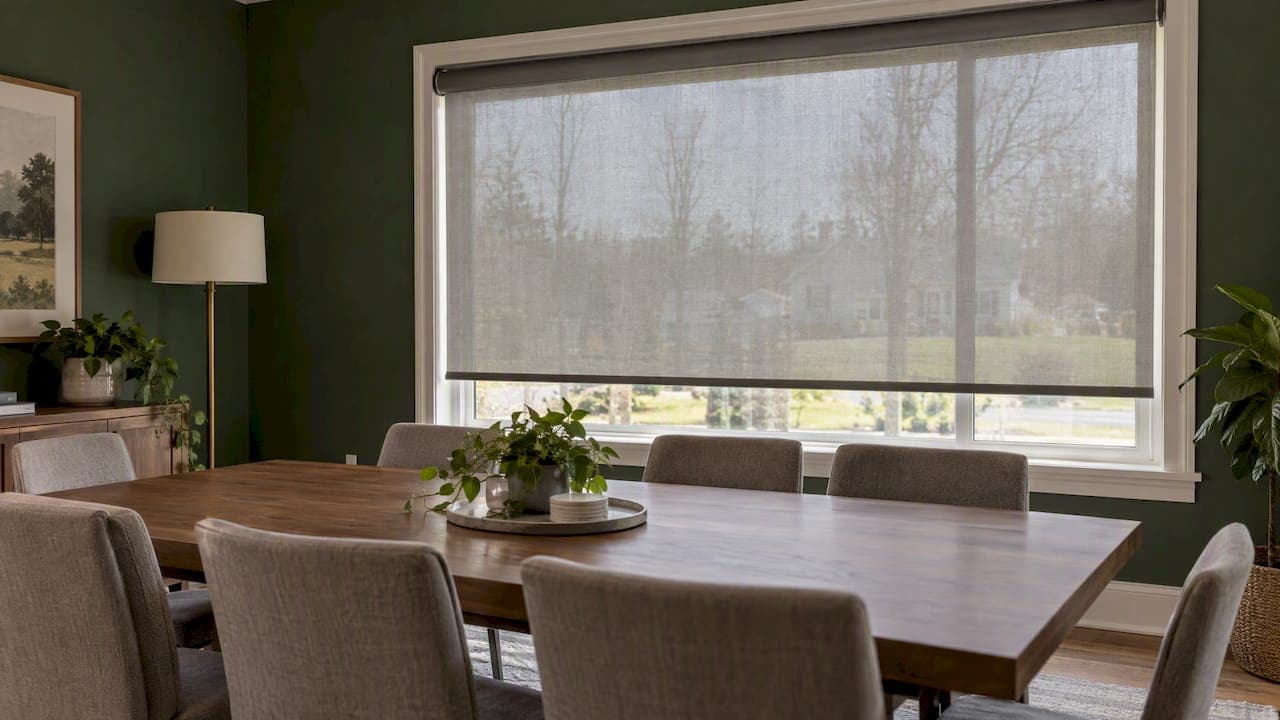
The best conference room privacy shades depend on one trade-off: the more privacy a fabric gives, the less view and daylight it passes. Most meeting rooms end up with one of three answers. A tightly woven light-filtering roller shade handles daytime privacy and screen glare. A blackout or dual-shade setup handles confidential sessions and presentations. Motorization makes either option easy to use. Below, we explain how each works, where each one fails, and how to decide for your own room.
TL;DR
- Privacy in a conference room is about what people can see, not just whether light comes in. Fabric openness, color and weave decide that.
- Mesh and light-filtering shades work well by day, but when the lights are on at night, people outside can often see in. Opaque blackout fabric is the fix for nighttime privacy.
- Dual shades (one light-filtering, one blackout, on the same window) cover glare control, daily privacy and full darkness for presentations.
- Motorized controls with preset scenes keep shades at the right position without anyone fiddling with cords before a meeting.
- Made in the Shade Bucks County measures, advises and installs for commercial spaces in Bucks County, PA and Mercer County, NJ, starting with a free in-home or on-site consultation.
Table of Contents
- What privacy means in a meeting room
- Fabric types and how they differ
- Can people see in? Day versus night
- Solving glare without sitting in the dark
- Motorized and smart controls
- Shades or privacy film?
- How to choose: a practical checklist
- Our perspective
- Window treatments for commercial spaces from Made in the Shade Bucks County
- FAQ
- Book your free in-home consultation
- Sources
What privacy means in a meeting room
People use the word "privacy" for two different problems. One is that passersby, neighbors in the next building or people in the hallway can see who is in the room and what is on the table. The other is that they can read what is on a whiteboard or screen. A shade that blurs faces into shapes solves the first. It may not fully solve the second.
Draper's white paper on shades and privacy makes this distinction, noting that privacy shades must balance privacy against natural light, outside views, room design, window size, location and budget. It also separates real privacy from simply obscuring fine detail. That is a useful way to frame your own list of needs.
Before you look at a single sample, answer these questions:
- Who can see into the room? A street-level storefront, a hallway with glass walls and a parking lot all call for different coverage.
- What gets discussed? Routine team meetings need less than HR, legal or financial conversations.
- When is the room used? A room that is busy only from 9 to 5 has a different night problem than one used for evening client calls.
- Is there a screen or projector? If yes, glare and darkness matter as much as privacy.
Fabric types and how they differ
Hunter Douglas Architectural's fabric guide sorts commercial shade fabrics into transparent, translucent, privacy or blackout, and dual options. Here is how those categories play out in a conference room.
| Fabric type | What it does | Best for | Watch out for |
|---|---|---|---|
| Transparent | Keeps the view through the glass, minimal privacy | Rooms where outward views matter more than discretion | Little privacy for anyone looking in |
| Translucent (light-filtering) | Improves glare control and privacy, reduces exterior view | Everyday meetings, screens near windows | Not private at night with lights on |
| Privacy or blackout (opaque) | Strongest light control, no view-through | Confidential sessions, presentations | Blocks daylight and views when closed |
| Dual shades | Two fabrics on one window | Rooms with mixed uses | Higher cost and a deeper headrail |
The same guide notes that the right choice follows the task: transparent fabrics favor views, translucent fabrics favor glare control with diffused daylight, and privacy fabrics suit meeting rooms that need strong light control.
Openness, color and weave
Two shades that look similar on a sample card can behave very differently once they are on the glass. Three details matter.
Openness. This is the percentage of open space in the weave. Crestron's design guide describes sheer or basketweave fabrics at roughly 3 to 10% openness, which transmit light and help with glare. It describes light-filtering fabrics, typically 0 to 1% open, as transmitting diffused light while reducing the exterior view to partial silhouettes and shadows. Hunter Douglas Architectural gives a handy rule of thumb: a fabric with 3% openness blocks about 97% of UV light.

Color. Draper explains that darker mesh generally gives a better view out from the room, while lighter mesh gives more privacy. Phifer, a fabric maker, adds that darker fabrics usually improve outward visibility but can provide less privacy at night. If your priority is glare control on a screen, a darker mesh may feel better. If your priority is keeping the room private, lean lighter.
Weave. According to the same Draper paper, tighter twill weaves offer more privacy than looser basketweaves. This is why you should always look at samples in your actual room, in your actual light, instead of choosing from a swatch under office fluorescents.
Can people see in? Day versus night
This is the question we hear most. The honest answer is: it depends on the time of day.
Draper says most offices can use mesh shades for daytime privacy and outward views, but privacy becomes a much bigger issue at night when the space is occupied and lights are on. Phifer makes the same point: daytime performance depends on openness, fabric color and the contrast between interior and exterior light, and interior lighting can reverse that picture after dark. For rooms that need privacy at night, Phifer recommends opaque blackout fabric.
In practice, that means:
- Daytime: A light-filtering shade is usually enough, because the outside is brighter than the inside. People looking in see mostly reflection and glare.
- Evening with lights on: The contrast flips. A screening fabric can turn into a lit display case. If the room is used after dark, plan for an opaque layer.
- Blackout shades: These use opaque fabric, so they block natural light and the view completely when closed. They are the right answer for confidential sessions and A/V presentations, but not as a default setting for the whole day.
In the Philadelphia suburbs, where winter sunset arrives before many offices close, this matters more than people expect. A room that felt perfectly private in the showroom sample on a July afternoon can feel exposed at 5:15 PM in December.
Solving glare without sitting in the dark
A conference room with a wall display and a bright window is a common problem. People squint, the camera on a video call washes out, and someone ends up closing the shades all the way and turning on every light.
A better approach is to choose a fabric that reduces glare while keeping some daylight, and then adjust position through the day. The Lawrence Berkeley National Laboratory (LBNL) recommends window coverings that let some light in while controlling sun and glare, with individual control because people tolerate glare differently. Its residential windows page also notes that indoor coverings are used mostly for aesthetics, privacy and glare control.
For a room that doubles as a screening space, translucent coverings that soften daylight help the picture without making the room feel closed in. The same idea applies at home, and a guide on softening glare on a TV screen walks through why diffused light and controlled views help. For more on glare in work spaces, see our own article on glare-reducing window shades for home offices.
Dual shades for mixed-use rooms
If your room serves both a sunny brainstorm and a confidential review, two fabrics on one window can solve it. Draper describes dual-roller systems as pairing a light-blocking shade with a light-filtering shade. Occupants can choose privacy or darkening, or glare control with view-through. We find this is the setup most conference rooms with real windows end up wanting. It is the layered-treatment idea applied to an office, and our guide to layering window treatments explains the logic.

Bottom-up and top-down coverage
When the issue is people walking past a ground-floor window, you may not need to cover the whole pane. Draper notes that bottom-up shades block views through the lower part of a window while allowing light through the upper portion. It is a good fit for street-level offices in a town like Doylestown or Newtown, where the sidewalk sits close to the glass.
Motorized and smart controls
Shades that nobody can reach, or that end up at three different heights, are a daily irritation. Motorization fixes both. Lutron's commercial brochure describes conference rooms as a natural fit for intelligent shading and lists wall controls, mobile-device and PC control, wireless remotes, keypads, preset scenes and lighting integration. Its contract roller sheet adds centralized monitoring to that list and notes that integrating lights and shades allows coordinated control of both.
The most useful feature in meeting rooms is the preset scene. One button can lower the blackout layer, dim the lights and bring up the display. Another returns the room to daylight mode.
Some systems go further. Lutron's Hyperion solar-adaptive control lowers shades for direct sun, adjusts for bright-sky contrast, closes them against reflected glare, and opens them when it is overcast. That is a system-level design decision usually made with the building's controls in mind, so it is best discussed early.
On the product side, Draper's LightBloc Motorized FlexShade is designed for conference rooms and similar spaces. Its fabric-retention system and side channels are intended to limit light leakage, a detail worth asking about for any blackout shade you plan to use with a projector.
At Made in the Shade Bucks County, we specialize in motorized and smart-home-compatible shades that work with Alexa and other major platforms. Cordless and motorized lifts also remove dangling cords, which is a safety plus in any space visited by children, from a pediatric practice to a church committee room.
Shades or privacy film?
Privacy film is the other option you will hear about, and it deserves a fair look. Film works well on interior glass partitions where you want a permanent frosted look. Shades fit better when you want to change your mind during the day.
| Consideration | Shades | Film |
|---|---|---|
| Adjustability | Raise, lower or tilt to any position | Usually one fixed look unless it is a switchable type |
| Daylight control | Fabric choice plus position | Fixed once applied |
| Blackout for presentations | Available with opaque or dual shades | Not generally a blackout solution |
| Glare control | Can be adjusted by time of day | Limited to what the film does |
| Look | Soft, tailored, and can match the office decor | Clean and minimal |
| Smart control | Motorized with scenes | Only with switchable film |
If your conference room has exterior windows with changing sun, shades usually have the edge. If your concern is an interior glass wall facing a corridor, film can be a reasonable choice, and some rooms use both. We sell and install window treatments, so we are not the right provider for film. We would rather be clear about that than steer you wrong.
How to choose: a practical checklist
Use this list when you meet with any provider.
- Define the privacy goal. Hiding detail from passersby is different from blocking all view in.
- Map the sun. Which wall faces south or west? Glare from a low winter sun in Bucks County hits differently than a high July sun.
- Plan for night. If the room is used in the evening, add an opaque layer or choose dual shades.
- Pick openness and color together. Lower openness gives more privacy and less light. Lighter colors add privacy, darker colors improve the view out.
- Decide how people will operate them. Wall keypad, remote, app or voice. Motorize anything large, high or hard to reach.
- Check the mount. Inside mount, outside mount, ceiling pocket and side channels each change light gaps.
- Ask for samples in the room. Hold them against the glass at the hours the room is actually used.
- Consider accessibility and code. Commercial spaces have their own requirements. Our article on commercial window treatments that meet code and budget is a good starting point.
Our perspective
Most conference room shade problems we are asked to solve trace back to one decision made too early: someone picked a fabric from a catalog photo. The room then turned out too dark, too exposed at night, or too bright on the screen.
We approach it the other way around. We bring the samples to you, so you can see them against your glass, at the hour the room is used, with the lights on and off. The first questions we ask are about people, not products: who sits where, who passes by, and what gets said.
Our usual recommendation for a room with real windows is a light-filtering layer for everyday use, with an opaque layer available for the moments that need it. Motorization is worth considering for any large or high window, because shades that are easy to use are shades that actually get used. We also like to keep things cordless wherever possible.
That is our view, based on how our customers use their spaces. Your room may call for something simpler, and we will say so.
— Tony
Window treatments for commercial spaces from Made in the Shade Bucks County
Made in the Shade Bucks County serves commercial clients and property managers in Bucks County, PA and Mercer County, NJ. We bring the showroom to you: a personal design consultant brings sample collections to your office, helps you compare fabrics against your own windows, measures every opening, and handles installation with trained professionals. Our products carry manufacturer warranties, most with limited lifetime coverage.
See our commercial window treatments page for what we offer offices, and browse our window shades for roller, solar, cellular and other styles. If you are weighing privacy by room across a whole property, our guide to privacy window treatments by room can help you plan.
FAQ
Can people see into my conference room through the shades?
It depends on the time of day and the fabric. In daylight, a tightly woven light-filtering shade usually reduces outsiders' view to shapes and shadows. At night with the lights on, screening fabrics can let people see in, so an opaque blackout layer is the safer choice for evening use.
What is the best shade for a conference room with a TV or projector?
A dual shade setup is the most flexible choice. A light-filtering shade tames glare during normal meetings, and a blackout shade closes for presentations. Side channels or tight mounting help limit light leaks around the edges.
Are motorized shades worth it for a meeting room?
For large, high or multiple windows, yes. Preset scenes let anyone set the room with one touch, and cordless operation removes cords from the space. Motorized shades from Made in the Shade Bucks County can be compatible with Alexa and other major smart-home platforms.
Should I use shades or privacy film?
Choose shades when you want to change privacy and light through the day, especially on exterior windows with shifting sun. Film fits permanent frosted looks on interior glass walls. Some rooms combine the two.
How do I get started?
Start with a free consultation. We come to your office with samples, measure the windows and talk through how the room is used before recommending anything.
Book your free in-home consultation
If you manage an office, practice or rental property in Bucks County, PA or Mercer County, NJ, we will bring samples to your conference room, measure the windows and help you choose shades that balance privacy, light and glare. Request your free consultation with Made in the Shade Bucks County and see the options in your own room.
Sources
- Draper, Shades and Privacy white paper
- Hunter Douglas Architectural, Guide to Fabric Selection
- Crestron, Design Guide: Shading Solutions
- Phifer, Privacy and one-way window shades
- LBNL, Tips for Daylighting
- LBNL, Residential Windows and Attachments
- Lutron, Commercial Shade Brochure
- Lutron, Contract Roller Sell Sheet
- Lutron, Commercial Roller Shade Selection Guide
- Draper, LightBloc Motorized FlexShade
- TV glare solutions