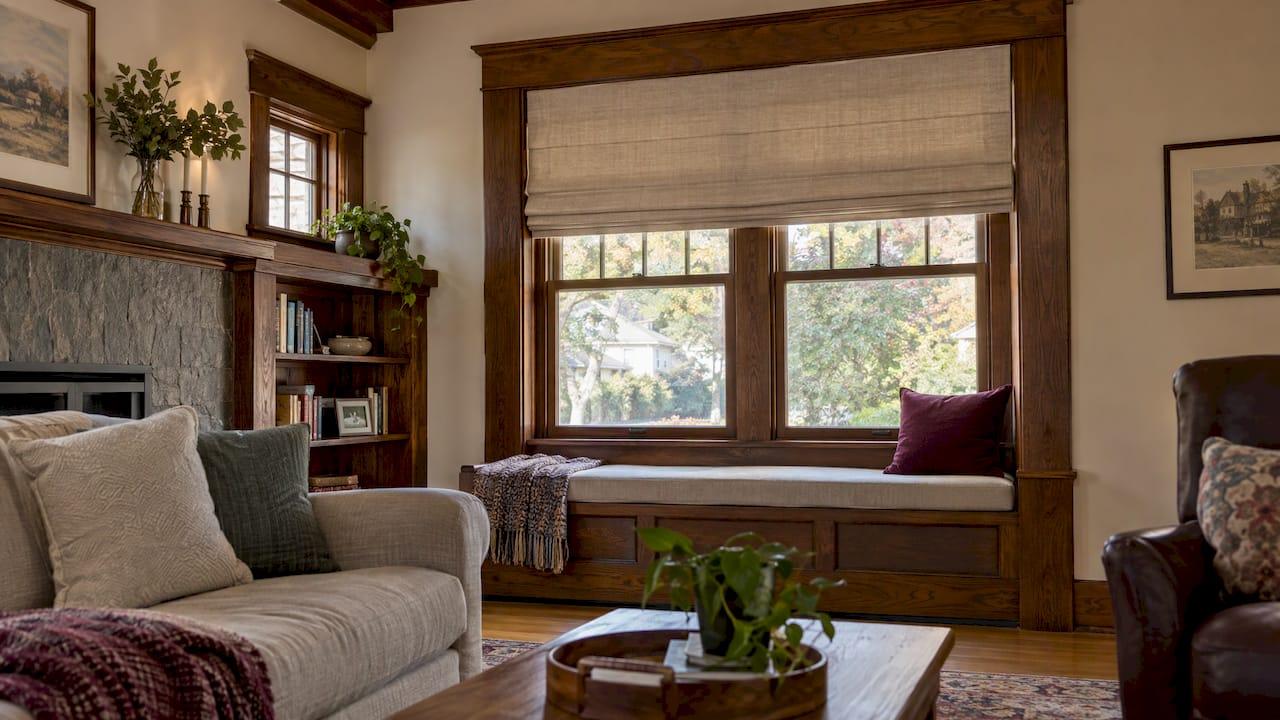
The best window treatments for a Craftsman home are simple, natural and mounted so the woodwork stays visible: wood blinds, woven wood shades, flat-fold Roman shades, roller shades and plain drapery panels. Made in the Shade Bucks County helps homeowners across Bucks County, PA and Mercer County, NJ choose and install these styles through a free in-home consultation. This guide explains what suits Craftsman and Mission-style windows, how to mount treatments around deep casings, and how to handle strong sun and child safety.
TL;DR
- Choose natural textures (wood, woven grasses, cotton and linen-look fabrics) and clean lines that echo Craftsman and Arts and Crafts design.
- Inside mounts keep stained trim on display. Where casings are shallow, an outside mount sized to the trim works better.
- Match wood blinds and shutters to your trim, and keep patterns bold but plain, drawn from nature.
- For west-facing or large windows, layer a light-filtering shade with drapery, or choose cellular shades for insulation.
- Choose cordless or motorized lifts if children live in or visit the home.
Table of Contents
- What makes Craftsman windows different
- The best window treatments for Craftsman homes
- Mission-style window coverings: what to look for
- Inside mount or outside mount: protecting the trim
- Light, privacy and insulation: how the options compare
- Large windows and strong sunlight
- Child safety and smart controls
- Get a Craftsman-friendly plan in your home
- FAQ
- Sources
What makes Craftsman windows different
Craftsman windows are the star of the room. Double-hung windows with stained wood interiors are the predominant type in the style, and Andersen's Craftsman bungalow style book notes that colors lean toward warm, earthy browns, greens, burgundies and yellows. It also describes grilles on upper windows that are vertically proportioned or square, never horizontal.
That has a practical meaning for you. The wide casings, deep sills, built-ins and divided upper sashes are what people love about the house. A good treatment frames them rather than covers them.
Across the Philadelphia suburbs, you will find this look in true early-1900s bungalows and in the many newer homes and renovations built with Craftsman trim. The advice below applies to both.
The best window treatments for Craftsman homes
Wood blinds
Real wood is the most natural match for stained casings. Match the blind to the trim you already have. Havenly's design guide suggests matching the stain of wood blinds or shutters to existing trim, such as maple blinds with maple trim, or a painted white wood or resin option where the trim is white.
Louvered blinds also give you more control over light and view than most other conventional interior coverings, reducing glare and solar heat gain, according to Efficient Window Coverings. Tilt them up for a view of the maple outside, down for privacy. Our wood blinds are measured and installed by trained professionals.

Woven wood shades
Woven wood shades bring in grasses, bamboo and reeds, the kind of natural material that sits comfortably beside oak and fir. They filter light softly and add texture without pattern. They suit dining rooms, studies and living rooms where you want warmth rather than a crisp, modern look.
They also carry a flat valance at the top that can hide the hardware. We cover woven wood and other window shades in a range of styles, so you can compare fabrics against your own trim in daylight.
Roman and roller shades
Flat-fold Roman shades in a plain cotton or linen-look fabric are a classic choice. Keep the fabric solid, or with a simple woven stripe or small stenciled-style motif. Skip heavy ruffles and fussy swags, which clash with the straight lines of the woodwork.
Roller shades are even simpler. Roller shades can darken a room and provide full privacy, according to the same Efficient Window Coverings guide, and a clean roller sitting inside the casing disappears behind the trim when raised. Choose a solid in an earthy tone, or a light-filtering fabric when you want daylight and a view.
Plantation and wood shutters
Shutters work in Craftsman homes with deep, square casings, especially on the front rooms and in bedrooms. Wood shutters in a stain that matches the trim look built in. Where the trim is painted, faux wood shutters in white or a soft neutral keep the look cohesive.
Drapery and curtain panels
Fabric is where color and pattern enter the room. Arts and Crafts textiles used natural materials such as cotton and linen, with nature-inspired ornamentation including embroidery, appliqué and stenciling, as described on Bungalows 101. That site also notes that fabric treatments can soften the angular bulk of Craftsman furniture.
For a period feel, choose straight panels in a plain weave, hung simply from a plain rod, and stack them beside the window rather than across the glass so the casing stays visible. Our drapery options include custom fabrics and motorized versions, including the Norman SmartDrape for homeowners who want drapery that moves with a button or voice command.
Mission-style window coverings: what to look for
Mission style is the straight-lined, furniture-driven cousin of Craftsman design. Window treatments that fit it share a few features:
- Square, rectilinear shapes. Flat Roman folds, straight valances and slat blinds echo the grid of Mission furniture and trim.
- Natural, handcrafted materials. Wood, woven grasses, linen and cotton in matte finishes.
- Restrained color. Earth tones: warm browns, mossy greens, rust, burgundy and golden yellow, in line with the palette Andersen describes.
- Bold but plain ornament. Stickley described Craftsman needlework as simple, bold and plain, per Bungalows 101. A single stenciled or embroidered border does more than a busy all-over print.
- Hardware that looks like hardware. Simple rods and brackets in a dark or aged finish rather than ornate finials.
If you are choosing colors, a short guide on matching art to interior styles can help you see how wall art and window fabrics can share one palette.
Decorative grilles for divided-light looks
Many Craftsman windows have a divided upper sash. If you have modern replacement windows with plain glass, or a door panel or cabinet insert that needs character, decorative faux-iron grilles can add the handcrafted detail the style prizes. Keep the lines vertical or square in keeping with the style's proportions.
Inside mount or outside mount: protecting the trim
The single most common worry we hear is hiding the woodwork. Mounting is the answer.
- Deep casings: mount inside. Roller shades, cellular shades, wood blinds and flat Romans all sit within the frame and leave the trim fully visible.
- Shallow casings: mount outside, sized to the trim. For shallow window casings, designer Patty McGownd recommends an outside-mount Roman shade that extends to the width of the trim with a valance, so the shade hugs the trim with no gap, as reported by St. Louis Magazine.
- Narrow windows: choose a thin profile. The same article notes that honeycomb shades have a slim profile and can be mounted inside a narrow window, and that natural jute or rattan shades have a flat valance covering the return mechanism, with brackets in some cases small enough for a very narrow window.
- Fabric panels: hang them on or just above the casing line and stack them past the edges, so the trim shows in the open position.
We measure every project and install it ourselves, which matters most here. A quarter inch of difference changes whether a shade clears the casing or rubs it.
Light, privacy and insulation: how the options compare
Craftsman homes often have big windows and porches that shade or expose them. Here is how the main types compare.
| Treatment | Look in a Craftsman home | Light control | Privacy |
|---|---|---|---|
| Wood blinds | Natural, matches trim | Adjustable by tilt | High when closed |
| Woven wood shades | Textured, earthy | Soft filtering | Moderate to high, depending on lining |
| Roman shades | Soft, tailored | Depends on fabric and lining | High with lining |
| Roller shades | Minimal, clean | Sheer to blackout | Full with room-darkening fabric |
| Cellular shades | Slim, neutral | Light filtering or blackout | High |
| Drapery | Adds color and pattern | Lined panels block light | High when closed |
| Shutters | Built-in look | Adjustable louvers | High when closed |
For deeper guidance on layering a shade under drapery, see our guide to layering window treatments, and our privacy window treatments by room.
Large windows and strong sunlight
Big south- and west-facing Craftsman windows bring warm afternoon light, and with it glare and fading on floors, rugs and furniture. A layered approach tends to work best: a light-filtering or solar shade for daytime, and lined drapery for evenings and cold nights. Layered treatments can diffuse or block light and add some R-value, according to Bungalows 101, and different layers let you change the light through the day.

Solar shades cut glare while keeping the view of the yard. Our vertical blinds can also handle wide openings and sliding doors that open onto a patio or deck.
Winter and summer energy
Southeastern Pennsylvania and central New Jersey have hot summers and cold winters, so insulation matters on older single-pane or original windows. Be realistic about what ordinary coverings do: according to Efficient Window Coverings, the added insulation from conventional interior treatments such as curtains, drapes, roller blinds and venetian blinds is modest, normally not greater than R-1, and only helps when fully deployed.
Cellular shades are the insulating choice. EcoThrift Home reports that cellular shades achieve R-3 to R-4 in single-cell designs and higher in double and triple-cell designs. Our energy-saving window treatments page explains the options, and a simple white or ivory cellular shade complements most trim colors, as noted by Havenly.

Child safety and smart controls
Families in Craftsman neighborhoods often have kids, and many have grandchildren visiting. The U.S. Consumer Product Safety Commission recommends cordless window coverings in all homes where children live or visit, and lists corded window coverings among the top five hidden hazards in the home. Keep cribs and beds away from windows as well.
We offer cordless, child-safe lift options across our shades and blinds. Read our child safety options and cordless blinds safety guide for more.
Motorization is also a natural fit for tall, hard-to-reach Craftsman windows, and it removes cords altogether. Our motorized shades are smart-home compatible and work with Alexa and other major platforms, so you can schedule shades to lower on summer afternoons.
Our perspective
We have measured a lot of Craftsman windows, and the same thing happens every time: homeowners start by asking what style is right, and end by asking how to keep the trim in view. That second question is the better one.
Our approach is to choose the simplest treatment that does the job in each room. Wood blinds or woven wood in the rooms you live in, a clean roller or cellular shade where you want quiet function, and straight drapery panels where you want color. Then we measure carefully so each one sits right against your casing.
Because we bring the samples to your home, you can hold fabrics and wood stains against your real trim in your real light. That is the part a screen cannot show you, and it is why we do consultations in the home.
Tony
Get a Craftsman-friendly plan in your home
Made in the Shade Bucks County has no storefront. Instead, a personal design consultant brings sample collections to your home at no cost, helps you compare wood stains, fabrics and mounting options against your trim, and then measures and installs the finished treatments. We serve Bucks County, PA and Mercer County, NJ.
Read more about our measuring and installation services, or request a free consultation.
FAQ
What window treatments look best in a Craftsman home?
Wood blinds, woven wood shades, flat Roman shades, roller shades, shutters and simple drapery panels all suit the style. Choose natural materials and clean lines. Mount them to keep the trim visible.
Should I use curtains on Craftsman windows?
Yes, if you want color and pattern. Choose plain-weave cotton or linen-look panels with a simple nature-inspired motif, and hang them so they stack beside the casing rather than across it. You can pair them with a roller or wood blind underneath for light control.
Are Arts and Crafts window treatments the same as Mission style?
They overlap. Both favor simple, handcrafted forms, natural materials and earthy colors. Mission style is typically more rectilinear and tied to furniture design, while Arts and Crafts textiles bring in embroidery, stenciling and nature motifs.
Can I get child-safe treatments that still suit a period home?
Yes. Cordless lifts and motorized shades keep the same look as corded versions, in wood, fabric and woven materials. The CPSC recommends cordless window coverings wherever children live or visit.
Do you serve my town?
Made in the Shade Bucks County serves homeowners throughout Bucks County, PA and Mercer County, NJ. Request a free in-home consultation and we will confirm your address.
Sources
- Andersen Corporation, Craftsman Bungalow style book
- Havenly, Window Treatments 101
- Efficient Window Coverings, Roman shade
- Bungalows 101, Bungalow Window Treatments
- St. Louis Magazine, Ask Veronica
- CPSC, Are Your Window Coverings Safe?
- EcoThrift Home, Energy Efficient Window Treatments
- Sense Canvas, Matching Art to Interior Styles