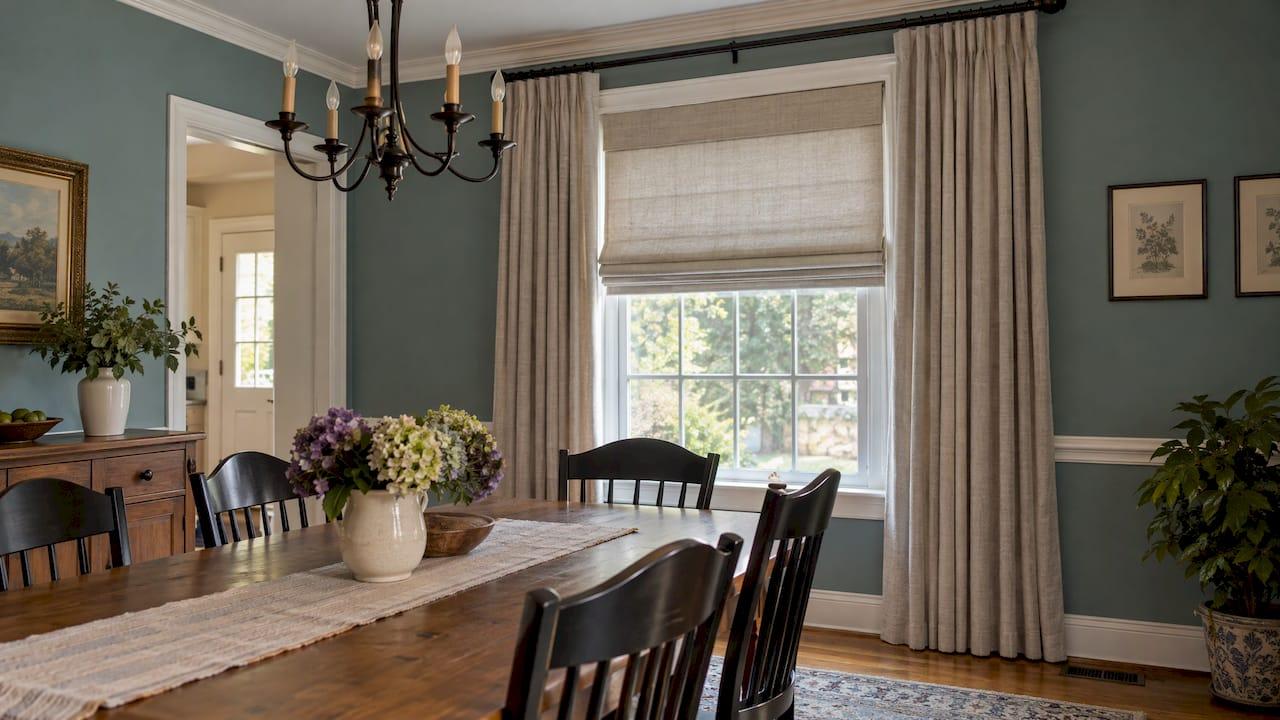
The best dining room window treatment is the one that matches how you use the room: layered Roman shades and full-length drapery for a formal table, a single shade or wood blind for an everyday eating area, and cordless or motorized lift wherever you want easy control. Made in the Shade Bucks County brings samples of all of these to your dining room, so you can judge fabric, color and light against your own table and walls instead of a catalog page.
TL;DR
- Formal dining rooms look finished with tailored Roman shades under full-length drapery. Casual eating areas suit a single Roman shade, wood blind or shutter.
- Give each window its own shade if you want to control glare at different times of day.
- Hang drapery high and wide, and keep the hem from pooling where chairs will catch it.
- Choose cordless or motorized lift. Federal guidance and the industry standard now push custom products toward cordless operation.
- Measure carefully: an inside mount needs enough depth in the frame, and a free in-home consultation takes the measuring off your hands.
Table of Contents
- Start with how you use the dining room
- Roman shades and drapery for a formal dining room
- Blinds, shades and shutters for everyday dining rooms
- What color should dining room curtains be?
- Motorized and smart dining room shades
- Child-safe and cordless choices
- Energy and comfort in the dining room
- Measuring and mounting
- A simple plan for your dining room
- Bring the consultation to your table
- Our perspective
- FAQ
- Sources
Start with how you use the dining room
Before you pick a fabric, decide what the windows need to do. A dining room is often used at two very different times: a bright weekday morning or late-afternoon sun, and a candlelit dinner with the shades drawn. Apartment Therapy quotes a window treatment executive who suggests thinking about functional needs first, such as fade prevention, privacy, durability and blackout, and then choosing a finish that meets them.
A short checklist helps:
- Light: Does the sun hit the table at breakfast or at dinner? West-facing windows bring harsh evening light in the summer months.
- Privacy: Does the dining room face a street or a neighbor's yard? In many Philadelphia-suburb homes, a bay or picture window sits right at the front of the house.
- Formality: Is this a room for holiday dinners with a china cabinet, or a kitchen-adjacent eating area used every day?
- Ceiling height and window size: Tall ceilings and wide windows invite drapery. Short windows often call for a simple shade.
- Who lives in the house: Young children and pets make cord-free operation a priority.
The answers to these five questions narrow the options faster than browsing photos does.
Roman shades and drapery for a formal dining room
If your dining room is formal, layering is the classic answer. Bob Vila's guide quotes an expert who recommends tailored Roman shades paired with full-length drapery so the room feels formal and finished: the drapery frames the view and adds drama, while the shades adjust light and privacy. Pottery Barn's guidance, summarized in the same article, notes that formal dining rooms are often layered, with a shade framed by heavier drapery and sometimes topped with a cornice.
This suits the older center-hall colonials, Georgian homes and stone farmhouses common across Bucks County, where dining rooms tend to be separate rooms with traditional trim. It also works in newer Mercer County homes with a two-story foyer and a formal dining room off the entry.
Two practical points:
- Shades do the daily work. You can lower them for privacy or glare without closing the drapery, so the drapery stays as a frame.
- Drapery adds softness. Hard surfaces in a dining room (a wood table, hardwood floors, a china cabinet) bounce sound around. Fabric drapery softens both the look and the room.
We lay out the logic of combining layers in more detail in our guide on how to layer window treatments. If you already know you want fabric, see our drapery collection and our window shades.
Pleat styles and headers
Bob Vila's guide suggests a rod pocket or pinch pleat header for a more traditional, tailored look. Pinch pleats suit a formal table. A simpler header fits a more relaxed room.
Hang drapery to make the room feel taller
The Spruce suggests installing treatments higher than the window or door they cover to keep a dining area feeling spacious, and Pottery Barn's advice, as reported by Bob Vila, is that compact dining rooms benefit from floor-to-ceiling curtains to create a sense of height. The common designer approach is to mount the rod closer to the ceiling than the window frame and extend it past the frame on each side so the fabric doesn't cover the glass when open.
Keep fabric away from the chairs
If your table sits close to the window, Bob Vila advises against pooling drapery on the floor, because it can catch on chair legs. A hem that just skims the floor, or sits slightly above it, keeps chairs moving freely. Once the drapery is up, think about the walls around it too. If you're planning the room as a whole, these dining room art ideas are worth a look, since art and drapery compete for the same wall space.

Blinds, shades and shutters for everyday dining rooms
Not every dining room needs a layered look. For an eat-in kitchen, a breakfast nook or an informal dining space, one well-chosen treatment can do the whole job.
The Spruce describes Roman shades as easy to use and a fit for shorter windows or informal dining areas, and it recommends wooden blinds for contemporary, colonial and traditional settings where convenience is the top priority. That second point matters in our area, where colonial and traditional homes are everywhere.
Here is how the main options compare:
| Treatment | Best for | Look and feel |
|---|---|---|
| Roman shades | Formal or casual rooms, shorter windows | Soft fabric folds, many fabric choices |
| Drapery | Tall windows, formal rooms | Frames the window, adds height and drama |
| Wood blinds | Traditional and colonial homes | Warm, natural, easy tilt for light control |
| Shutters | Bay windows, front-facing rooms | Tailored, permanent, strong privacy |
| Sheer or light-filtering shades | Rooms where you want glow without glare | Soft daytime light, a view that stays visible |
| Woven wood shades | Rooms with natural textures | Organic texture that suits wood tables |
You can browse each in our window blinds, wood blinds and shutters collections. We also offer wood shutters and faux wood shutters for dining rooms that need a tailored, structured look.
Give each window its own shade
For the most control over light, The Spruce suggests a separate blind or shade for each window. That way you can lower the shade on the window where the sun is harshest and leave the others open. It is a useful trick in a dining room with two or three windows facing different directions, or in a bay where the center window gets more sun than the sides.
Large windows and patio doors
Many dining rooms open to a deck or patio through a sliding door. For wide openings, vertical blinds or a panel-style solution can be easier to operate than a stack of narrow shades. Our guide to sliding door window treatments covers the choices, and our vertical blinds page shows the options for large openings.
What color should dining room curtains be?
There is no single right answer, but there is a sensible order of decisions.
- Start with function. If the room gets strong sun, a fabric that handles fading matters more than the exact shade. If you need privacy at night, consider a fabric with enough body or a liner.
- Pick a color family from what is already in the room. Take cues from the rug, the wall paint or the upholstered chairs. A color that appears elsewhere in the room feels intentional.
- Decide whether the treatment should blend or contrast. Drapery close to the wall color makes a room feel larger and calmer. A deeper or patterned drapery makes the windows a feature.
- Think about evening. A dining room is mostly seen at night, with lamps on. Look at samples under the lighting you actually use.
That last step is the main reason an in-home consultation works well. Colors that look right on a screen can change under your own dining room light, on your own walls and next to your own table. Our consultant brings sample collections to you, so you compare them in place.
Motorized and smart dining room shades
Motorization is a good fit for dining rooms because windows are often tall, wide or behind a sideboard or buffet, which makes reaching a cord or wand awkward. With a motorized shade, you raise or lower the shade with a remote, an app or a voice command, and you can group several windows together so they move at the same time.
Made in the Shade Bucks County specializes in motorized and smart-home-compatible shades that work with Alexa and other major platforms. That means you can set the dining room shades to lower for the evening sun, or lift for a dinner party, without leaving the table.
Motorized shades also solve a safety question. The Consumer Product Safety Commission's guidance says stock window covering cords must be cordless (including motorized systems), short or inaccessible. For a layered dining room, motorization is worth considering on the shade layer, while the drapery stays traditional. Our Norman SmartDrape drapery page and our product spotlight on smart drape shades show how motorization can work with fabric.
Child-safe and cordless choices
Dining rooms are family rooms: homework happens at the table, and little ones climb on chairs near windows. Cords near a table are a risk worth removing.
The rules have tightened. The Window Covering Manufacturers Association announced that its ANSI/WCMA A100.1-2022 standard has a June 1, 2024 compliance date and eliminates free-hanging operating cords, free-hanging tilt cords and multiple cord connectors on made-to-order custom products. The same document states that the standard will require more than 95 percent of window coverings sold in the U.S. to be cordless or have inaccessible cords.
For your dining room, that means cordless lift is the standard way to choose, and it also looks cleaner. We offer cordless, child-safe lift options across our shades and blinds. For more on how they work, see our pages on cordless and child-safe blinds and child safety options for windows.
Energy and comfort in the dining room
Dining rooms with large south- or west-facing windows can get warm in summer and drafty in winter. Window coverings help. Consumer Reports, citing the U.S. Department of Energy, says that smart management of window coverings can reduce heat gain by up to 77 percent, and that window awnings can reduce solar heat gain by up to 65 percent on south-facing windows and 77 percent on west-facing windows.

That is one more reason to consider motorized shades that you can schedule to lower during the hottest part of the day. If your dining room opens to a patio, an exterior solution may help too. Our retractable awnings and outdoor window shades are made for exactly that. Our guide to awning fabrics for Bucks County covers how to choose for local weather.
Measuring and mounting
Measurement is where many window projects go wrong. Apartment Therapy notes that most treatments need at least 2 inches of space for an inside mount, though some need more room to sit flush inside the frame, and that you should measure the width and height of the area to determine the size.
Three common mistakes in dining rooms:
- Measuring once. Windows in older homes are rarely square. Measuring width at the top, middle and bottom shows the difference.
- Ignoring the frame depth. A deep frame suits an inside mount. A shallow frame may need an outside mount, which also makes a window look larger.
- Forgetting the hardware. Drapery rods, brackets and returns need to clear trim, crown molding and chair backs.
At Made in the Shade Bucks County, every project is measured and installed by trained professionals, so the fit is handled for you. Custom products are made to your measurements, which is why we take them ourselves.
A simple plan for your dining room
- Formal room, two or three windows: Tailored Roman shades on each window, with full-length drapery hung high and wide. Consider motorization on the shades.
- Eat-in kitchen or breakfast nook: A Roman shade or wood blind in a cordless style.
- Bay window or front-facing room: Shutters for privacy and structure, or shades in a light-filtering fabric.
- Dining room with a sliding door: Panel or vertical solutions, with cordless operation.
- Sunny, warm room: Shades you can schedule or control by voice, and an awning outside if the room opens to a patio.
Bring the consultation to your table
Made in the Shade Bucks County has no showroom to drive to. A personal design consultant comes to your home in Bucks County, PA or Mercer County, NJ, brings sample collections and talks through shades, blinds, shutters and drapery at no cost. Measuring and installation are included in the project, and our products carry manufacturer warranties, most with limited lifetime coverage.
If you're ready to pick treatments for your dining room, request a free consultation and we will bring the samples to you.
Our perspective
A dining room is one of the few rooms where the window treatment is seen up close, at night, by guests who have time to look. That is why we start every project at your table, not in a catalog.
We bring sample collections into the room so you can see fabric against your walls and under your own lamps. We measure every window ourselves, because custom treatments are made to those numbers, and our trained installers hang them.
We lean toward cordless and motorized lift. It keeps the lines clean, it keeps cords away from chairs and children, and it makes tall or hard-to-reach windows easy to manage. Motorized shades that work with Alexa and other major platforms let a dining room change from bright and open to quiet and dim with one command.
Layering is the other thing we recommend most. A shade for the daily work and drapery for the finish gives you control and a room that feels complete.
Tony
FAQ
How do you decorate a dining room window?
Start with the function, then the style. A formal room looks finished with tailored Roman shades under full-length drapery hung high and wide. A casual room can use a single shade, wood blind or shutter. Keep the hem away from chair legs.
What color should dining room curtains be?
Pick a color from something already in the room, such as the rug, paint or chairs, and check fabric samples under your own evening lighting. Choose for function first, like fade resistance, privacy and durability, then settle on the finish. Our consultants bring samples to your home so you can compare in place.
Are blinds or drapes better for a dining room?
It depends on the room. Drapery frames the window and adds height, so it suits formal rooms and tall windows. Blinds and Roman shades are easier for daily light control and fit shorter windows and informal dining areas. Many dining rooms look best with both layered together.
Are cordless shades available for dining rooms?
Yes. Cordless and motorized lift are available across our shades and blinds, and the industry standard for custom products now eliminates free-hanging operating cords. Ask your consultant to show cordless samples during your free in-home consultation.
Sources
- The Best Window Treatments for Every Room in Your Home, Bob Vila
- 34 Dining Room Window Treatments for the Perfect Finishing Touch, The Spruce
- How to Choose Window Treatments: Expert Guide, Apartment Therapy
- Window Coverings 15(j) Rule Business Guidance, CPSC
- Window Covering Manufacturers Association: Standard Update Announcement
- Lower Your Energy Costs With Window Coverings, Consumer Reports