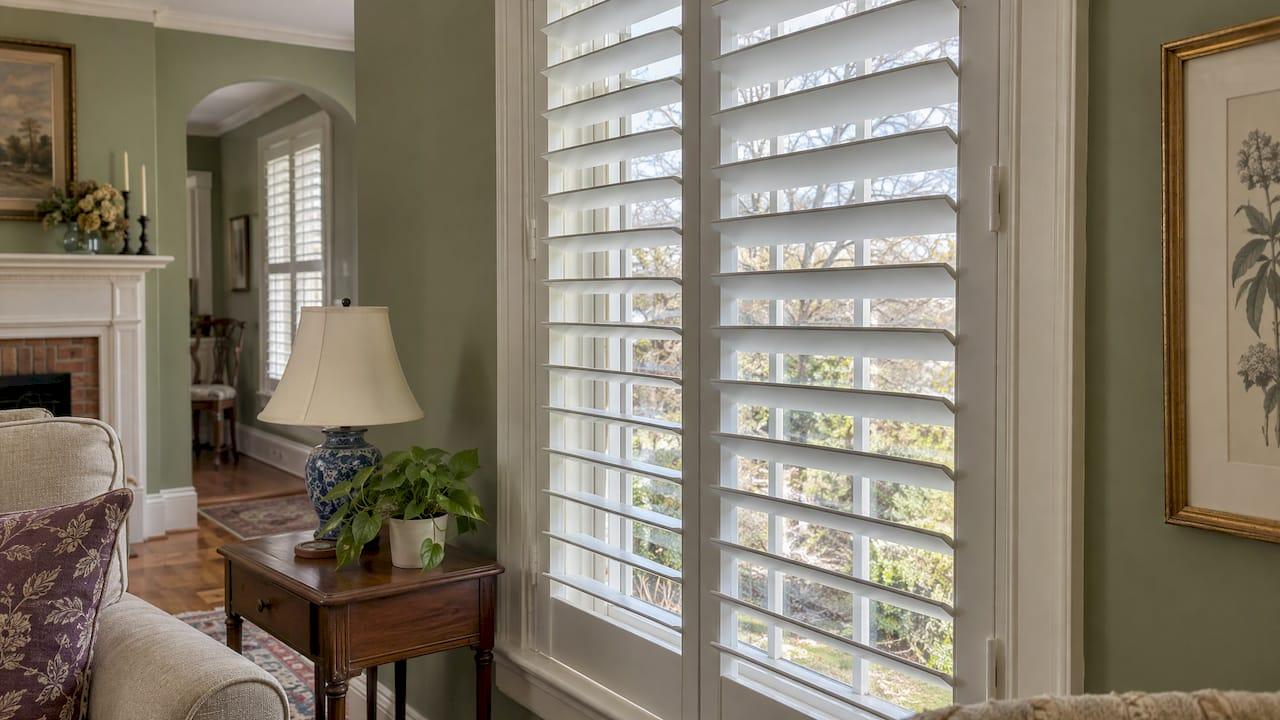
Most interior plantation shutters come with a louver of 2.5, 3.5 or 4.5 inches, measured across the width of a single slat. The right one depends on three things: how wide your window is, how much clear depth the window opening has, and how much of the view you want to keep. A 3.5-inch louver suits most windows. A 4.5-inch louver opens up the view on large windows and doors. A 2.5-inch louver suits small, traditional windows. At Made in the Shade Bucks County, a design consultant brings sample louvers to your home, so you can hold each size against your own windows and light before you order.
TL;DR
- Common interior louver sizes are 2.5, 3.5 and 4.5 inches. Louver size is the width of one slat, not the size of the shutter.
- Bigger louvers mean fewer slats, a clearer view and a more contemporary look. Smaller louvers mean more slats and a classic, finer-lined look.
- Window depth can limit your choice, because larger louvers need more clear space in the opening when they tilt open.
- Exterior louvered shutters follow a different set of dimensions from interior plantation shutters.
- Made in the Shade Bucks County offers a free in-home consultation, with measuring and installation by trained professionals.
Table of Contents
- What shutter louver size actually means
- How louver size changes the look of a room
- Matching louver size to window width
- Window depth: the limit nobody mentions until measuring
- Louver size and airflow
- Are 2.5-inch louvers out of style?
- Interior plantation louvers versus exterior louvered shutters
- Choosing by room
- Wood or faux wood: does it change the louver choice?
- Child safety, smart homes and shutters
- Our perspective
- See your louver options at home
- FAQ
- Sources
What shutter louver size actually means
A louver is one of the horizontal slats in a shutter panel. Louver size is the width of that slat, measured from its front edge to its back edge. It is not the height of the shutter or the width of the panel.

That distinction trips up many first-time buyers. A shutter panel can be 20 inches wide with 3.5-inch louvers, or the same 20 inches wide with 4.5-inch louvers. The panel stays the same. What changes is how many slats fill it, how far apart they sit, and how the shutter looks when the slats are tilted open.
For interior plantation shutters, the sizes you will meet most often are:
| Louver size | Typical look | Best suited to |
|---|---|---|
| 2.5 inches | Traditional, colonial, finely lined | Small windows, older homes, tight openings |
| 3.5 inches | Balanced, works with most styles | Standard windows in most rooms |
| 4.5 inches | Open, modern, clean lines | Wide windows, sliding doors, rooms where the view matters |
Some lines also offer in-between or smaller and larger slats. Your consultant can tell you which sizes are available for the product you are considering. See our plantation shutters page for the range we offer.
How louver size changes the look of a room
Fewer slats, clearer view
A wider louver fills the same panel with fewer slats. With fewer slats there are fewer gaps and fewer edges between you and the outdoors. When the louvers are open, you see more of the yard, the street or the trees. That is why larger louvers are a popular choice for living rooms and family rooms with big windows.
Smaller louvers do the reverse. They create a denser pattern of lines across the window. Some homeowners love that detail, especially on a smaller window where a wide slat would look out of scale.
Style and architecture
Louver size does not change how well a shutter does its job. It changes the character of the room. A 2.5-inch louver fits the look of a colonial or Cape-style home. Wider louvers read as more contemporary and tend to look balanced on larger windows.
Around Bucks County you will find a wide mix of homes: stone farmhouses and colonials in Doylestown and New Hope, Cape Cods and ranchers in Levittown and Bristol, and newer builds in Newtown and Yardley with big picture windows and sliding doors. The same louver size will not suit all of them. A narrow double-hung window in a 1700s stone house calls for a different proportion than a wide window in a newer great room.

Light and privacy
Tilted slats let you steer daylight. Closed, they give privacy. Open, they let light in. The louver profile matters less here than the louver width: with wider slats you get larger openings of light between them, and with narrower slats the light is broken into smaller bands.
If you are using shutters mainly on a street-facing bedroom or bathroom, privacy may matter more to you than the view. In a family room that looks onto the backyard, the view usually wins.
Matching louver size to window width
A useful starting point is to match the slat to the scale of the window.
- Narrow or small windows: a 2.5-inch louver keeps the proportions in balance. A big slat in a small panel can look heavy.
- Standard windows: 3.5 inches is the all-round choice. It suits most room styles and most window widths.
- Wide windows, bay windows, sliding doors and French doors: 4.5 inches lets the view through and looks in proportion with large panels.
These are guidelines, not rules. A tall, narrow window in a formal dining room might look better with 3.5-inch louvers than with 2.5-inch. A wide window in a home office where you want to control glare might work well with smaller louvers. Walk through your rooms and think about what you want the shutter to do in each one.
For sliding and patio doors, see our guide to sliding door window treatments. For doors with glass panels, our French door window coverings article explains how to choose.
Window depth: the limit nobody mentions until measuring
The most practical question is not which size you like. It is which size your window can hold.
When louvers tilt open, their edges swing out from the back of the panel. In an inside mount, where the shutter sits within the window opening, that swing needs clear space. A larger louver needs more depth than a smaller one. If the opening is shallow, a big louver may hit the glass, a window crank, a latch or a handle.
Two things can get in the way:
- Shallow window frames. Many newer homes have thin trim and shallow openings. Many older homes have deep sills that suit larger louvers well.
- Obstructions. Cranks on casement windows, locks, handles and hardware can sit inside the opening and limit what size louver fits.
If your window is too shallow for the louver size you want, there are choices. One is an outside mount, where the shutter frame sits on the trim or wall around the window rather than inside the opening. Another is to choose a smaller louver. Your consultant can measure the depth and the obstructions and tell you what will work before you commit.
This is one of the places where measuring by a professional matters. At Made in the Shade Bucks County, every project is measured and installed by trained professionals. A shutter that is a fraction of an inch off will not close cleanly, so getting the opening measured once, correctly, protects your investment.
Louver size and airflow
Shutters are a good fit for rooms where you want to control air and light by adjusting slats. How much air passes also depends on the window itself. A casement opens fully, while other window types open only part of the way. If you are weighing how much ventilation different window types give, this overview of sliding window ventilation is a helpful comparison. When you pair a shutter with the window, think about how you will open the window and whether the shutter leaves enough room to do so.
Are 2.5-inch louvers out of style?
You may read that small louvers look dated. It is true that wider louvers have become the more popular choice in recent years, especially in open-plan rooms and on large windows. It is also true that a smaller louver can be the best choice for the right window.
What matters more than trend:
- Proportion. Does the slat look right for the width of the panel?
- Your home's style. A colonial or farmhouse often suits a finer louver.
- Your clearance. If depth is limited, a smaller louver may be the one that works.
- How long you will live there. Shutters are a long-term fixture, so choose the look you will still like in ten years, not only the one trending now.
If you plan to sell, a 3.5-inch louver is a safe all-round choice that appeals to most buyers. Realtors and property managers often prefer it for that reason.
Interior plantation louvers versus exterior louvered shutters
People searching for louver sizes sometimes mean the decorative louvered shutters mounted on the outside of a house. Those are a different product with different measurements.
Exterior louvered shutters are sized as pairs for the outside of a window. According to dimensions.com, louvered window shutters are typically 1 to 2 feet wide and range from about 2 feet 11 inches to 7 feet tall. The size of the slats inside them is a fixed part of the design, not a choice made from a menu like interior louvers.
Interior plantation shutters are built for your specific window, with the louver size chosen to fit your opening and your style. This article covers interior shutters. If you are also thinking about the outside of your home, we offer outdoor window shades and retractable awnings for patios and decks.
Choosing by room
The same louver size does not have to run through the whole house. Many homeowners use different sizes in different rooms, as long as the choice looks intentional.
- Living and family rooms: larger louvers keep the view open and look in proportion on wide windows.
- Bedrooms: 3.5 inches is a good balance of light control and privacy.
- Kitchens: smaller or mid-size louvers on windows over the sink suit the scale of the window.
- Bathrooms: privacy matters most, so choose a louver that closes tightly and suits the window size. Ask your consultant about materials suited to humid rooms.
- Sliding and French doors: larger louvers look best in panels this size.
One rule of thumb for a whole-house look: keep the louver size consistent on windows that are visible from the same street-facing or open-plan view, and vary it only where a window is much smaller or larger than the rest.
Wood or faux wood: does it change the louver choice?
The material affects weight, finish and how a shutter behaves in humid rooms, and so it can influence which louver size and panel width you choose. Larger panels with big louvers are heavier. We offer both wood shutters and faux wood shutters, and your consultant can show you samples of each so you can see the difference in finish and feel.
If budget is part of the decision, our guide to plantation shutters cost explains what Bucks County homeowners should plan for.
Child safety, smart homes and shutters
Shutters have no hanging cords, which makes them a natural fit for families with young children. If child safety is a priority across the house, we also offer cordless, child-safe lift options in other window treatments, such as shades and blinds.
For homeowners who want motorized or smart-home controls, we specialize in motorized shades that work with Alexa and other major platforms. Shutters can be used alongside them: a family room might have 4.5-inch shutters on the lower half of a bay and motorized shades for the tall upper windows. Our window shades page shows what is available.
Our perspective
Homeowners often ask us which louver size is "correct." There isn't one. There is the size that suits your window, your depth, your view and your house.
The mistake we see people want to avoid is choosing from a photo. A louver that looks perfect in a showroom picture can look different on a window with a deep sill, or in a room with strong afternoon sun. That's why we bring the samples to you. You can hold a 3.5-inch and a 4.5-inch louver against your own window, in your own light, and decide.
We measure every project ourselves and install with trained professionals, because depth and obstructions decide what fits long before style does. Our products carry generous manufacturer warranties, most with limited lifetime coverage, so the decision you make today is one you can live with.
Tony
See your louver options at home
Made in the Shade Bucks County serves homeowners, realtors and commercial clients throughout Bucks County, PA and Mercer County, NJ. We have no storefront: a personal design consultant brings sample collections to your home, helps you compare louver sizes on your own windows, and measures the openings so the size you choose will fit. Browse our window shutters to see the styles we offer, or request a free consultation.
FAQ
What are the most common shutter louver sizes?
The most common sizes for interior plantation shutters are 2.5, 3.5 and 4.5 inches. The 3.5-inch louver is the most versatile, and it works in most rooms and with most home styles. Some product lines also offer other sizes, so ask your consultant what is available.
How do I figure out my louver size?
Start with the width of the window and how much of the view you want to keep. Then check the depth of the opening and any hardware inside it. Smaller windows suit smaller louvers, and wide windows and doors suit larger ones. A consultant can measure and confirm what fits.
What is the best louver size for plantation shutters?
For most homes, 3.5 inches is the safe, balanced choice. Choose 4.5 inches for wide windows and doors where you want a more open view. Choose 2.5 inches for small windows or traditional homes where a finer line suits the architecture.
Can I use large louvers if my window is shallow?
It depends on the clear depth of the opening and any cranks or handles in it. If the opening is too shallow, an outside mount or a smaller louver may be the answer. We measure your windows during the free in-home consultation so you know before you order.