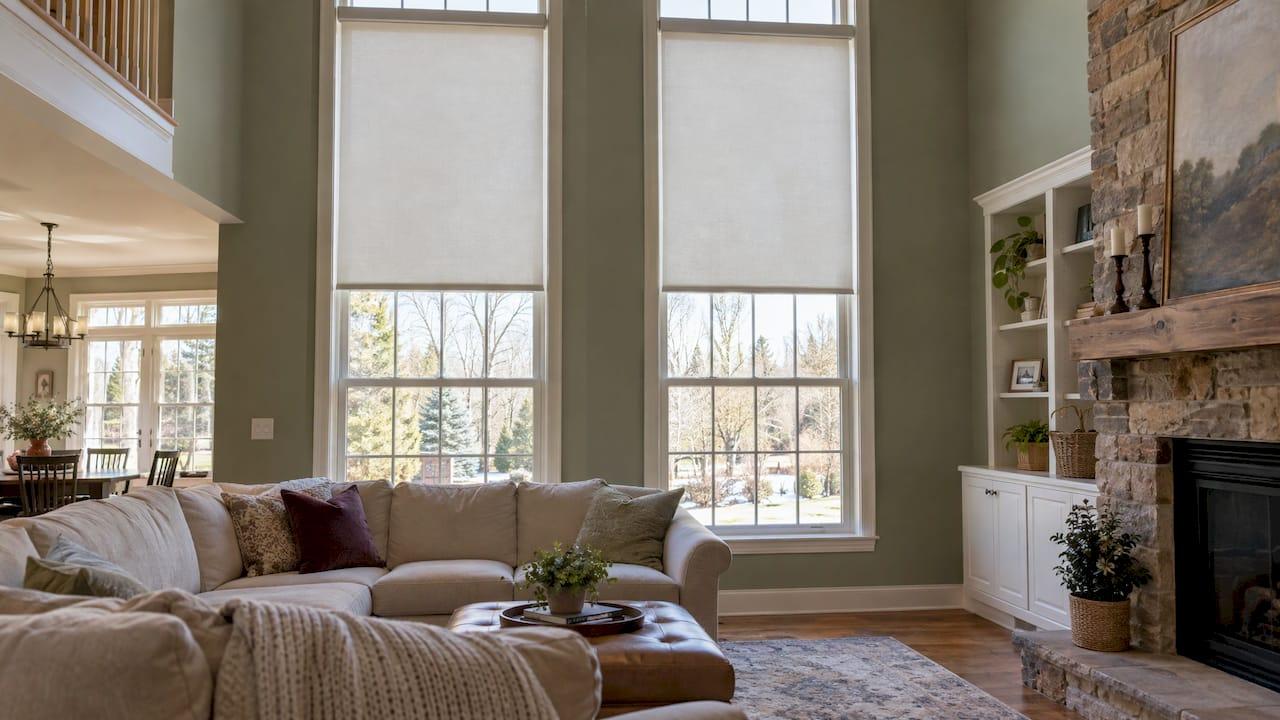
The best treatment for a two-story window is usually a motorized, cordless shade (or a layered shade-and-drapery combination) that you can raise and lower with a remote, a wall switch or your voice. A window that stretches 15 or 20 feet up your family room wall is too tall to reach, too tall to measure from a stepladder and too big to treat like an ordinary window. Made in the Shade Bucks County brings samples to your home, measures the full height and has trained professionals install the finished product, so the shades fit the wall and work from the floor.
TL;DR
- Motorized, cordless shades are the practical choice for windows you cannot reach. Operation is by remote, wall control or a smart-home platform such as Alexa.
- Shade, drapery or both: shades on the upper section for light and glare control, drapery or lower shades for privacy and softness.
- Light-filtering cellular shades are the energy-minded option, with Department of Energy lab research showing lower heating and cooling loads.
- Custom products made to order no longer use free-hanging operating cords, a change that took effect in 2024.
- Accurate measuring and safe installation at height matter more here than anywhere else in the house.
Table of Contents
- Why two-story windows need a different plan
- The main options for tall and high windows
- How to treat the upper and lower sections together
- Operating shades you cannot reach
- Energy, glare and comfort on tall glass
- Measuring, installing and maintaining at height
- What affects the cost
- Our perspective
- Bring the consultation to your great room
- FAQ
- Sources
Why two-story windows need a different plan
A standard window treatment is chosen by style and fit. A two-story window adds three problems: reach, light and scale.
Reach. You cannot adjust, clean or replace what you cannot get to. Anything you pick has to be operated without a ladder.
Light. Tall glass in a great room or foyer lets in a lot of sun. In the Philadelphia suburbs that means strong low-angle light on winter mornings, glare on screens and TVs, and heat in July and August. Faded floors and furniture follow if the glass faces south or west.
Scale. A wall of glass is a design feature. A treatment that is too small, or a rod hung at the wrong height, makes the whole room look unfinished. Transoms, arched tops, French doors and angled rooflines are common in colonial revivals, Tudor-style homes and the newer executive homes across Bucks County and Mercer County. Each of those shapes limits what fits.
Start with what you want the window to do: control glare, add privacy, save energy, or simply look finished. That answer narrows the options quickly.
The main options for tall and high windows
Roller and solar shades
Roller shades are clean and simple, and they suit modern and transitional rooms. Solar shades use a woven fabric that cuts glare and heat while keeping much of the outside view. They are a common pick for a tall window facing a yard or a wooded lot, because you keep the view and lose the squint.
Cellular (honeycomb) shades
Cellular shades trap air in pockets in the fabric. They are the energy-focused choice, and the research below explains why. They are softer-looking than rollers and available in light-filtering and room-darkening versions.
Roman shades and woven wood
Roman shades fold into soft pleats, and woven wood shades bring in natural texture. Both warm up a tall room that feels like a cold box of glass. On very tall windows they work best in sections, so no single panel becomes too large and heavy to lift cleanly.
Sheer shades and layered treatments
Sheer shades diffuse light gently and keep the room bright. For a window that serves as the focal point of the room, a layered window treatment pairs a shade for function with drapery for softness and height.
Drapery
Floor-length drapery on a tall wall draws the eye up and makes the ceiling feel higher. It frames the glass rather than covering it. Motorized drapery tracks mean you never have to pull a heavy panel by hand.
Shutters and blinds
Plantation-style shutters work well on the lower section of a tall window, where you can reach them and want privacy. Wood blinds and vertical blinds cover wide openings and glass doors.
Decorative grilles
On an upper section you do not need to cover, decorative faux-iron grilles add a finished look without blocking light.
How to treat the upper and lower sections together
Many two-story windows are really two windows stacked on one wall, often separated by a transom line or a change in frame. You have three ways to handle that.
- One continuous treatment top to bottom. This gives the cleanest look and works well with a single motorized shade or full-height drapery. Everything moves together.
- Two separate treatments. The upper section gets a shade for glare and heat. The lower section gets a different treatment for privacy and views, such as shutters or a shade you can raise by hand.
- Different fabrics blocked together. Where fabrics are combined, the seams should line up with the window divisions and the wall, so the result looks planned.
Privacy decisions drive the split. Upper windows rarely need privacy during the day, since nobody can see in from the street, so they can stay open for light. The lower section usually faces the neighbors or the road. In the evening, when interior lights are on, the upper glass becomes a mirror and can feel exposed. A light-filtering or sheer shade on the top that you close at dusk solves it.
To keep the view, choose fabrics by openness. A lower openness percentage blocks more light and heat. A higher percentage preserves the view but lets in more glare. A consultant who sees the actual room and the sun's path across it can help match openness to the window's orientation.
Operating shades you cannot reach
This is the question behind most searches for shades for tall windows and hard-to-reach windows. A ladder is not a long-term operating plan.
Motorized shades
Motorized lift moves the shade with a remote, a wall switch, a smartphone app or a voice command. Made in the Shade Bucks County specializes in motorized and smart-home-compatible shades that work with Alexa and other major platforms. That means you can schedule the upper shades to lower at noon in summer and open at sunrise in winter, without touching them. For a window where the shade only moves when someone climbs up, automation is what makes it usable.

The same applies to Norman SmartDrape drapery, which brings motorized control to full-length drapery.
Cordless and child-safe lift
Families with young children should know what the rules now say. The Consumer Product Safety Commission approved a federal standard for operating cords on custom window coverings, and its announcement explains it is aimed at strangulation risk to children. The industry's updated ANSI/WCMA A100.1-2022 standard took effect on June 1, 2024, and removes free-hanging operating cords, tilt cords and multiple cord connectors from made-to-order products.
Motorization fits this naturally. No cord means no loop for a child or pet. Made in the Shade Bucks County offers cordless, child-safe lift options across its range. Our pages on cordless and child-safe blinds and child safety for windows explain the choices, and the guide to cordless blind safety for parents covers what to move away from windows.
As a rule of thumb for any window treatment in a home with small children, keep cribs, beds and climbable furniture away from windows, even with cordless products.
Energy, glare and comfort on tall glass
Big windows mean big heat gain and heat loss. That is the practical case for choosing the treatment on performance, not just looks.
Department of Energy research from Oak Ridge National Laboratory found that single-cell light-filtering cellular shades reduced the cooling load by 4.6% and the heating load by 24% on north and west windows. On south and east windows the reductions were 9.3% for cooling and 57% for heating. The same work reported glare reduced by up to 91% and annual HVAC energy savings of 19% to 27% in simulation. That study looked at commercial buildings, so treat the numbers as a measure of how the shade type behaves rather than a guarantee for your house.

A separate 2017 building simulation study modeled a typical two-story home with 16 windows in Houston, Washington DC and Minneapolis. It compared venetian blinds, roller shades, cellular shades, fixed panels and solar screens, and found that the way a window attachment is installed affects heating and cooling energy use differently across climates. Fit and sealing around the glass matter as well as the product.
A tall window also works against the rest of your insulation. Warm air rises, so heat collects at the top of a two-story room, and it escapes where glass and ceiling meet. This is the same principle explained in this guide to attic insulation and energy efficiency: a well-sealed envelope cuts what you spend on heating and cooling. Cellular shades on the upper glass add another layer.
For more on this, see our page on energy-saving window treatments and our guide to glare-reducing shades, which helps with TV rooms and home offices that face tall glass.
Measuring, installing and maintaining at height
Measuring a two-story window is where most do-it-yourself projects go wrong. A tape measure 15 feet up on a ladder gives you numbers with errors, and custom products are made to those numbers. A shade that is half an inch off will not hang square or sit inside the frame properly.
Several things have to be right at once:
- Width at three points (top, middle, bottom), since frames in tall openings are rarely perfectly square.
- Total height, including any transom or arch.
- Mounting depth, to confirm an inside mount works and whether the frame is deep enough.
- Wall and ceiling structure, since a wide, heavy shade or drapery track needs secure anchoring.
- Power, where motorized shades need a plug point or a battery-powered option near the head of the window.
At Made in the Shade Bucks County, every project is measured and installed by trained professionals, so you are not on a ladder and the order is made from checked dimensions. Installation at height needs the right equipment and training, which is one more reason to leave it to a team.
Maintenance. Dust collects on tall treatments just as it does elsewhere, but you cannot reach it. Motorized shades can be lowered fully for light dusting within reach, and a handheld duster or vacuum brush attachment does the job. Fabrics that resist dust and are easy to wipe are a good choice for a room where the upper section stays out of reach. Our manufacturers' products carry warranties, most with limited lifetime coverage, so the shade is protected long after installation.
What affects the cost
We do not publish a price list, because custom window treatments are quoted for each project. Four things move the number most:
- Size. Taller and wider means more fabric, a bigger headrail and more labor.
- Product type. A drapery wall, a cellular shade and shutters are priced differently.
- Motorization and automation. Motors, remotes and smart-home integration add to the cost of a manual shade, and they are what make a high window usable.
- Layering. A shade plus drapery costs more than either alone.
Ready-made curtains are sold in set lengths, such as 16 feet, so they often fall short of a full two-story wall. Custom treatments are made to your window, so they fit the opening, and they can include child-safe cordless lift and motorization. A free consultation lets you compare products against your budget before you commit.
Our perspective
We think a two-story window should be treated as a system, not a single purchase. The shade type, the way it lifts, how it is installed and how it is powered all depend on each other.
If you cannot reach it, it has to move on its own. That is why we lean toward motorized and smart-home-compatible shades for tall windows, and why cordless, child-safe lift is built into how we recommend products for families.
We bring the showroom to your home because it is the only way to judge a tall window properly. Fabric looks different in your light, at your ceiling height, next to your floors and furniture. Our design consultants bring samples, talk through glare, privacy and energy, and then our trained team measures and installs.
Most of our work across Bucks County and Mercer County is exactly this: big, bright rooms where good shades change how the space is used every day.
Tony
Bring the consultation to your great room
Made in the Shade Bucks County offers a free in-home consultation for homeowners in Bucks County, PA and Mercer County, NJ. A personal design consultant brings sample collections to your home, and you compare shades, drapery, shutters and motorization options against your actual window. Measuring and installation are handled by our trained professionals. Explore our window shades to see the range.

If you are also planning an outdoor living space, we offer outdoor patio shades and retractable awnings, which can be planned in the same appointment.
FAQ
What kind of window treatment is best for a two-story window?
For most homes, a motorized shade on the upper section, paired with drapery or a manual treatment on the lower section, works best. Cellular and solar shades handle heat and glare, and drapery adds softness. The right mix depends on which way the window faces and how much privacy you need.
Can cordless shades work on high windows?
Yes. Cordless and motorized lift both avoid hanging cords, which is the current direction for custom products. Motorized models add the ability to raise and lower the shade from the floor with a remote or voice command, so a tall window never needs a ladder.
Can I control my high-window shades with Alexa?
Yes, with smart-home-compatible motorized shades. Made in the Shade Bucks County offers shades that work with Alexa and other major platforms, so you can set schedules or give voice commands for windows you cannot reach.
Why not just buy long curtains for a two-story window?
Standard curtains come in fixed lengths and usually fall short of a full-height wall. Custom treatments are made to your window's exact measurements, so they fit the opening and can include motorization and child-safe lift.
Sources
- Window Covering Manufacturers Association: ANSI/WCMA A100.1-2022 standard announcement
- CPSC: Federal safety standard for custom window coverings
- U.S. Department of Energy: Cellular Shades in Commercial Buildings
- IBPSA 2017: Parametric study of window attachment impacts on building energy
- The Role of Attic Insulation in Roofing and Energy Efficiency