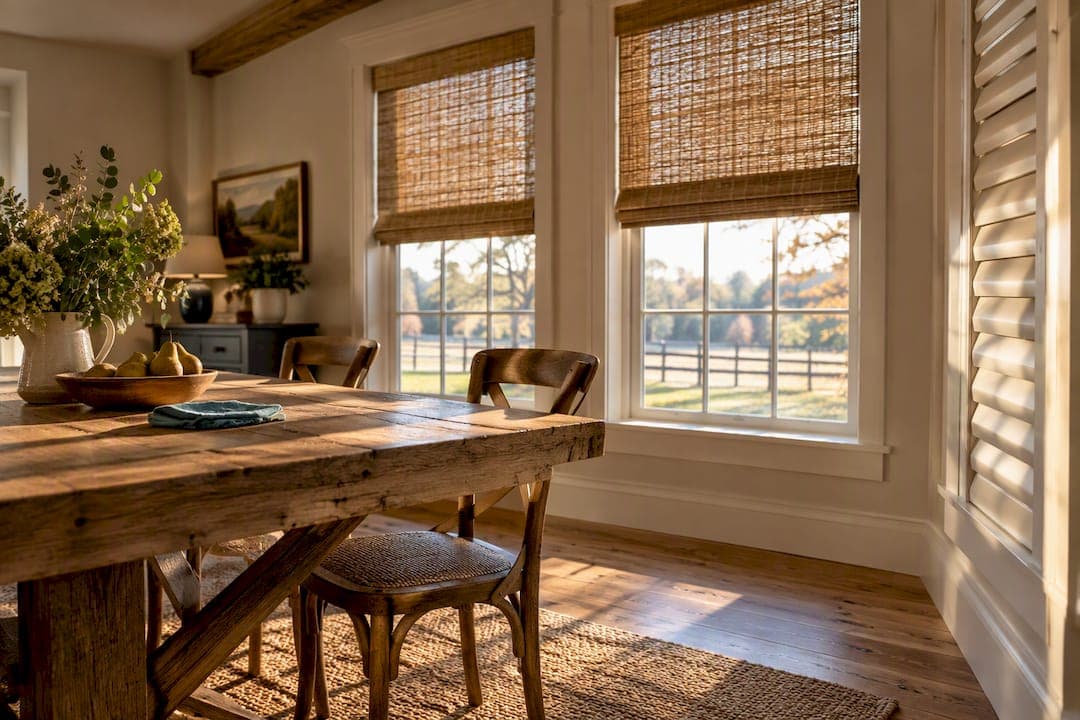
For a modern farmhouse look, choose natural textures and warm neutrals: woven wood shades, tailored Roman shades, or white shutters layered with airy linen panels. Pair the style you pick with a cordless or motorized lift for safety, and have the windows professionally measured before ordering. The sections below walk through material choices, room-by-room fit, and mounting details so the final result looks intentional, not accidental.
TL;DR:
- Woven wood shades are ideal for adding natural texture in living and dining rooms, but they may warp in humid environments like bathrooms.
- Layering shades with curtains enhances window proportions and control, with the shade mounted inside and the curtain rod placed higher and wider.
- Cellular shades provide the best insulation for older windows, making them a strong choice for energy efficiency in regions with cold or humid seasons.
- Cordless and motorized window treatments significantly improve safety around children and pets, with options for smart home integration.
- Professional measurement and installation ensure proper fit, especially in older homes with uneven window openings, and help achieve a cohesive farmhouse look.
Table of Contents
- Which window treatments fit the farmhouse look best?
- What materials and colors define the farmhouse palette?
- How should you layer shades and curtains for the right proportions?
- How do you choose treatments room by room?
- What role do insulation and light control play in your choice?
- What should you know about safety and motorized options?
- What does a professional measurement and installation actually solve?
- What actually makes a house feel like a farmhouse
- Get the look with a free in-home consultation
- Sources
- FAQ
Which window treatments fit the farmhouse look best?
Farmhouse style leans on texture and simplicity rather than pattern or shine, so the treatment families that work best all share a raw, natural quality. Each one brings something different to a room, and most farmhouse homes end up mixing two or three of them across different windows.
Woven wood shades bring the most texture of any option, with bamboo, jute, or grass weaves that read as warm and handmade. They suit living rooms, dining rooms, and any space where you want the window itself to feel like a design feature. Woven wood shades add natural texture while shutters add architectural definition, a combination that shows up often in farmhouse-style homes.
Roman shades offer a cleaner, tailored alternative. Fabric folds add softness without the bulk of full drapery, which makes them a strong choice for kitchens and bathrooms where a fuller curtain would feel impractical.

Shutters, especially in white or a soft off-white, give farmhouse rooms their architectural backbone. They hold their shape for decades, which matters for a style built on permanence rather than trend-chasing.
Roller and cellular shades round out the practical end of the lineup. They are not the most textural option, but they solve real problems: light control, privacy, and in the case of cellular shades, insulation.
Curtains, particularly linen or cotton-linen panels, finish the look. Farmhouse rooms rarely use curtains alone; they are almost always paired with a shade underneath.
- Woven wood shades: best for texture and warmth in living and dining spaces.
- Roman shades: tailored, space-saving, good for kitchens and baths.
- Shutters: durable, architectural, especially strong in white finishes.
- Roller or cellular shades: practical light control and insulation, often hidden behind curtains.
- Linen curtains: the finishing layer, rarely used alone in farmhouse rooms.
What materials and colors define the farmhouse palette?
The farmhouse palette runs warm and quiet: think cream, oatmeal, soft gray, and weathered wood tones rather than stark white or bold color. Design coverage of modern farmhouse trends points to natural textiles and warm neutral palettes as the through-line across current interiors.
For curtains, linen and linen-cotton blends are the standard. Pure linen has a relaxed, slightly wrinkled drape that photographs beautifully but wrinkles easily in humid rooms, so a linen-cotton blend often holds up better near kitchens or bathrooms. Choose a medium weight: too sheer and the panels look flimsy, too heavy and they read more traditional than farmhouse.
For woven shades, natural jute, bamboo, and grass weaves give the most authentic texture, but they absorb moisture and can warp in bathrooms or humid basements. Faux-wood or synthetic woven alternatives solve that problem while keeping the look nearly identical.
- Linen or cotton-linen: soft drape, breathable, best in medium weight.
- Jute or bamboo weaves: authentic texture for dry rooms.
- Faux-wood or synthetic weaves: same look, better for kitchens and baths.
- Warm neutrals: cream, oatmeal, greige, and weathered wood tones.
- Finishes to avoid: high-gloss white, black-out foil backing visible from outside, and glossy metallic hardware that clashes with wood tones.
Pro Tip: Bring a swatch of your flooring or cabinetry to compare against fabric samples in your own light before ordering; warm neutrals shift noticeably between store lighting and home lighting.
How should you layer shades and curtains for the right proportions?
Layering is what separates a farmhouse room that looks styled from one that looks unfinished. Layering a functional shade inside the frame with curtain panels outside the frame elongates windows visually and gives flexible control of light and privacy, a technique designers use to make standard-height windows feel taller.
The order matters. The shade mounts inside or close to the frame and handles the practical work of blocking light and offering privacy. The curtain panels mount higher and wider, framing the window rather than covering it.
- Mount the shade first, inside the frame or just outside it, sized to the actual window opening.
- Mount the curtain rod 4 to 6 inches above the frame and extend it 6 to 10 inches beyond each side, following the rule of thumb designers and installers use to make windows look larger.
- Choose curtain panels wide enough to stack fully off the glass when open, so the woven texture or shutter beneath stays visible.
Mounting the rod higher and wider than the frame is one of the simplest ways to make a standard window look larger and a ceiling look taller, and it costs nothing extra beyond a slightly longer rod.
Keep hardware finishes consistent across a room. Matte black, brushed nickel, and aged brass all work in farmhouse spaces, but mixing two finishes in the same sightline tends to look accidental rather than intentional. A double rod works well when you want shade and curtain to move independently; a single combined mount can work for lighter, decorative panels that stay mostly open.
How do you choose treatments room by room?
Farmhouse style has to answer to real life, not just photographs, and each room in a Philadelphia-area home comes with its own demands.
In the kitchen, keep fabric away from the stove and sink. Café curtains in a lightweight cotton add charm at the lower half of the window without dragging near a burner, and faux-wood blinds or shades wipe clean when something splashes. Practical farmhouse installs often favor faux-wood or composite shutters and blinds in kitchens and bathrooms for durability while keeping the look intact, and a kitchen-specific approach to sink and stove zones helps avoid the most common mistakes.
Bedrooms benefit from cellular or blackout-lined shades underneath a linen curtain, especially for anyone trying to sleep through a bright June sunrise or a streetlight in winter.
Living rooms have room to be textural. Long linen panels or woven wood shades add warmth and frame a view without fighting for attention.
Bathrooms and outdoor spaces need durability first. Faux wood resists humidity better than real wood, and exterior patio shades handle sun and weather that indoor fabrics were never built for.
- Kitchen: faux-wood shades or blinds, café curtains, washable fabrics only.
- Bedroom: cellular or blackout shades layered with linen curtains for softness.
- Living room: woven wood shades or floor-length linen panels.
- Bathroom: faux-wood shutters or blinds, never real wood.
- Outdoor or covered patio: exterior shades built for sun and weather exposure.
What role do insulation and light control play in your choice?
Style aside, a window treatment has a job to do, and that job changes by season in a region with humid summers and cold, gray winters.
Cellular, or honeycomb, shades are the strongest performer for insulation. Their honeycomb structure traps air, improving energy performance compared with flat shades, which matters most on older double-hung windows common in Bucks County and Mercer County farmhouses and colonials.
Woven wood shades filter light beautifully but rarely block it completely, since the weave itself lets slivers of daylight through. For bedrooms or media rooms, adding a blackout liner behind a woven shade keeps the texture visible from inside while solving the privacy and darkness problem.
- Cellular shades: best for energy performance, especially on older single-pane windows.
- Woven wood shades: soft, filtered light; add a liner where privacy matters.
- Blackout liners: worth adding in bedrooms, nurseries, and media rooms.
- Sheer or light-filtering fabrics: good for living rooms where you want brightness without direct glare.
Cellular shades are one of the more reliable upgrades for reducing energy loss through older windows, based on how their trapped-air design performs against flat shade styles.
What should you know about safety and motorized options?
Cords used to be the default lift mechanism, and they are also the biggest safety issue in window treatments. The Consumer Product Safety Commission approved a federal safety standard addressing corded window-covering hazards and recommends cordless or motorized systems to reduce strangulation risk, a point worth taking seriously in any home with young children or pets.
Motorized shades solve the safety issue and add convenience, particularly on tall windows, transoms, or anything over a stairwell that would otherwise need a step stool. Many motorized systems work with Alexa and other major smart-home platforms, so shades can open on a schedule or respond to a voice command.
Before choosing a motorized system, ask a few practical questions:
- Does the shade run on battery power or need hardwired electrical work?
- What does the manufacturer warranty cover, and for how long?
- Is the lift system certified as cordless or child-safe?
Pro Tip: Battery-powered motors are usually the easier retrofit for an existing home, while hardwired systems look cleaner long term but need an electrician involved during installation.
What does a professional measurement and installation actually solve?
A tape measure and a good eye only go so far on older homes, where window openings are rarely perfectly square. Professional measurement catches the small variances that cause shades to bind, gap, or hang unevenly, and it accounts for reveal depth before anything is ordered.
Installation is where layering and motorization either come together or fall apart; for expert help, consider Hassell-Free Window Replacement in Port St Lucie to ensure perfect fit and mounting. A trained installer sets curtain rods at the height and width that actually elongates the window, wires or pairs motorized shades correctly, and confirms every lift system meets current child-safe standards before leaving the house.
When you're vetting anyone for the job, ask directly about manufacturer warranties, installation guarantees, and whether cordless or motorized options are available for the specific product line you're considering. Those answers tell you more about the company than any showroom display could.
What actually makes a house feel like a farmhouse
Texture and proportion do more work than pattern ever will. A room with the right mix of linen, wood, and warm neutrals feels like a farmhouse even without a single piece of shiplap in sight.
Budget and lifestyle should shape the final decision more than trend photos do. Renters need treatments that don't require permanent hardware changes; families with kids or pets need washable fabrics and cordless lifts; anyone renovating on a timeline needs to know what's actually in stock. Choose the version of the look that survives contact with your actual life, not just the one that photographs well.
— Tony
Get the look with a free in-home consultation
Choosing fabric swatches under store lighting is one of the easiest ways to end up with curtains that look nothing like you pictured at home. Made in the Shade Bucks County solves that by bringing the samples to you: a personal design consultant sets up in your own living room, under your own light, with your existing furniture in view.
The same visit covers measurement, so proportions, reveal depth, and mounting height get sorted before anything is ordered, and installation is handled by trained professionals rather than left to guesswork. Made in the Shade Bucks County offers cordless and motorized lift options that work with major smart-home platforms, along with manufacturer warranties on product lines.
- Free in-home consultation with sample collections brought to your door.
- Professional measurement and installation included in the process.
- Cordless, child-safe, and motorized options available across shades, blinds, and shutters.
This service is available to homeowners throughout Bucks County, PA and Mercer County, NJ. Request a free consultation to see farmhouse-style options in your own home before you decide.
Sources
- CPSC — CPSC Approves New Federal Safety Standard for Custom Window Coverings
- Veranda — The window treatments ruling interiors now
- Architectural Digest — Layered drapery trend
FAQ
What window coverings suit a modern farmhouse look?
Woven wood shades, tailored Roman shades, white shutters, and linen curtains are the treatments most associated with the modern farmhouse look. Practical style guides recommend these same options for their natural texture and clean lines, often layering two together for a fuller effect.
What window treatment style is trending right now?
Layered treatments, pairing a functional shade with curtain panels, are the dominant trend rather than any single style on its own. Current design coverage points to natural textures, warm neutrals, and streamlined shades like Roman and woven wood as the direction most designers are following.
How do you decorate farmhouse-style windows on a budget?
Start with one strong texture, a woven wood shade or a linen curtain, and let it carry the look rather than layering several expensive elements at once. Faux-wood shutters and blinds cost less than real wood and hold up just as well in humid rooms, which keeps the farmhouse look intact without the higher material cost.
Are corded window treatments safe for homes with kids or pets?
Corded lift systems carry a known strangulation risk, which is why the Consumer Product Safety Commission approved a new federal safety standard for window coverings. Cordless and motorized lift systems avoid the hazard entirely and are the recommended choice for any home with young children or pets.
Does Made in the Shade Bucks County offer motorized farmhouse shades?
Yes, Made in the Shade Bucks County offers motorized and smart-home-compatible shades that work with Alexa and other major platforms, alongside cordless, child-safe lift options. A free in-home consultation is the best way to see which farmhouse-friendly styles support motorization in your own windows.