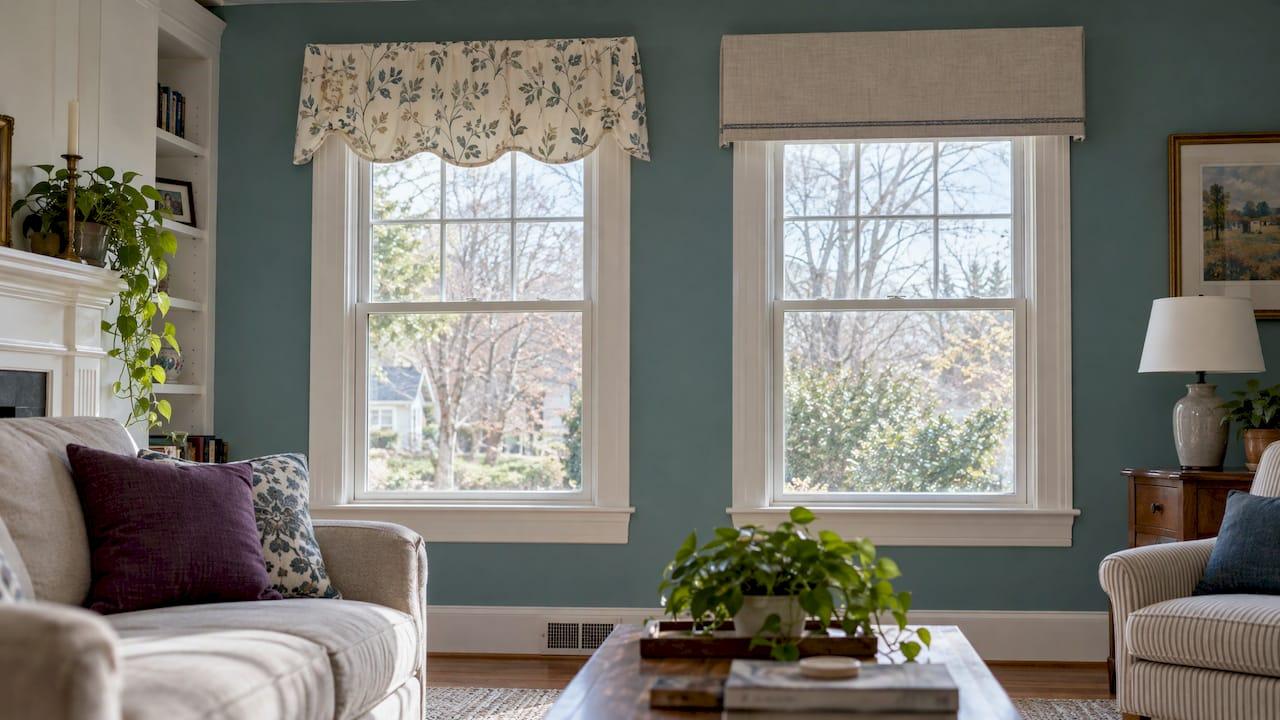
A valance is a short piece of fabric that hangs across the top of a window. A cornice is a rigid, box-shaped frame, usually wood, mounted above the window and often covered in fabric or paint. Both are top treatments: they finish the window and hide the hardware beneath. The real difference is structure. Soft and flowing, or tailored and solid. Once you know which look suits your room, the next question is what sits underneath, because a top treatment works best layered over the shade, blind or drapery that does the daily work of light and privacy.
If you are choosing for a home in Bucks County, PA or Mercer County, NJ, this guide covers the definitions, the room-by-room choices and how to pair a top treatment with the rest of the window.
TL;DR
- A valance is soft fabric hung from a rod or board. A cornice is a hard, box-like frame, often wood, that can be covered in fabric, wallpaper or paint.
- Valances suit larger windows and traditional rooms. Cornices work in most spaces and give a small or low window more presence.
- Neither one provides light control or privacy alone. Pair them with shades, blinds, shutters or drapery.
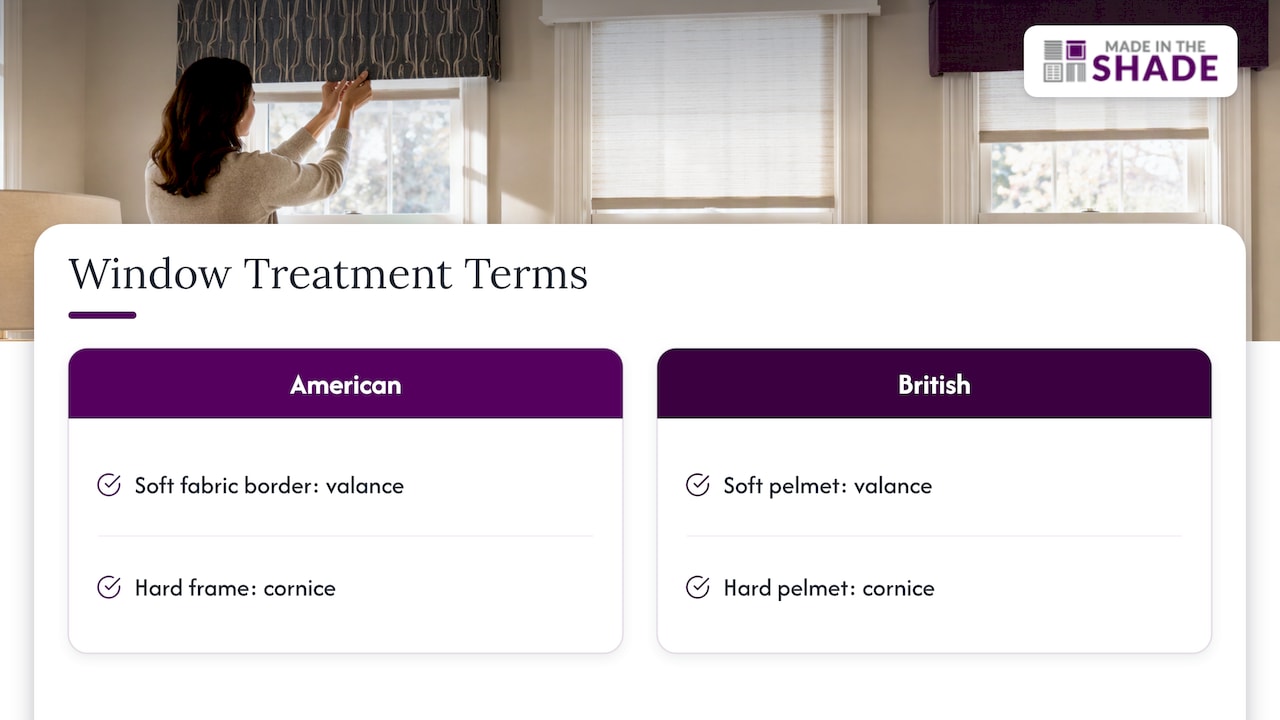
- "Pelmet" is the British word for both: a soft pelmet is a valance and a hard pelmet is a cornice.
- A free in-home consultation from Made in the Shade Bucks County lets you compare samples against your own windows and light.
Table of Contents
- What is a valance?
- What is a cornice?
- Valance vs cornice: side-by-side
- What about a pelmet?
- Which one suits your room?
- A top treatment is only half of the window
- How to choose: five checks
- Seeing it in your own home
- Our perspective
- FAQ
- Sources
What is a valance?
A valance is a relatively short treatment that hangs at the top of the window. According to Homes and Gardens, it is fabric hung across the top of a window on a rod with rings, or with a grommet top or tab top. The Spruce describes the simplest version as a slip of fabric attached to a rod with clip rings or a rod pocket. That is the most basic, casual option, and it can be used alone or layered over other treatments.
Valances come in several forms:
- Simple or rod-pocket valance. Gathered or flat fabric on a rod. Casual and easy to live with.
- Box-pleated valance. Stitched pleats make it hang straight down. The Spruce calls it more formal and notes it is generally attached with an L-shaped rod.
- Swag. Soft pleats of fabric that drape to a low center point, sometimes with side pieces called jabots. Homes and Gardens says swags suit lavish, classic, formal rooms such as dining rooms, but they hang across the glass and take some light.
- Faux Roman shade valance. A flat, tailored fabric front that gives the look of a Roman shade at the top of the window.
Because a valance is soft, it brings texture and movement to a room. It also softens hard lines, which matters in rooms with a lot of glass, tile or wood.
What is a cornice?
A cornice is a box that frames the top of the window. The Spruce describes it as a box-like wooden valance, typically built from plywood and covered with paint, wallpaper or fabric, then mounted to the wall above the window. It can also be carved from attractive wood and stained. This Old House describes cornices as decorative box-like structures that add architectural interest and hide hardware.
You may also see these terms:
- Cornice board. Another name for the same thing: a board or box above the window.
- Soft cornice. Per Wikipedia, a cornice covered in cloth and given padding is sometimes called a soft cornice, as opposed to a hard cornice.
- Lambrequin. A cornice-style frame with fabric pieces that run down the sides of the window. Brownstoner traces the trend to 1850s Italianate parlors, where a carved cornice topped the window and a fabric lambrequin hung from it, sometimes halfway down the glass.
The word cornice also has an architectural meaning: a horizontal decorative molding that crowns a building or a piece of furniture. That is why searches for cornice and crown molding overlap. As a window treatment, though, a cornice is its own box, mounted to the wall over the window rather than where wall meets ceiling.
If you have wondered what the box above the curtains is called, it is usually a cornice, or a cornice board. Homes and Gardens notes that a cornice typically covers the curtain rod or the top of a blind.
Valance vs cornice: side-by-side
| Valance | Cornice | |
|---|---|---|
| Structure | Soft fabric that hangs freely | Rigid box, often wood |
| Finish | Fabric, pleated, gathered or tailored | Fabric, paint, wallpaper or stain |
| Look | Relaxed to traditional | Tailored, architectural |
| Mounting | Rod, rings, board or L-shaped bracket | Wall-mounted box over the window |
| Best for | Large windows, traditional rooms | Most spaces, small or low windows, rooms with little trim |
| Care | Pleats gather dust and need cleaning | Fixed finish, vacuum gently with an upholstery attachment |
The care row comes from Homes and Gardens, which notes that a valance's pleats gather dust, while a cornice's fabric finish cannot be laundered and is best vacuumed carefully with an upholstery attachment. Both are low-maintenance in daily use: they sit above your reach and out of the way of kids and pets.
What about a pelmet?
If you have seen pelmet vs valance in a design article, it is likely British. Homes and Gardens explains that a pelmet is the UK term for a fabric-covered wooden frame or a soft fabric border above a window. A soft fabric pelmet can also be called a valance, and a hard pelmet can also be called a cornice. In American homes, the words valance and cornice cover the same ground.
Which one suits your room?
Choose a valance for large windows and traditional rooms
Homes and Gardens says valances suit large windows and traditional homes, and are not the best fit for small, dark rooms. A valance can look visually heavy, so it works best where the window is tall enough to carry it. Suburban Philadelphia has plenty of those: the wide double-hung windows in Colonials, the bay windows in Victorians around Newtown and Doylestown, and the picture windows in family rooms.
On a very tall window, a valance also helps the eye. Our guide to two-story window treatments covers how to handle height, and our piece on large window treatments explains how to keep wide spans looking straight.
Choose a cornice for small or low windows and plain walls
A cornice, according to Homes and Gardens, works in most spaces, small or large, contemporary or traditional. It gives a window that is proportionally too small or set too low more presence, because the box raises the visual top of the window.
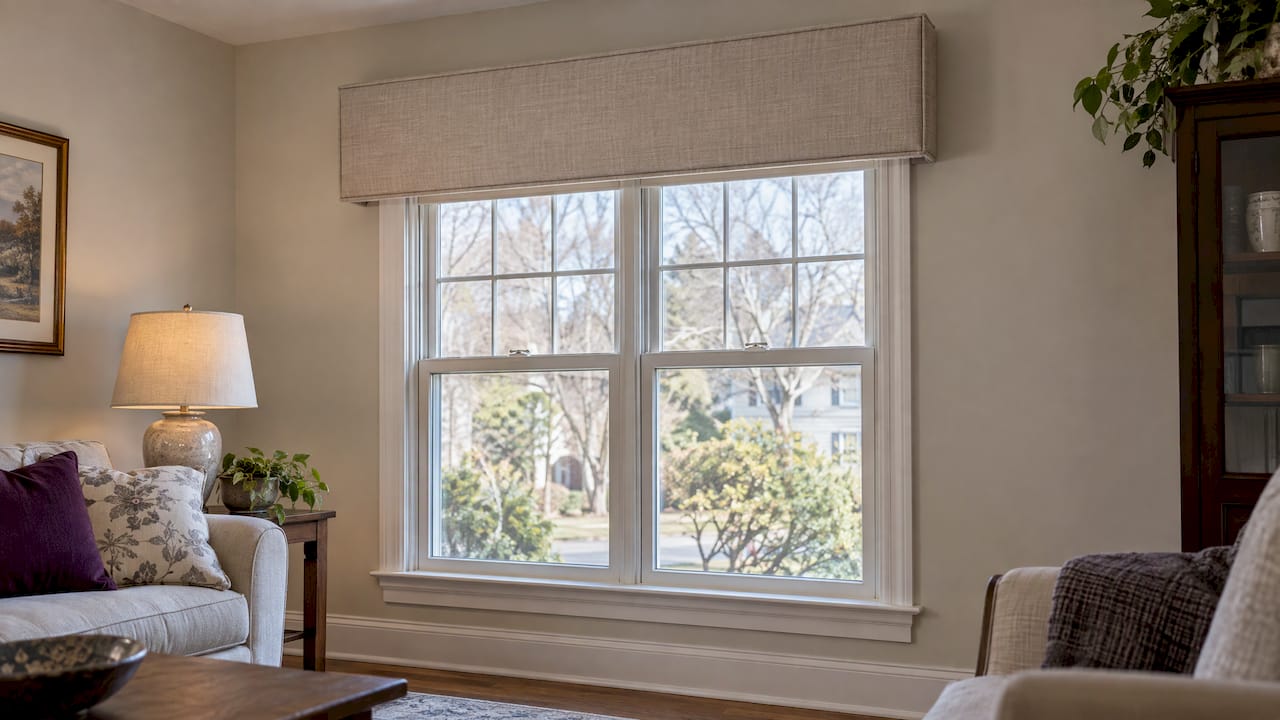
The Spruce's designer tip is that cornices work best in rooms that lack architectural interest. A cornice can dress a window that has no trim, or give a room without crown molding some added appeal. That describes many newer homes and townhouses across Bucks and Mercer counties, where windows are clean and plain.
If you are weighing proportions against the rest of the wall, a look at large wall decor ideas for living rooms can help you think about how much visual weight a window wall can carry.
Formal rooms and period homes
Interior designer Henry Prideaux told Homes and Gardens that cornices, pelmets or custom frames are especially effective in formal living or dining rooms. He likes a lambrequin layered over a Roman blind to frame the window like a theater set. Our guide to dining room window treatments shows how styles, colors and fit come together in that room.
For Craftsman-style homes, which already have strong trim lines, the top treatment should respect the casing. See Craftsman home window treatments for what fits the trim.
Are cornices and valances still in style?
Yes, in a more tailored form. The heavy, ruffled valances of earlier decades have given way to clean box pleats, flat faux Roman fronts and simple upholstered cornices. A cornice in a solid linen or a painted finish reads as contemporary or transitional. A wood cornice that is stained suits a traditional room. If you plan to stain wood for the finish, a guide to wood staining shows what that process involves.
A top treatment is only half of the window
Here is the part that most comparison pages skip. A valance or cornice is decorative. It does not control light, and it does not give privacy. The Spruce makes the same point about swags: they cannot provide much privacy on their own, so they need curtains, blinds, shutters or shades. The same holds for any top treatment.
So the useful question is not just valance or cornice. It is what goes underneath.
- Over shades. A cornice hides the headrail of a roller, cellular, roman or woven wood shade, so you see only the fabric. This matters if the shade is motorized: the cornice gives the mechanism a tidy finish at the top of the window.
- Over blinds. A top treatment over wood blinds or other window blinds covers the headrail and makes a stock-looking window feel finished.
- Over drapery. A valance or cornice above drapery hides the rod and rings and ties the panels to the top of the window. Homes and Gardens notes that cornices commonly cover curtain rods.
- Over shutters. Shutters are clean enough that most rooms do not need a top treatment. In a room with a very plain wall, a slim cornice can still add a finishing line.
For more on building up a window in layers, see our guide on how to layer window treatments.
Child-safe and cordless layering
If there are small children in the house, the layer underneath is the one that matters for safety. Cordless lift options remove the hanging cords from shades and blinds, and a top treatment sits above all of that, well out of reach. Made in the Shade Bucks County offers cordless, child-safe lift options across its shades and blinds.
Smart-home and energy considerations
If you want shades that work with Alexa and other major platforms, the top treatment is where the motor and headrail go out of sight. Energy is a separate matter. This Old House says cornices can help with energy efficiency, but most of the work is done by the shade or drapery below. Our page on energy saving window treatments covers which products fit that goal.
How to choose: five checks
- Measure the window and the wall above it. A top treatment needs room. If the wall between the window and the ceiling is short, a shallow cornice fits better than a deep valance.
- Match the formality of the room. Casual rod-pocket valances belong in kitchens and breakfast nooks. Box pleats and upholstered cornices fit dining rooms and primary bedrooms.
- Plan for the light. Swags and low valances can steal light across the glass. A cornice that sits above the glass line leaves the whole window open.
- Decide what hides behind it. Rods, headrails and motors are all easier to live with when something covers them.
- Pick the fabric against your own light. A fabric that looks right in a swatch under store lighting can read differently on a north-facing wall in January. That is why seeing samples in your own home matters.
Seeing it in your own home
Made in the Shade Bucks County has no storefront. Instead, a personal design consultant brings sample collections to your home at no cost and helps you compare them against your own windows, trim, floors and daylight. Every project is measured and installed by trained professionals, and the products carry manufacturer warranties, most with limited lifetime coverage.
We serve homeowners, realtors and commercial clients throughout Bucks County, PA and Mercer County, NJ. You can see our full range, including window shades, drapery and shutters, on our site.

When you are ready to pick the layer that goes under your valance or cornice, request a free in-home consultation and we will bring the samples to you.
Our perspective
Most homeowners come to us asking about the top of the window, and we understand why. It is the part you see first from across the room. But the window works every day because of what sits beneath it.
We start with how you live in the room. Does the afternoon sun hit the sofa? Do you need privacy at night? Are there small children, which means cordless lift? Would you like shades you can raise from your phone, or through Alexa? Once those answers are clear, the top treatment becomes a design choice rather than a guess.
In the older Colonials and Victorians around Bucks County, we like a layered look with shades or drapery as the base, because it respects the trim. In newer homes with plain, flat windows, a clean top line gives the room finish. Either way, accurate measuring decides whether the whole thing looks built-in or looks off, which is why our trained professionals measure and install every project.
Seeing real samples in your own light is the quickest way to decide, and the consultation is free.
Tony
FAQ
What is the main difference between a valance and a cornice?
A valance is soft fabric that hangs from a rod or board. A cornice is a rigid, box-shaped frame, usually wood, covered with fabric, paint or wallpaper. Both sit at the top of the window and hide hardware.
Can I use a valance or cornice without curtains or shades?
You can, but it will not give you light control or privacy. Both are decorative and are meant to finish a window that already has a shade, blind, shutter or drapery. A formal room may use a cornice alone for the look, as The Spruce notes for primary bedroom suites.
Is a cornice the same as a pelmet?
In British usage, yes. Homes and Gardens says a hard pelmet can be called a cornice, and a soft pelmet can be called a valance. In the US, the terms cornice board and valance are more common.
How do I clean a valance or cornice?
Pleated valances collect dust, so they need regular cleaning. A cornice with a fabric finish cannot be laundered, so Homes and Gardens advises vacuuming it carefully with an upholstery attachment.
Which is better for a small window?
A cornice is the usual choice. Homes and Gardens says it gives a window that is too small or too low for the wall greater presence, while a valance can look heavy on a small window.
Sources
- Valances vs pelmets vs swags vs cornices: the differences, Homes and Gardens
- Differences Between Valances, Swags, and Cornices, The Spruce
- Comprehensive Guide To Building a Window Cornice, This Old House
- Cornice, Wikipedia
- From Practical to Ornamental: The History of Dressing Windows, Brownstoner
- Large wall decor ideas for living room, Bodaq
- Wood staining, Painting by Ray